
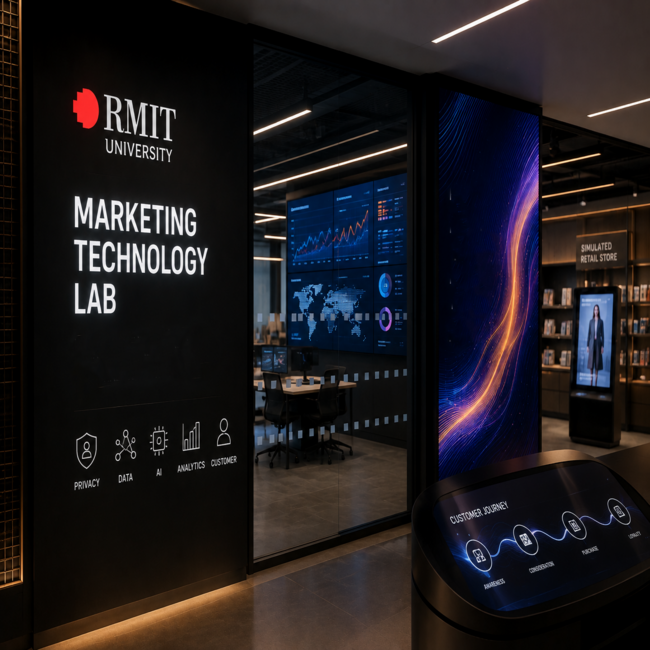

RMIT University has launched a Marketing Technology Lab designed to give marketers hands-on experience with emerging technologies while examining how businesses can balance personalised customer experiences with growing expectations around data privacy.
The immersive learning environment has been developed as organisations increasingly use customer data, artificial intelligence and marketing technology to personalise interactions across digital and physical channels. At the same time, businesses face pressure to ensure those capabilities are deployed responsibly and without undermining consumer trust.
The RMIT Marketing Technology Lab is designed to support teaching, applied research and industry engagement, giving students and industry partners opportunities to work directly with technologies being used across modern marketing environments.
The facility forms part of RMIT’s broader investment in marketing technology education. The university has previously introduced a Marketing Technology major, which it describes as the first of its kind in the Asia-Pacific region and the third globally.
According to RMIT, the lab includes immersive experiences, a simulated retail store, an integrated software stack, analytics and visualisation zones and hands-on access to marketing technologies. The university has also indicated that its technology environment includes areas such as CRM, analytics, MarTech stacks and AI-enabled platforms.
Jason Pallant, founding director of the RMIT Marketing Technology Lab, said the facility is intended to prepare graduates to understand both the capabilities of emerging technology and the responsibilities associated with using it.
The university is placing particular emphasis on what it describes as a privacy-first approach to marketing. The aim is to provide an environment where students and industry participants can explore the trade-offs between personalisation and privacy without treating the two as mutually exclusive.
Personalisation has become a central part of digital marketing as brands use customer information to tailor recommendations, advertising, communications and online experiences. The growing use of AI is extending those capabilities by allowing companies to analyse larger volumes of data and automate aspects of customer engagement.
However, the same shift has increased scrutiny around how consumer information is collected, analysed and activated. Marketers are increasingly required to consider consent, transparency and trust alongside the performance benefits offered by data-driven technology.
Shane Duggan, Senior Industry Fellow in Economics, Finance and Marketing at RMIT, said the lab is intended to provide marketers with an opportunity to examine how organisations can use data and AI responsibly while still delivering personalised customer experiences.
The launch also addresses a wider skills challenge within the MarTech industry. RMIT previously cited research indicating that only 28% of businesses had adequate in-house MarTech capabilities, while 74% reported a critical skills gap.
The university’s approach combines technical education with practical exposure to platforms and technologies used by businesses. Its Marketing Technology Lab will also support applied research projects and collaboration with industry partners, creating a setting where emerging marketing practices can be tested outside live customer environments.
As AI becomes more deeply integrated into marketing operations, questions around responsible data use are likely to become increasingly relevant to how brands design customer experiences.
RMIT’s new facility places those questions alongside practical technology training, positioning privacy, personalisation and consumer trust as connected parts of MarTech education rather than separate considerations.