
AI is changing how marketers plan, distribute and measure webinars. Recent industry research shows that recordings are increasingly being turned into short videos, personalised campaigns and audience insights, allowing businesses to extend the value of a single event beyond its original broadcast.
A webinar ends, the speakers log off and the marketing team sends a recording to everyone who registered. A few days later, attention shifts to the next event.
For years, this has been a familiar routine in B2B marketing.
Webinars have largely been treated as individual campaigns, measured through registrations, attendance, engagement and leads generated around the event.
Artificial intelligence is beginning to change that approach.
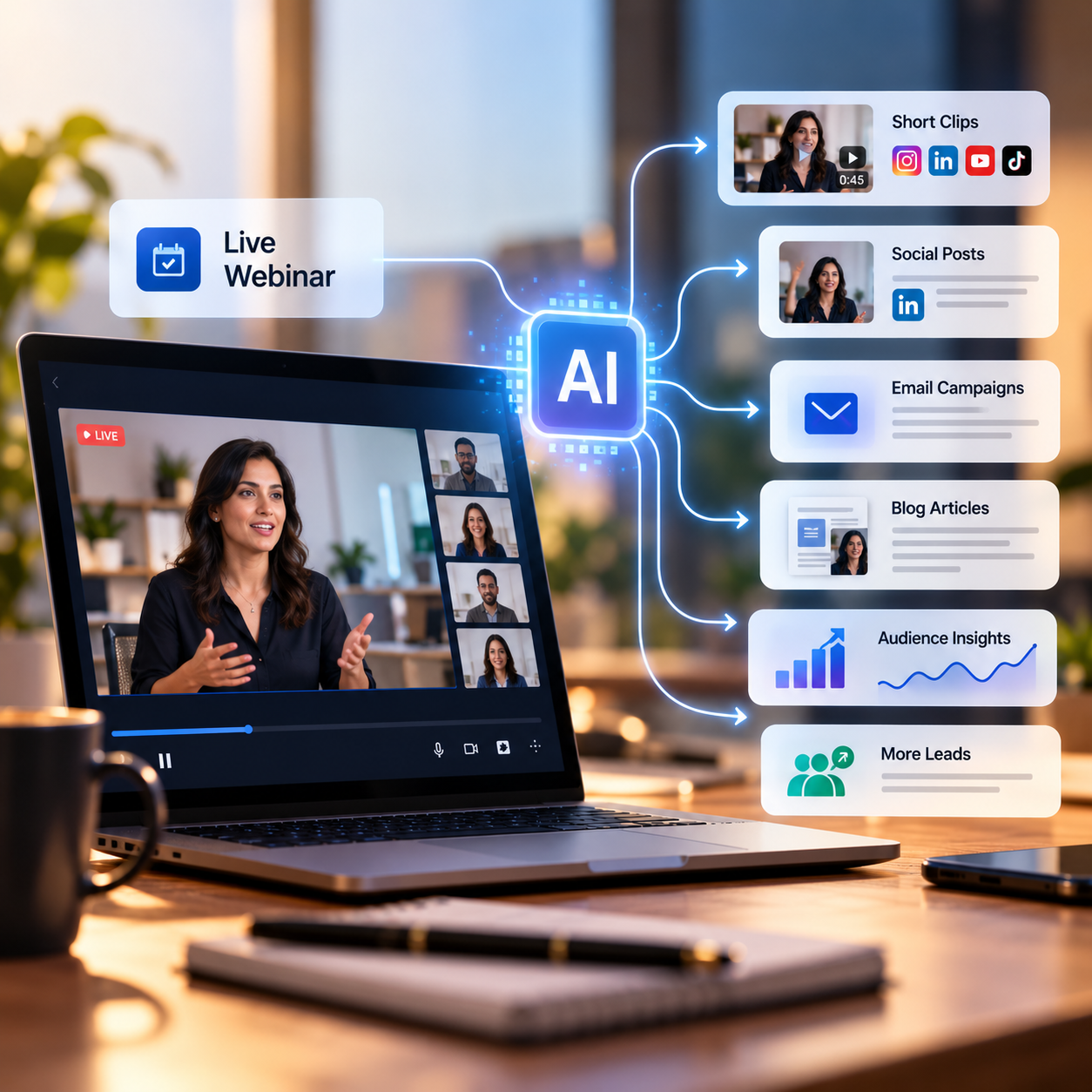
A single discussion can now become several short videos, a series of social posts, an email campaign and a collection of answers to common customer questions. AI can identify relevant moments from a recording, prepare transcripts, summarise audience feedback and help marketers develop follow-up communication based on individual engagement.
The result is a webinar that can continue contributing to marketing activity long after the live session has finished.
For businesses, the opportunity extends beyond producing additional content. Each event can contribute information that helps shape subsequent webinars, improve audience targeting and support conversations with prospective customers.
Recent benchmark reports indicate that these practices are becoming more common, although adoption remains uneven.
Goldcast’s 2026 B2B Webinar Benchmark Report analysed 26,190 webinars conducted by 522 B2B organisations during 2025. It found that customers generated 365,253 video clips from their webinar and video content, an increase of 173% over the previous year.
Of these clips, 97.8% were AI-generated. The platform also recorded 231,538 text assets, representing growth of 144.5%.
Kelly Cheng, Chief Marketing Officer at Goldcast, described webinars as becoming “infrastructure” for B2B teams to build visibility, qualify buyers and generate content.
The findings suggest a change in how marketers are using webinars. Instead of assessing an event only through its immediate performance, teams are beginning to examine the content, audience information and future opportunities it creates.
However, the Goldcast figures reflect activity among its customers rather than the entire B2B marketing industry.
Other research suggests a similar direction, while also highlighting the operational challenges involved.
From One Live Session to Multiple Marketing Assets
The first change concerns what happens to webinar content after an event ends.
A typical webinar may contain a product demonstration, an industry discussion, expert commentary, audience questions and examples that address specific business challenges.
Traditionally, extracting these elements required considerable manual work.
An editor would review the recording, identify useful sections, cut video clips, prepare captions and create material suitable for different platforms.
AI-powered tools can now assist with these tasks.
A 45-minute webinar on retail customer experience, for example, could generate a short video explaining a consumer trend, an article examining an industry challenge and several social media posts highlighting individual observations.
A question raised during the discussion could become the subject of a subsequent email campaign.
Rather than creating entirely new material for every channel, marketers can adapt different parts of the original conversation.
Wistia’s 2026 State of Video research, based on a survey of more than 900 professionals and analysis of over 13 million videos and 79 million viewing hours, found that almost 90% of teams were reusing webinar content.
The research also found that approximately one-third of webinars continued receiving plays three months after their live broadcast.
This suggests that the useful lifespan of a webinar need not be restricted to the day it takes place.
The shift is particularly relevant for marketing teams managing several content channels with limited resources.
A webinar featuring industry experts may require substantial planning, coordination and production. Repurposing the resulting material allows that investment to support additional communication.
Goldcast’s research found that adoption of its AI-powered content repurposing capability increased 76% during 2025.
Among text assets generated from webinar content, social media posts accounted for 37.9%, followed by emails at 35.9%. Blogs and takeaway content each represented approximately 13%.
These figures illustrate how one event can support several stages of a marketing campaign.
However, producing multiple assets does not automatically mean reaching additional customers or generating more business.
The effectiveness of repurposed material still depends on whether it provides relevant information and reaches an appropriate audience.
Can AI Help Marketers Get More From Every Webinar?
The potential of AI becomes clearer when compared with how webinar programmes currently operate.
Livestorm’s 2026 Webinar Benchmark Report combined a survey of 853 B2B go-to-market professionals with platform data covering 33,786 webinar sessions and more than seven million registrations during 2025.
It found that 59.8% of teams used AI specifically for webinars, compared with 80.2% using AI more generally across marketing.
Topic ideation was the most common application, cited by 48.6% of respondents, followed by social media promotion at 38.7%.
Yet only 23.4% used AI to prepare webinar summaries and notes, while 11.5% used it to create post-event video clips.
The findings indicate that although marketers are adopting AI, many have yet to incorporate it throughout the webinar process.
The same study identified time and bandwidth as the leading barrier to content repurposing, reported by 32.3% of respondents.
While 66.5% produced on-demand recordings, just 32.2% created short social clips and 25% developed blog or search content.
For marketing teams, this creates a gap between the material available and the material ultimately used.
AI could help reduce that gap by automating transcription, suggesting suitable clips and generating initial drafts for different formats.
It can also support promotional activity before a webinar begins.
For instance, marketers could use AI to prepare invitation emails for different audience segments, identify frequently discussed industry topics and develop promotional messages based on previous event performance.
Once the event concludes, the same systems could assist with follow-up emails, summaries and content distribution.
ON24’s 2026 webinar benchmarks also point towards increased use of these capabilities.
The company reported that adoption of its AI-powered analytics and content technology for producing derivative webinar content grew 37% during 2025.
It also recorded a 2.5-fold increase in AI-assisted video clips and a 2.4-fold increase in written content.
These figures reflect activity within the platform and do not establish that AI independently caused better marketing results.
Nevertheless, they indicate a growing use of automation in the work surrounding webinars.
The practical advantage is that marketers can spend less time preparing repetitive formats and more time evaluating the quality and relevance of what they publish.
When Audience Data Starts Shaping the Next Event
Content repurposing is only one part of the changing webinar model.
The other involves how businesses use audience information.
During a live webinar, participants may ask questions, answer polls, download resources and respond to calls to action.
Others may attend briefly before leaving or return later to watch the recording.
These activities provide information about what interests the audience and where additional communication might be useful.
In traditional webinar reporting, much of this behaviour could be reduced to a registration or attendance record.
AI-assisted analytics and integrations with customer relationship management systems can help marketers examine these signals in greater detail.
For example, consider a software company hosting a webinar on marketing automation.
Some participants might ask introductory questions, while others enquire about integration capabilities, implementation costs or specific product features.
These interactions may indicate different information needs.
A marketing team could use them to develop separate follow-up content rather than sending every participant the same presentation.
Sarah Kamp, Director of Field Marketing and Account-Based Marketing at Betterworks, described how connecting webinar engagement data with its CRM helped shift attention towards “which accounts are actually progressing toward pipeline.”
The example illustrates how webinar information can become relevant to marketing and sales teams beyond the event itself.
Goldcast’s research found that chat was enabled in 62.3% of webinars, while Q&A appeared in 56.1%. Resource links were available in 35.1%, polls in 19% and calls to action in 17.8%.
These engagement features create opportunities to understand audience interests.
However, participation should not automatically be interpreted as purchasing intent.
A participant downloading a report may be researching an industry issue rather than considering an immediate purchase.
Accurate interpretation therefore remains important when using engagement data for lead scoring or sales follow-up.
The information can also improve future programming.
If several participants raise similar questions during a webinar about AI adoption in marketing, those questions may identify a suitable topic for the next session.
The subsequent webinar can then address issues that the earlier audience demonstrated interest in.
Over time, this creates a connected process in which one event informs the planning, promotion and content of the next.
Why the Value of a Webinar May Continue Growing
On-demand viewing provides another opportunity to extend a webinar’s lifespan.
Goldcast found that 89.1% of webinars hosted on its platform were made available on demand during 2025.
For recordings that attracted on-demand audiences, the average was 20.8 views. The platform also reported average completion rates of 91% for on-demand viewing, compared with 74% for live attendance.
More than one in ten live attendees subsequently returned to watch the recording.
These findings suggest that webinar content can remain useful to people who cannot attend at the scheduled time or want to revisit particular information.
AI can help make recorded sessions easier to navigate through searchable transcripts, summaries, captions and shorter topic-specific clips.
A buyer researching a product several weeks after a webinar, for example, may be more interested in a five-minute explanation of a particular feature than the entire original presentation.
An accessible content library can help connect that buyer with relevant material without requiring another live event.
Recurring webinar programmes can build on this approach.
Goldcast reported that 31.2% of webinars were part of a series in 2025, compared with 26% in the preceding year.
Each episode can contribute additional content, audience questions and insights that inform future discussions.
However, the growth in content output also raises questions about effectiveness.
Content Marketing Institute’s 2026 B2B research, based on 1,015 marketers, found that 95% of respondents said their organisations used AI-powered applications.
Among marketers using AI for content creation, 87% reported productivity improvements and 80% reported better operational efficiency.
Only 39%, however, reported improved content performance.
The difference suggests that producing content more efficiently does not necessarily improve audience response.
As Ann Handley, Chief Content Officer at MarketingProfs, observed, “Efficiency is only the first chapter of the AI marketing story.”
For webinars, this distinction is particularly relevant.
Automatically generating numerous clips from a discussion cannot compensate for a weak topic, limited expertise or material that offers little value to the intended audience.
AI-generated summaries and edited excerpts also require review to ensure that speakers’ remarks remain accurate and properly contextualised.
Privacy considerations are equally important when collecting participant information and connecting webinar activity with wider marketing systems.
The emerging approach is therefore not simply about creating more content or increasing the number of events.
It involves connecting webinar planning, audience engagement, content distribution and follow-up into an ongoing programme.
A discussion can generate clips and articles. Those assets can attract new audiences. Their interactions can inform future topics and more relevant communication.
Whether that process delivers measurable commercial returns will depend on execution, audience relevance and the quality of the underlying content.
AI is giving marketers more ways to extend the value of webinars beyond the live broadcast. The emerging question is no longer only how many people attend an event, but how much useful content, engagement and audience understanding it continues to generate afterwards.
Disclaimer: All data points and statistics are attributed to published research studies and verified market research. All quotes are either sourced directly or attributed to public statements.
Related Articles