
AWS will deploy two million additional Nvidia GPUs across its global infrastructure in 2027 and 2028 as demand for large-scale AI computing continues to grow.

Microagi has partnered with Google Cloud to accelerate embodied AI development, using Google's AI infrastructure and NVIDIA Blackwell systems to scale enterprise robotics.

Humanoid robots emerged as a key attraction at Shanghai's World AI Conference, highlighting advances in embodied AI and real world robotics applications.

Japan and NVIDIA have launched the world's first national AI infrastructure to power physical AI, robotics, digital twins and multimodal foundation models.

Mistral has launched Robostral Navigate, an AI model that enables robots to navigate using a single RGB camera and natural language instructions.

Arduino has launched an Edge AI Invention Lab at IIT Delhi to strengthen practical AI education, embedded AI research and hands on innovation using edge computing.

NVIDIA has launched Halos for Robotics, a safety framework designed to support the safe deployment of robots and physical AI systems.

NeoCambrian AI has launched an India-focused robotics data factory aimed at supporting physical AI model development and training.
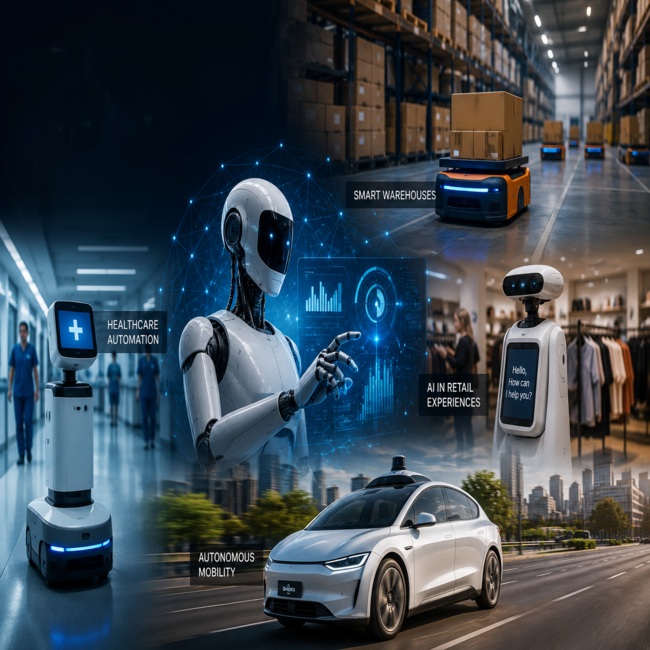
Physical AI is moving beyond chatbots into warehouses, hospitals, retail, and mobility, driving automation through robotics and intelligent systems.

LG is expanding its partnership with Nvidia to advance physical AI in robotics and smart infrastructure applications.
Alibaba has launched RynnBrain, an open-source robot model aimed at advancing physical AI and accelerating robotics innovation.

Arm launches a dedicated physical AI unit to support growth in robotics and autonomous systems, expanding its role in real-world AI applications.

TCS partners with France’s CEA to advance physical AI research, targeting innovations in manufacturing, energy, and sustainable industrial systems.

Next-gen AI evolves into “Physical AI”—autonomous factories, wearable exoskeletons, and service robots are embedding intelligence into the real world.
