
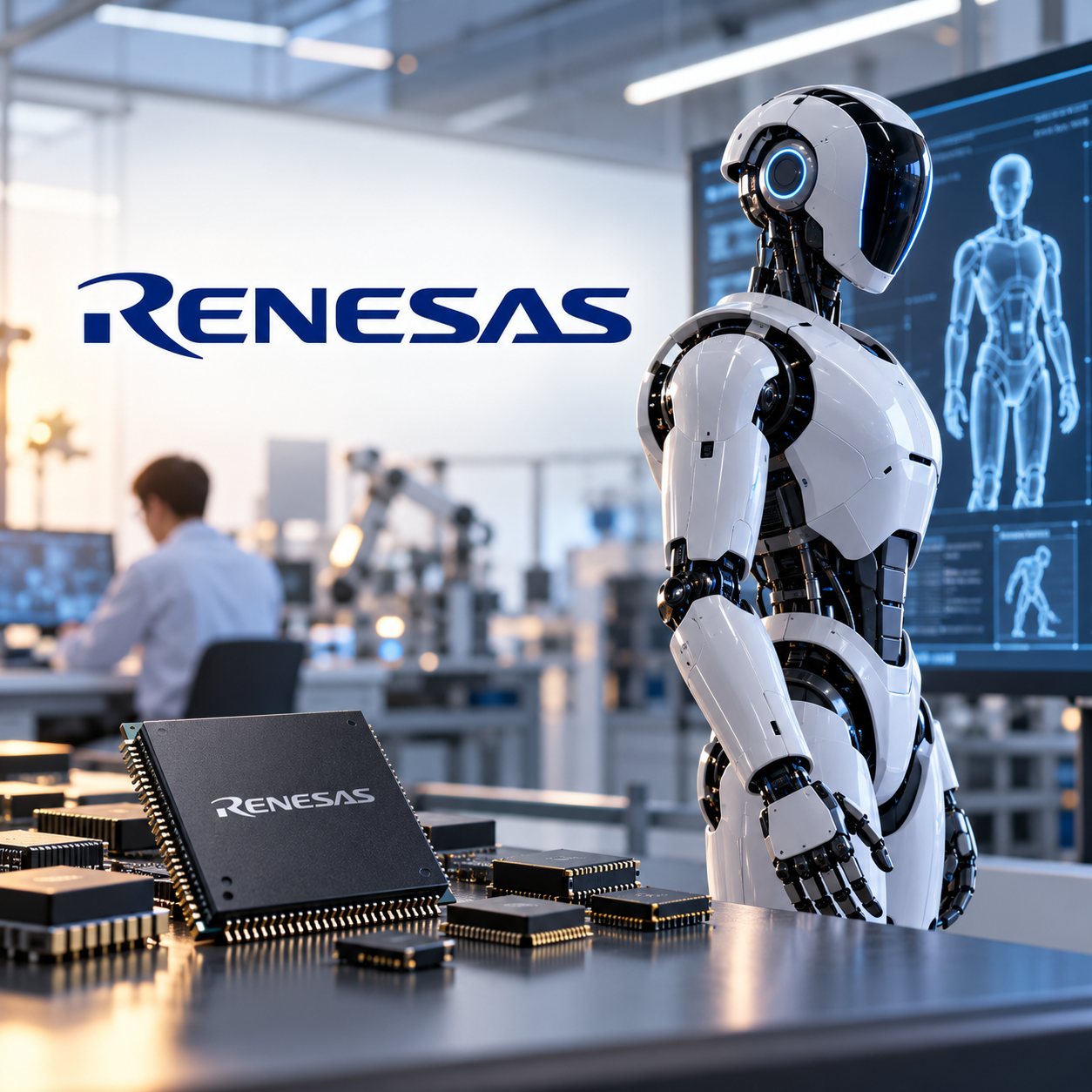

Japanese semiconductor manufacturer Renesas Electronics has established a dedicated physical artificial intelligence (AI) team to expand its presence in the humanoid robotics market, as demand grows for chips and integrated systems supporting autonomous machines.
The company is also developing robotics technologies through a laboratory in Beijing, China, where it plans to collaborate with local humanoid robot manufacturers and strengthen its semiconductor offerings.
According to a report by The Elec, Yang Tae-young, a director at Renesas, disclosed the development during the "Semiconductors Powering Humanoids" conference held alongside the Semiconductor Exhibition (SEDEX) at COEX in Seoul on October 16.
The new team operates within Renesas' user experience (UX) organisation, which was established in the second half of 2024. The organisation has 403 employees globally, including more than 108 working in the physical AI division.
Its operations are divided into three areas: physical AI, marketing and technology strategy.
The move represents an expansion of Renesas' role beyond supplying individual semiconductor components, with the company seeking greater involvement in the development of complete robotic systems.
Physical AI refers to artificial intelligence technologies that enable machines to interact with their surroundings through sensing, movement and decision-making capabilities. Humanoid robots represent one application, requiring coordinated operation across processors, sensors, motors and power management systems.
Renesas' physical AI team will provide engineering support, system architecture development and semiconductor solutions for robotics manufacturers. Its portfolio includes microcontrollers, microprocessors, motor control chips and sensors.
The company has also developed tools for autonomous mobile robots that use microprocessors equipped with two 64-bit cores. These systems allow developers to connect peripheral components and test motors and actuators without requiring a separate robot control platform.
Renesas is expanding its semiconductor portfolio to address the requirements of humanoid robot joints and industrial communication systems.
According to the report, humanoid applications currently account for approximately 8% of revenue from these products, with their share more than doubling annually. China has emerged as a significant source of demand.
The company is also working to reduce semiconductor package sizes for use in robotic joints, particularly wrists and ankles, where limited space creates challenges for integrating motors, wiring and electronic components.
Reliability remains another consideration. Certain robotic joints use two microcontrollers to maintain operation if one component malfunctions. This arrangement is particularly relevant for knees and ankles, where system failures could affect a robot's balance.
The Beijing laboratory will support joint development with Chinese robotics companies while allowing Renesas to develop and test its own technologies.
The expansion comes as semiconductor manufacturers explore opportunities in physical AI, where robotics applications require combinations of computing, connectivity, sensing and motor control capabilities.
Renesas' latest initiative places integrated semiconductor development and engineering support at the centre of its strategy for the humanoid robotics market.
Disclaimer: This article may include information derived from interviews, press releases, public statements, research, company communications and other publicly available or third-party sources. Such material may be summarised, paraphrased or contextualised for journalistic and editorial purposes. All rights in third-party content remain with their respective owners.