
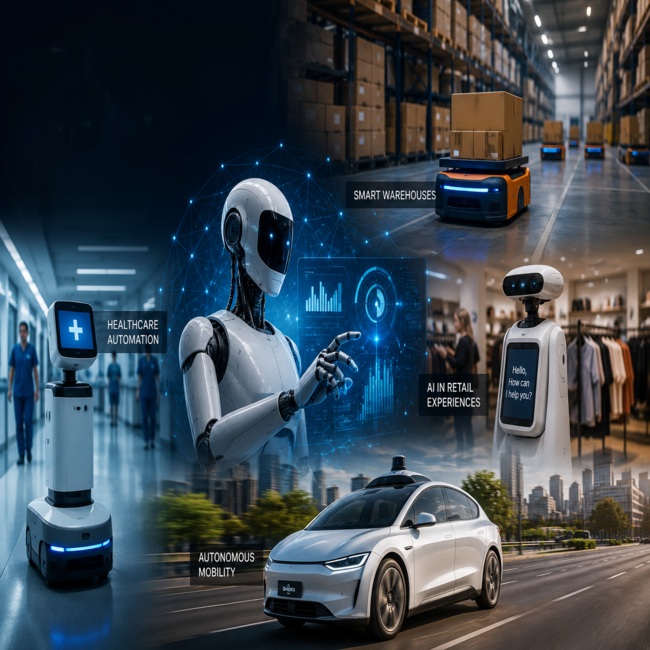

For most people, AI has so far lived inside a screen. It has been a chatbot answering questions, a tool summarising documents, a recommendation engine on a shopping app, or an assistant inside workplace software. The next phase of AI looks very different. It is starting to move into warehouses, hospitals, factories, retail stores, airports and roads. Instead of only generating text or analysing data, AI is beginning to interact with the physical world through robots, autonomous systems, sensors and connected machines.
The industry has started calling this shift “physical AI” or “embodied AI.” The term broadly refers to AI systems that can perceive, reason and take actions in real-world environments. Google DeepMind, while introducing Gemini Robotics earlier this year, described the move as AI going beyond the “digital realm” and into physical tasks. Deloitte’s latest Tech Trends report similarly frames physical AI as the convergence of robotics, mobility and intelligent systems that can operate in live environments rather than just inside software interfaces.
The timing matters because the technology is no longer limited to laboratory demonstrations or futuristic concept videos. AI-powered robotics systems are already sorting packages in logistics centres, transporting medical supplies in hospitals, monitoring industrial infrastructure and operating autonomous vehicles in selected cities. In Capgemini’s 2026 survey of 1,678 executives across 15 industries, 79% said their organisations were already exploring or implementing physical AI in some form. Twenty-seven percent said they were already deploying or scaling it, while 66% identified it as a high automation priority over the next three to five years.
Rebecca Yeung, strategic adviser at robotics company Dexterity and former FedEx executive, summed up the transition in practical terms: “The last decade of AI was about information. The coming decade will be about action.”
That line captures the broader shift now underway. The previous AI wave largely focused on generating insights, predictions or content. The next one is increasingly about moving objects, navigating spaces and automating physical workflows.
Warehouses are becoming the first large-scale testing ground
The clearest signs of this transformation are appearing in logistics and manufacturing. These industries already depend heavily on repetitive movement, inventory management, machine vision and operational efficiency, making them natural candidates for physical AI deployment.
According to the International Federation of Robotics, global industrial robot installations reached 542,000 units in 2024, making it the second-highest annual figure ever recorded. The global operational stock of industrial robots climbed to 4.664 million units. Asia accounted for 74% of all installations, while China alone represented more than half of new deployments worldwide.
India remains a smaller robotics market by comparison, but the pace is increasing. The country recorded 9,100 industrial robot installations in 2024, up 7% year on year and enough to place India sixth globally for annual installations.
The service robotics market is also expanding rapidly. IFR’s 2025 service robot report found that professional service robot sales reached nearly 200,000 units in 2024. Transportation and logistics accounted for the largest share, with more than 102,000 units sold, reflecting strong demand from warehouses and fulfilment networks.
Takayuki Ito, President of the International Federation of Robotics, said there was now “strong demand for service robots in a number of different application areas,” particularly in sectors dealing with labour shortages and operational pressure.
That demand is visible in real deployments. Amazon announced in 2025 that it had deployed its one millionth robot across more than 300 facilities worldwide. The company also introduced DeepFleet, an AI model designed to coordinate robotic movement more efficiently across warehouse environments. Amazon said the system could improve robotic fleet travel efficiency by 10%.
DHL is moving in the same direction. The logistics company recently disclosed that it now operates more than 8,000 collaborative robots globally and has equipped over 90% of its warehouses with at least one automation or digitalisation system. The company also said it had invested more than €1 billion in warehouse automation over the past three years.
What makes these deployments different from earlier warehouse automation is adaptability. Traditional industrial robots generally repeated fixed actions inside tightly controlled environments. Physical AI systems are increasingly designed to respond to variability. They can identify unfamiliar objects, adjust movement patterns and make contextual decisions based on changing conditions.
Capgemini’s research found particularly strong executive interest in adaptive material handling, autonomous transport systems and dynamic packaging workflows. In practical terms, that means companies are now trying to automate the less predictable parts of logistics rather than only repetitive assembly-line tasks.
Hospitals and healthcare systems are quietly becoming AI environments
Healthcare is emerging as another major deployment area for physical AI. Unlike consumer-facing AI assistants, many of these systems operate behind the scenes in laboratories, rehabilitation centres and hospital logistics operations.
IFR data shows that medical robot sales rose 91% in 2024. Rehabilitation and non-invasive therapy robots grew 106%, surgery robots increased 41%, and diagnostic laboratory robots jumped more than 600%.
Capgemini’s findings suggest healthcare executives see significant potential in automating repetitive operational workflows. Seventy-nine percent of healthcare respondents identified lab automation and sample handling as high-impact applications, while 72% pointed to patient mobility and rehabilitation support.
The goal in many cases is not replacing doctors or nurses. It is reducing the time spent on transportation, inventory movement, routine handling and repetitive support tasks. Hospitals increasingly face staffing shortages and rising operational pressure, making workflow automation more attractive.
Physical AI systems are also becoming part of rehabilitation environments where robotic assistance can help patients recover mobility through guided movement exercises. In laboratories, AI-enabled robotics systems are being used to transport samples, prepare analyses and reduce turnaround time for routine diagnostics.
The shift is gradual, but it reflects a larger trend. AI is moving beyond information processing and becoming part of operational infrastructure.
Retail is testing AI beyond recommendation engines
Retail has already embraced AI heavily in forecasting, advertising and customer targeting. Physical AI is now beginning to enter store operations and fulfilment systems, though adoption remains early compared with logistics.
NVIDIA’s 2026 retail and consumer packaged goods survey found that 91% of retailers were either using or assessing AI overall, while 90% planned to increase AI investment. Yet only 17% said they were actively evaluating or deploying physical AI applications.
That gap is important because it suggests retailers still view robotics and embodied systems as an emerging layer rather than a mature operational standard.
Even so, the signs are becoming more visible. IFR reported that hospitality robot sales exceeded 42,000 units in 2024, while professional cleaning robot sales rose 34% to more than 25,000 units.
Capgemini’s research found that 67% of retail respondents viewed AI-powered customer experience systems as high-impact opportunities, while 64% highlighted smart shelf-stocking and inventory monitoring.
For most retailers, the first visible effect of physical AI may not be humanoid robots serving customers. It is more likely to appear through operational improvements such as faster replenishment, more accurate inventory tracking, cleaner stores and smoother fulfilment systems.
In that sense, physical AI may shape customer experience indirectly before consumers fully notice the technology itself.
Roads are becoming one of the hardest AI challenges
Autonomous mobility represents another major frontier for physical AI, though it also highlights the complexity of deploying intelligent systems safely in unpredictable environments.
Waymo said in early 2026 that it had surpassed 20 million lifetime rides and was now providing more than 400,000 weekly rides across six major US metropolitan areas. Aurora, meanwhile, launched commercial driverless trucking operations in Texas and said it had completed more than 1,200 driverless miles before commercial rollout.
These are no longer research experiments. They are functioning commercial services.
But autonomous mobility also reveals why physical AI is harder than digital AI. Errors in the physical world carry immediate operational and safety consequences.
Waymo temporarily paused some freeway operations this year while integrating software updates after weather-related incidents. Reuters also reported that the company recalled around 3,800 robotaxis following a flooding-related software issue.
The incidents underline a central challenge of physical AI. Unlike a chatbot producing an inaccurate answer, a robotic or autonomous system operates in environments where mistakes can have direct physical consequences.
Ayanna Howard, robotics researcher and dean of engineering at Ohio State University, warned in Deloitte’s analysis that “the physical world is inherently dynamic.” Her point was that real-world environments contain far more unpredictability than digital systems, making overtrust in AI more dangerous when physical action is involved.
Why the physical AI push is accelerating now
Several technological shifts are driving the current acceleration.
Edge computing has become more powerful, allowing AI models to run closer to physical systems in real time. Sensor quality has improved significantly. Robotics simulation environments and digital twins now allow companies to test physical workflows virtually before deployment. Multimodal AI models can process visual, spatial and language inputs simultaneously.
Google DeepMind’s Gemini Robotics project illustrates the direction of travel. The company said its system was designed to directly control robotic systems, adapt to unfamiliar tasks and respond to natural language instructions in real time. According to DeepMind, Gemini Robotics more than doubled benchmark performance compared with previous vision-language-action systems.
That matters because adaptability has historically been one of robotics’ biggest limitations. Earlier industrial robots worked best in highly predictable environments. Physical AI systems are increasingly being trained to operate under more dynamic conditions.
The applications are broadening quickly. Deloitte’s latest report describes physical AI as encompassing autonomous vehicles, drones, robotic systems, smart infrastructure and AI-managed environments. Capgemini’s research identified strong executive interest in hazardous environment operations, disaster assessment, autonomous earthmoving, precision agriculture and field inspection systems.
Labour shortages remain one of the biggest drivers. Capgemini found that 74% of executives cited labour shortages as a major motivation for physical AI investment, while 69% pointed to rising labour costs.
The biggest challenge is reliability, not excitement
The hype around physical AI is growing rapidly, but most industry reports still highlight major deployment barriers.
Capgemini’s survey found that 73% of executives viewed technology readiness as a key obstacle. Sixty-three percent cited high costs and unclear return on investment. Safety concerns and lack of established standards were mentioned by 62%, while cybersecurity and orchestration complexity also ranked high.
Pascal Brier, Capgemini’s Group Chief Innovation Officer, said the “opportunity is real, provided we focus on what works at scale.”
That caution reflects the reality of physical deployment. Demonstrating a robot in controlled conditions is one thing. Operating it reliably across thousands of hours inside unpredictable live environments is much harder.
The rise of physical AI therefore looks less like a single consumer breakthrough moment and more like a gradual operational shift spreading across industries. Warehouses are currently the clearest proving ground. Hospitals and laboratories are moving faster than many expected. Retail is still early but accelerating. Autonomous mobility has reached commercial deployment in some cities while still facing major edge-case challenges.
For businesses, the shift means AI is becoming part of physical infrastructure rather than remaining only a software layer. For consumers, it means the next major interaction with AI may not happen inside another app or chatbot window. It may happen through the warehouse fulfilling an order faster, the hospital reducing delays in diagnostics, the retail store managing inventory more accurately, or the autonomous vehicle arriving without a driver in the front seat.
The screen is no longer the only place where AI operates. Increasingly, it is beginning to move through the real world itself.
Disclaimer: All data points and statistics are attributed to published research studies and verified market research. All quotes are either sourced directly or attributed to public statements.
Related Articles


