
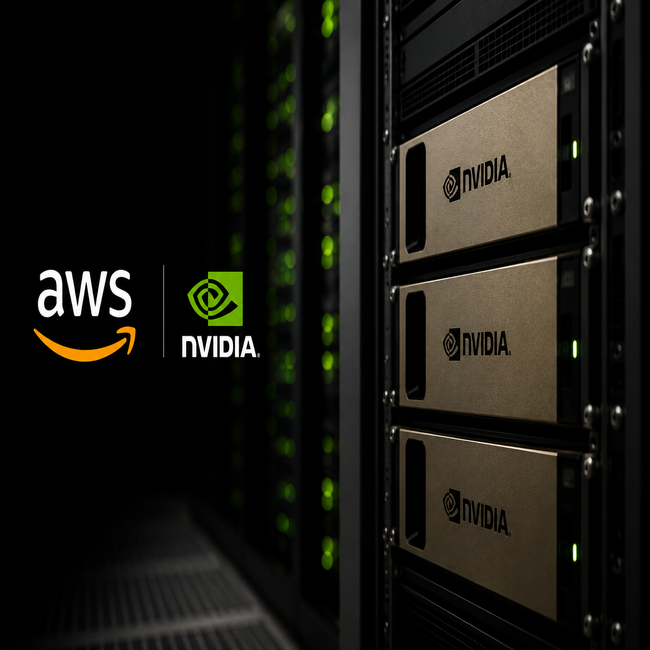

Amazon Web Services is set to deploy an additional two million Nvidia GPUs across its global infrastructure in 2027 and 2028, significantly expanding computing capacity as demand for artificial intelligence workloads continues to rise.
The expansion builds on AWS's announcement at Nvidia GTC 2026 that it planned to add more than one million Nvidia GPUs beginning this year. AWS and Nvidia said demand has since exceeded those expectations, leading to the additional deployment. The new capacity will include Nvidia Blackwell Ultra, Rubin and Rubin Ultra GPUs.
The GPUs will support workloads spanning agentic AI, scientific discovery, enterprise automation and physical AI. The companies are also widening their 16-year collaboration beyond graphics processors to include CPUs, networking, open models, data processing, AI factories and robotics.
As part of the agreement, Nvidia's Vera CPU-based infrastructure will be introduced on AWS. Vera is designed for CPU-intensive components of agentic AI and reinforcement learning, including code execution, analytics, data pipelines and orchestration. AWS said the addition would complement its existing computing portfolio, which includes its own Trainium AI accelerators.
AWS and Nvidia will also extend Nvidia's NVLink Fusion technology with custom high-bandwidth memory. The collaboration is intended to improve how AWS's Trainium chips and Nvidia GPUs can operate within large-scale AI infrastructure. Nvidia's Nemotron open models will continue to be available through Amazon Bedrock and Amazon SageMaker.
The partnership also extends to government AI infrastructure. AWS and Nvidia plan to develop AI factories for the US government, including 100,000 GPUs running on secure AWS infrastructure for federal and national-security workloads.
Another area of expansion is robotics. Amazon Robotics will adopt Nvidia's physical AI platform as the companies work on warehouse automation and next-generation robotic systems. Nvidia technologies will also be integrated further with the AWS Nitro System and Elastic Fabric Adapter to support security, reliability and network performance for large AI deployments.
The Nvidia expansion comes even as Amazon continues investing in its own AI chips. AWS has been developing Trainium as an alternative accelerator for training and running AI workloads, while its custom silicon business has been growing alongside its use of Nvidia hardware.
AWS CEO Matt Garman said customers increasingly want flexibility in selecting technologies for their AI workloads. Nvidia CEO Jensen Huang, meanwhile, said demand for AI computing has continued to exceed forecasts.
The additional two million GPUs underline the scale at which hyperscalers are expanding computing infrastructure as businesses move AI applications from experimentation towards production and increasingly compute-intensive agentic systems.
Disclaimer: This article may include information derived from interviews, press releases, public statements, research, company communications and other publicly available or third-party sources. Such material may be summarised, paraphrased or contextualised for journalistic and editorial purposes. All rights in third-party content remain with their respective owners.