AI assistants are moving beyond chat windows to monitor information, remember preferences and complete tasks without repeated instructions. As OpenAI, Google and Meta develop increasingly proactive agents, the competition is shifting from answering questions to managing everyday digital activity, with implications for search, shopping, customer engagement and privacy.
Until recently, using an AI chatbot meant opening an application, typing a question and waiting for an answer. Once the conversation ended, the user generally had to return and initiate another interaction.
That model is beginning to change.
An AI assistant can now prepare a morning briefing, monitor developments around a chosen subject, review emails, track schedules or continue an assigned task while the user is occupied elsewhere.
Instead of asking an assistant to check something every day, users can increasingly instruct it once and receive updates when needed.
OpenAI, Google and Meta are developing versions of this experience, moving from conversational AI towards systems designed to remain useful between interactions.
The industry describes these systems as persistent or always-on AI agents. However, the term covers different capabilities. Remembering a preference is not the same as monitoring information continuously, and a scheduled briefing is different from an autonomous agent completing a multi-step task.
The distinctions matter because the three companies are approaching the transition through different products, business models and existing platforms.
OpenAI is extending ChatGPT into research, task execution and proactive assistance. Google is connecting Gemini with search, productivity applications and background agents. Meta is bringing memory, automated tasks and personalised assistance into its social and messaging ecosystem.
The commercial interest is becoming clearer. If an assistant can remember what a user needs and act at the appropriate moment, it could become a regular point of contact for information, purchases and services.
The question is no longer only which AI produces the best answer, but which assistant users will trust to keep working after the conversation ends.
1. From Chatbots to Agents: The Shift Has Already Started
OpenAI’s September 2025 introduction of ChatGPT Pulse illustrated the transition towards proactive assistance.
Pulse was designed to research information overnight and provide personalised updates based on previous conversations, user feedback and connected applications.
In announcing the feature, OpenAI said: “This is the first step toward a more useful ChatGPT that proactively brings you what you need.”
Rather than waiting for users to request every update, the feature introduced an experience in which ChatGPT could initiate the next interaction.
OpenAI had already introduced ChatGPT agent in July 2025, combining research, browsing and task execution. The system could navigate websites, analyse information, work with files and complete certain online tasks, while requesting permission for consequential actions.
These developments established two related capabilities: proactively presenting relevant information and carrying out work across digital services.
Google has followed a similar direction.
In June 2025, Gemini introduced scheduled actions, allowing users to request recurring updates such as calendar summaries, unread email briefings or information about selected topics.
At Google I/O 2026, the company expanded that approach through Gemini Spark, proactive daily briefings and information agents within Search.
Google said its information agents could monitor selected subjects in the background and deliver updates when relevant developments occurred.
In July, the company also announced an expansion of Gemini Spark to eligible subscribers in India, describing an agent capable of working in the background even when a phone was locked or a laptop was closed.
Google’s Gemini app had surpassed 900 million monthly users by May 2026, according to the company’s announcement, compared with approximately 400 million reported at Google I/O the previous year.
The figures demonstrate the potential distribution available to Google’s evolving assistant, although monthly users do not indicate how many actively use persistent-agent features.
Meta has been developing a comparable experience through Meta AI.
Its July 2026 update introduced capabilities powered by Muse Spark 1.1, including connecting with email and calendar applications, preparing briefings, creating presentations and following through on assigned tasks.
Meta described the direction as “an AI that knows your context, is there for you whenever you need it, and handles things so you don’t have to.”
The company illustrated the capabilities through practical examples, including an assistant that monitors a running schedule, identifies suitable products for a home renovation or prepares recurring updates.
Availability varies by market and product, and these capabilities should not be confused with unrestricted autonomy.
Nevertheless, the direction is becoming consistent across the industry: assistants are being developed to maintain context and continue selected activities beyond individual conversations.
2. Why OpenAI, Google and Meta Want to Become Part of Everyday Decisions
The commercial significance of persistent AI extends beyond convenience.
Traditional chatbots compete largely on the quality of their responses. Persistent assistants introduce additional factors, including access to information, continuity, integration with applications and the ability to act at useful moments.
For OpenAI, this creates opportunities to extend ChatGPT beyond occasional questions.
An assistant that prepares recurring research, monitors developments or manages parts of a workflow could become more integrated into professional and personal routines.
For Google, the opportunity is closely connected to its existing position in search, email, calendars, mobile devices and productivity software.
A user researching a holiday might currently move between Google Search, Gmail, Maps, hotel websites and a booking platform.
A connected assistant could potentially bring information from those services into one interaction, identify relevant options and help complete the next steps.
Google’s introduction of Personal Intelligence in India in April 2026 demonstrated how Gemini could draw on authorised connections to Gmail, Photos, YouTube and Search to provide more contextual responses.
Meta approaches the opportunity through a different distribution network.
Its social platforms, messaging applications and commerce features already support interactions between consumers, creators and businesses.
An assistant integrated into those environments could help people discover products, compare options and engage with businesses without leaving familiar applications.
In June 2026, Meta reported that more than one million businesses were using Meta Business Agent on WhatsApp and Messenger to respond to customers around the clock.
This represents another dimension of persistence: AI systems that remain available to customers when human teams are offline.
The competition also reflects a broader shift in enterprise technology.
McKinsey’s August 2026 State of AI research found that 40% of respondents from organisations with annual revenue exceeding $1 billion reported scaling AI agents, up from 27% the previous year.
Among smaller organisations, the corresponding proportion remained at 22%.
The figures suggest that larger enterprises are advancing more rapidly towards deploying agents within business operations, although adoption varies substantially by function.
For technology companies, the commercial opportunity lies not only in providing intelligence but also in becoming the interface through which people organise activities.
That could influence where users begin a search, how they discover services and which platforms participate in a transaction.
It does not mean advertising or traditional search will disappear. It does suggest that consumer journeys could involve fewer separate interactions with websites and applications.
3. What Happens to Marketing When AI Starts Making the Shortlist?
For marketers, persistent agents could change how brands enter customer consideration.
Consider a consumer planning to purchase a laptop.
Today, the journey might involve searching for reviews, visiting ecommerce websites, comparing specifications and watching product demonstrations.
A persistent assistant could monitor prices, remember budget preferences, compare new releases and notify the consumer when a suitable product becomes available.
The assistant would not necessarily make the final purchase. However, it could influence which products are considered before the consumer visits a retailer.
A similar change could emerge in travel.
Someone planning a family holiday might instruct an assistant to monitor flights, identify accommodation within a particular budget and flag changes in availability.
Brands appearing in those recommendations could receive attention without the consumer beginning a fresh search.
This makes product information, availability, pricing accuracy and credible third-party references potentially more important to AI-mediated discovery.
The implications also extend to customer engagement.
Salesforce’s 2026 India findings, drawn from 250 Indian marketing decision-makers within a wider global survey, found that 81% of Indian marketers had adopted AI.
The research also reported that 92% believed customers increasingly expected brands to support two-way conversations, while 86% said they would trust AI to respond to customers to help scale engagement.
However, respondents identified disconnected or irrelevant data as a continuing barrier.
This creates a practical challenge for brands seeking to introduce persistent customer agents.
A retailer’s assistant might remember a customer’s preferred products and provide timely recommendations. But if it cannot access accurate inventory, order history or customer-service records, those recommendations could be irrelevant.
Similarly, an automated travel assistant might identify attractive hotel rates but require current pricing and availability before presenting them as actionable options.
Marketers would therefore need to assess more than whether an agent responds quickly.
Accuracy, customer context, escalation to human support and measurable commercial outcomes would remain important.
Meta’s January 2026 performance update also indicated that it was testing an AI business assistant capable of remembering advertisers’ objectives and offering personalised performance recommendations.
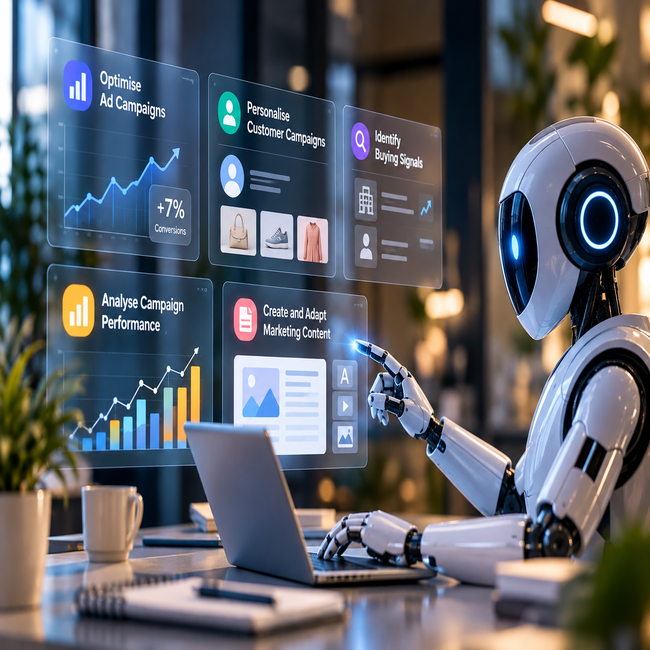
This suggests persistent agents could operate on both sides of marketing: helping consumers navigate choices while assisting brands with campaign management and customer communication.
The resulting measurement challenge is significant.
Traditional digital marketing often relies on impressions, clicks and conversions. If an assistant repeatedly recommends a brand, monitors offers or prepares a shortlist without generating an immediate website visit, some of that influence may be difficult to capture through conventional analytics.
Marketers may increasingly need to examine recommendation frequency, the accuracy of information available to agents, customer consideration and subsequent commercial activity alongside established performance metrics.
These are emerging possibilities rather than evidence that persistent agents have already transformed purchasing behaviour at scale.
4. The Bigger Question Is How Much Control Users Will Give Up
Persistent AI also introduces a different set of risks from conventional chatbots.
An inaccurate chatbot response can misinform a user. An inaccurate agent acting across connected services could create or modify information, contact another party or make an unwanted decision.
The consequences therefore depend partly on what the assistant is authorised to do.
An agent preparing a morning news summary requires a different level of access from one handling purchases, appointments or financial information.
OpenAI has emphasised permission requests and opportunities for users to interrupt or stop consequential actions.
Google’s Personal Intelligence connections are designed around user authorisation, while Meta has introduced controls for certain memory and personalised-assistance features.
The effectiveness of these safeguards will become more important as assistants gain access to additional services.
Privacy presents another concern.
A system that remembers preferences, reads selected emails and understands schedules may provide more relevant assistance. It also operates with information that users may not want retained indefinitely or combined across different activities.
Security risks include malicious instructions embedded in websites or documents that agents encounter, potentially leading them to take actions outside the user’s intended task.
Reliability is equally important. An agent that repeatedly monitors information must distinguish genuine changes from outdated or incorrect data.
The technology’s adoption also depends on whether organisations can integrate it responsibly.
Microsoft’s 2026 Work Trend Index, based on a survey of approximately 20,000 AI-using workers across ten countries, found that organisational factors such as culture, management support and working practices accounted for substantially more variation in reported AI outcomes than individual attitudes alone.
Although the study concerns workplace AI broadly, it reinforces the importance of how organisations implement these technologies rather than merely making them available.
For consumers, persistent agents will face a similar test.
An assistant that saves time, respects instructions and provides accurate updates may become useful enough to remain part of a daily routine.
One that sends unnecessary notifications, misunderstands preferences or acts without appropriate confirmation may struggle to maintain trust.
The transition is therefore unlikely to be uniform. Some users may prefer highly automated assistants, while others may want AI to prepare recommendations without completing actions independently.
For OpenAI, Google and Meta, the immediate objective is to make their assistants useful beyond the moment somebody opens a chat window.
The longer-term competition concerns who manages the continuing relationship between users, information and digital services.
Chatbots made AI available whenever people had a question. Persistent agents are being developed to keep working after the question has been answered. Whether that becomes the next standard for everyday technology will depend on how reliably these systems act, how much control users retain and whether the convenience outweighs the additional access they require.
Disclaimer: All data points and statistics are attributed to published research studies and verified market research. All quotes are either sourced directly or attributed to public statements.
Related Articles