
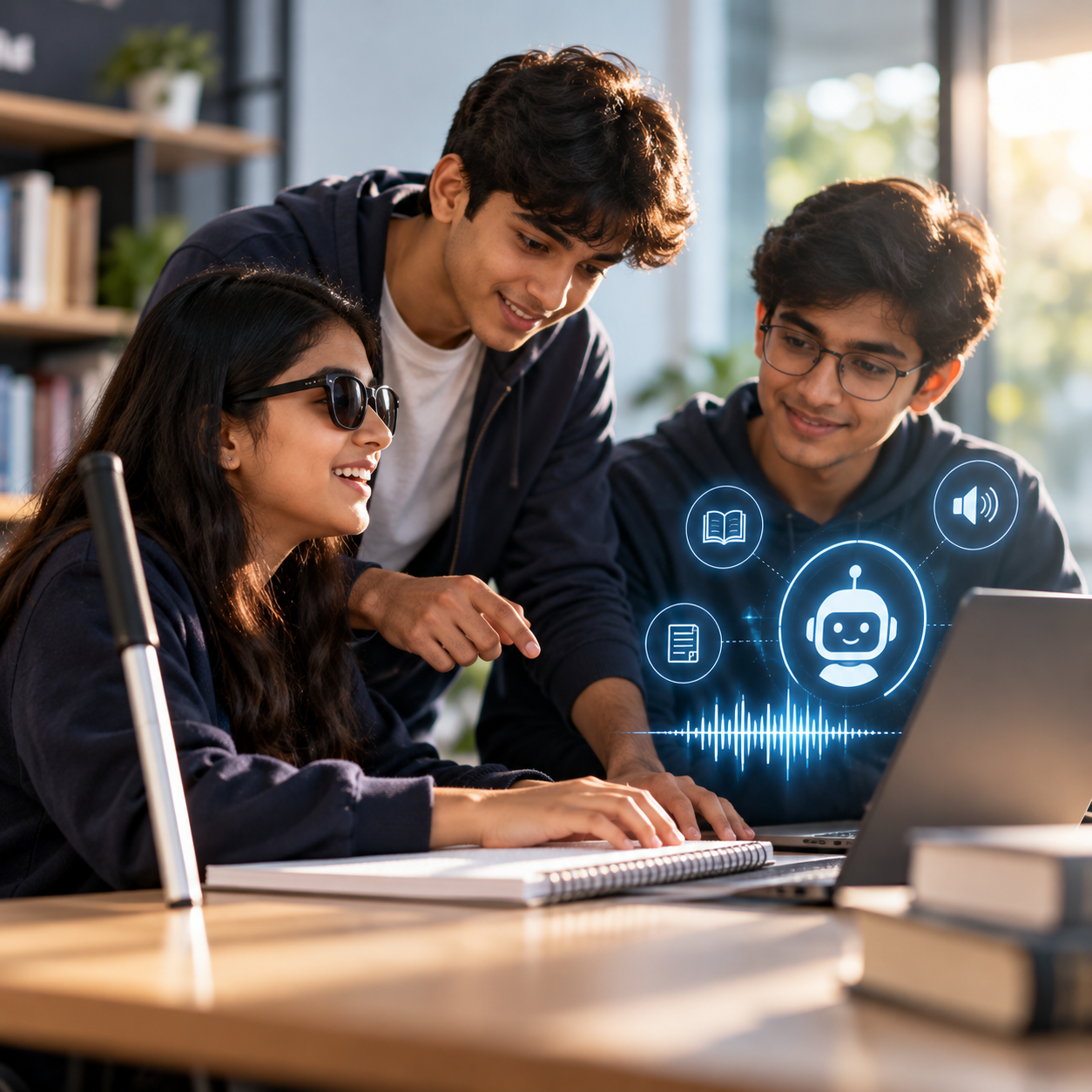

The voice-first AI companion, SARA AI, has been tested with more than 40 students and is among the top 20 solutions selected for Samsung Solve for Tomorrow 2026.
Two 17-year-old students from Delhi are developing an artificial intelligence-powered learning assistant designed to make digital education more accessible to visually impaired students. The project, called SARA AI, has been selected among the top 20 solutions in Samsung Solve for Tomorrow 2026.
Developed by Aditya and Sparsh under their team, Equinox, SARA AI is a voice-first, agentic AI companion intended to help students navigate educational activities without relying primarily on visual interfaces.
The solution is being designed to support voice-based interactions, speech-to-text conversion, learning progress tracking and participation in tests and assessments. It also includes a feature that can initiate interactions after periods of inactivity, allowing students to remain engaged with their learning activities.
The project addresses accessibility challenges associated with digital learning platforms, particularly for students who may find conventional screen-based interfaces difficult to navigate independently.
According to Samsung, Team Equinox has tested SARA AI with more than 40 students in Delhi and engaged with schools and trusts to understand the requirements of visually impaired learners.
These interactions have informed the development process, with the team focusing on usability, accessibility and reliability in educational environments.
The project is currently being developed beyond its initial prototype, with the students exploring how the technology could be introduced into schools and institutions supporting learners with visual impairments.
As part of Samsung Solve for Tomorrow 2026, Aditya and Sparsh have received mentorship and technical guidance through the programme's bootcamp.
The initiative included sessions on design thinking, marketing and the startup ecosystem, alongside discussions about product development and potential market adoption.
The students also participated in one-on-one mentoring sessions with Samsung and the Foundation for Innovation and Technology Transfer (FITT) at IIT Delhi. Inputs from AI experts within Samsung's research and development ecosystem helped the team address technical challenges and assess possible deployment models.
The programme is intended to support young innovators in developing technology-based solutions to challenges identified within their communities.
Team Equinox is now evaluating opportunities to introduce SARA AI through schools, non-governmental organisations and other institutions working with visually impaired students.
The students aim to expand the solution across schools in Delhi, with the potential to reach approximately 6,000 learners. However, the proposed expansion remains dependent on further development and institutional adoption.
Samsung has not disclosed a commercial launch timeline, pricing structure or independent performance assessment for SARA AI.
The project comes as educational institutions increasingly explore AI-enabled learning tools, including voice interfaces, personalised assistance and automated progress tracking.
For developers working on accessible education technology, the challenge extends beyond introducing AI capabilities to ensuring that such systems can be used reliably by students with different learning requirements.
SARA AI remains under development, with its creators focusing on improving the prototype and exploring opportunities for broader implementation.
Disclaimer: This article may include information derived from interviews, press releases, public statements, research, company communications and other publicly available or third-party sources. Such material may be summarised, paraphrased or contextualised for journalistic and editorial purposes. All rights in third-party content remain with their respective owners.