
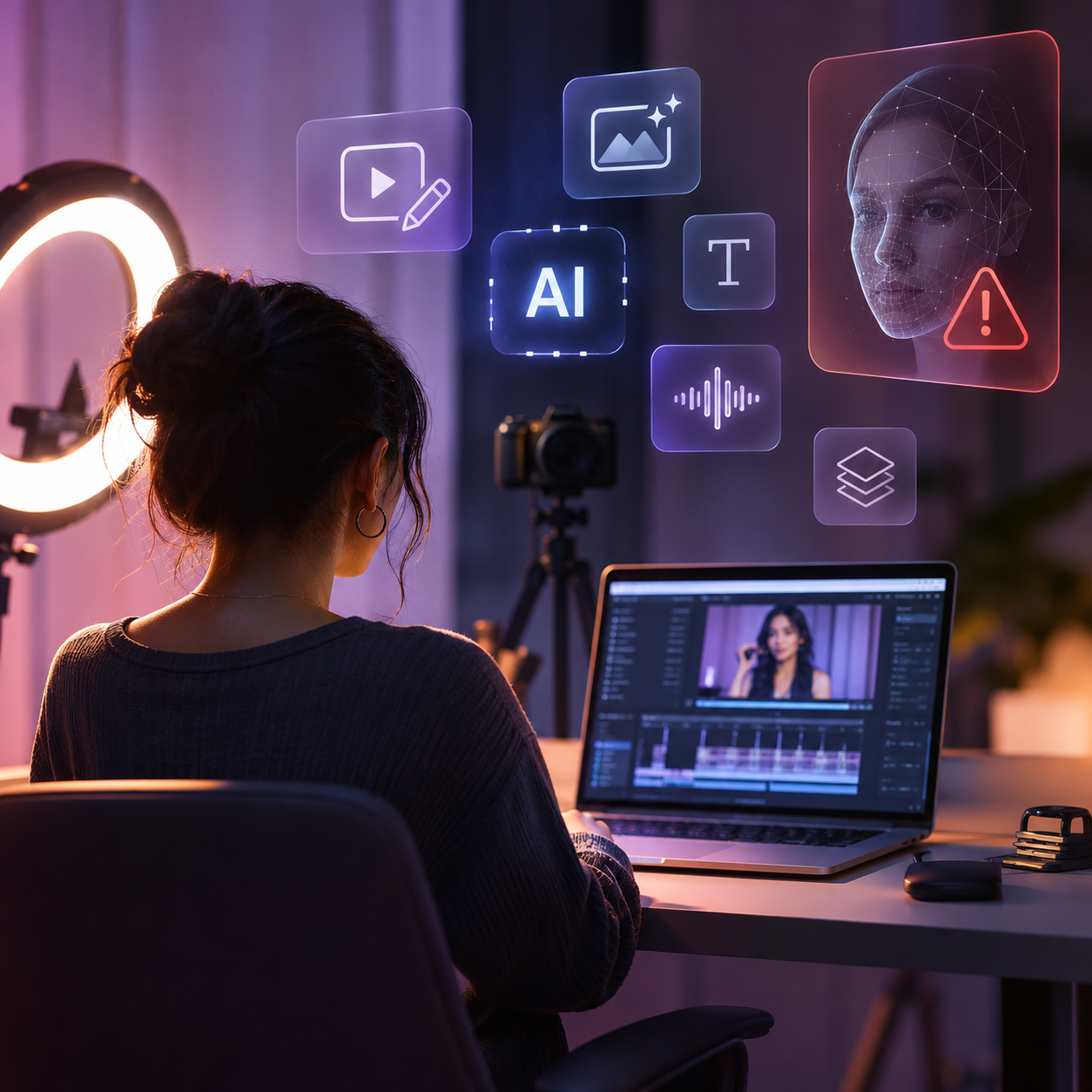

AI is helping content creators produce videos, edit photographs, translate audio and manage multiple platforms with fewer resources. However, the same technology can also be used to recreate their faces, clone their voices and generate endorsements without consent. As creators increasingly use AI to grow their businesses, new 2026 research highlights concerns about impersonation, ownership and the protection of digital identities.
Imagine a beauty creator recording a makeup tutorial for Instagram. Within minutes, AI tools can help remove unwanted pauses, generate subtitles, prepare a voiceover, resize the video for different platforms and suggest captions.
The creator can publish more content without necessarily hiring an editor, designer or production assistant.
Now consider another scenario.
The same creator discovers a video circulating online in which their face appears to promote a skincare product they have never used. Their voice sounds familiar, their expressions appear convincing and the advertisement looks like an ordinary brand collaboration.
Except the creator never recorded it.
Artificial intelligence is making both scenarios increasingly possible.
For content creators, AI has become a production tool that can reduce the time spent on repetitive tasks. But advances in synthetic media are also raising questions about who controls the faces, voices and other identifiable characteristics that creators use to build their audiences.
This is particularly relevant to influencer marketing, where brands pay creators partly because audiences recognise and trust them.
Adobe’s 2026 Creators’ Toolkit Report, based on a survey of more than 16,000 creators across eight markets, including India, found that 93% of creators using creative AI said it helped them produce content faster.
Another 75% considered AI integrated or essential to their workflows, while 87% said it had accelerated the growth of their business or audience.
The figures demonstrate the technology’s growing importance in content production. However, they also raise a question for an industry where an individual’s identity can carry significant commercial value.
What happens when producing a creator’s content becomes easier, but reproducing the creator also becomes possible?
1. AI Is Making Content Creation Faster, but Creators Still Want Control
The increasing use of AI across the creator economy is largely driven by practical requirements.
A YouTuber might use it to identify highlights from a lengthy interview. A travel creator could generate subtitles in multiple languages, while a podcaster might convert audio into written posts for LinkedIn.
A fashion influencer can prepare different versions of a campaign photograph, and an independent newsletter writer can use AI to organise research or draft promotional copy.
These applications can reduce production time, particularly for creators managing several platforms independently.
CreatorIQ’s 2026 State of Creators report, developed with Influencers.club, surveyed 5,095 creators across 100 regions.
It found that 72% had used AI tools, primarily for brainstorming, writing and editing.
However, only 4% reported using AI for strategy, while just 1% used it to automate workflows.
The findings suggest that most creators are using AI to support existing production activities rather than allowing autonomous systems to manage their businesses.
The distinction is important because faster content generation does not necessarily mean the creative process has become completely automated.
Adobe found that 57% of surveyed creators said AI-generated outputs required moderate or extensive editing before publication.
Another 85% believed the final creative decision should remain with the creator, even when AI agents are involved.
Sophia Kianni, creator and founder of Phia, described AI’s value as the time it allows her to redirect towards “storytelling, creative direction and the work that drives growth”.
The financial structure of the creator economy also helps explain the appeal.
CreatorIQ found that 67% of respondents earned less than $10,000 from content creation during the previous year, while 62% said it was not their primary source of income.
For creators operating without a dedicated production team, AI can help make regular publishing more manageable.
But the growing availability of creative tools introduces another challenge.
Photographs, videos and audio recordings are already publicly accessible across creator profiles. These materials can potentially be misused to generate convincing imitations without the creator’s involvement.
2. When a Creator’s Face and Voice Become Someone Else’s Content
Online impersonation is not new.
Fake celebrity accounts, stolen photographs and fraudulent brand endorsements existed before generative AI became widely accessible.
What has changed is the ability to create new material that appears to feature a real person.
Instead of copying an existing video, someone can use AI to alter facial expressions, generate synthetic speech or produce an entirely new recording that resembles a recognisable individual.
For creators, this can create confusion about which content they actually authorised.
Consider a fitness influencer whose voice is recreated to promote a weight-loss product, or a financial creator whose likeness appears in an investment advertisement.
Even if the material is eventually removed, audiences may have already encountered the false endorsement.
The problem extends beyond lost advertising opportunities. Such content could affect a creator’s credibility with followers and existing commercial partners.
Malwarebytes’ June 2026 research, based on a survey of 1,500 adults across the US, UK, Germany, Austria and Switzerland, found that 19% had experienced some form of AI-related identity harm.
The figure increased to 30% among Gen Z respondents.
Across the surveyed population, 11% reported being impersonated online, while 10% said their images or videos had been manipulated using AI without permission.
These findings describe identity-related experiences among consumers generally, not exclusively professional content creators.
Nevertheless, they demonstrate how synthetic-media misuse can affect individuals whose photographs and recordings are available online.
The difficulty increases when viewers cannot reliably distinguish authentic content from generated material.
Veriff’s 2026 Deepfakes Report, based on research conducted with Kantar among 3,000 adults in the US, UK and Brazil, tested participants using eight authentic and eight AI-generated or manipulated visuals.
Detection accuracy was only slightly better than random guessing.
In one comparison involving a synthetic video of a woman, 70% of respondents incorrectly identified the fake as genuine.
For influencer marketing, this creates a particular problem.
An advertisement featuring a familiar face may appear credible because audiences associate that person with previous recommendations.
AI-generated impersonation can exploit that familiarity without obtaining consent.
The commercial damage is difficult to measure because an individual may not know how many people encountered a fraudulent advertisement or whether it influenced their opinion.
Mark Beare, Head of Consumer at Malwarebytes, warned that the consequences extend beyond individual scams.
“When people can no longer trust what they see, hear, or who they’re talking to, the damage reaches far beyond any single scam,” he said.
That uncertainty makes identity protection increasingly relevant to creators, brands and platforms alike.
3. AI Is Making Content Easier to Produce, but Authenticity Harder to Establish
The growing volume of AI-assisted content is also changing how creators think about originality.
When similar editing, captioning and image-generation tools become widely available, production quality alone may become less effective at distinguishing one creator from another.
Adobe’s research found that among creators who believed standing out had become more difficult, 42% attributed the problem partly to increasing volumes of AI-generated content.
At the same time, 81% said human judgement remained essential to creative taste.
The distinction is commercially important because audiences may follow creators for their experiences, personalities and perspectives rather than production quality alone.
An AI system can imitate a person’s voice or generate a photograph resembling them. That does not establish that the individual agrees with the message being communicated.
Epidemic Sound’s 2026 Future of the Creator Economy Report surveyed 3,000 professional creators in the US and UK.
It found that 93% associated AI with significant risks involving music, sound or content creation.
Thirty-seven per cent were concerned about their work being used to train AI systems without permission, while 33% worried about AI reproducing their voice or style.
Another 73% believed unclear licensing could limit future business opportunities.
The report also found that 53% had experienced copyright or licensing issues affecting brand deals or other commercial opportunities.
These findings cover broader intellectual property concerns, not solely cases of AI impersonation.
Nevertheless, they indicate that ownership and control are becoming more relevant to creator businesses.
Sara Börsvik, Interim CEO of Epidemic Sound, said, “As output grows, authenticity, creative control, and rights clarity are becoming much more important.”
The challenge is particularly relevant when creators collaborate with brands.
A conventional influencer campaign may permit a company to publish an approved video for a specified period.
AI introduces additional questions about whether that company can generate new advertisements using the creator’s likeness, translate their voice or modify previously approved material.
Such uses may be acceptable when expressly authorised and appropriately licensed.
However, approval to publish one sponsored post should not automatically be treated as permission to generate unlimited synthetic content featuring the creator.
For brands, this makes contractual clarity and verification increasingly important when developing AI-assisted influencer campaigns.
4. Can Platforms and Regulations Keep Up With AI Impersonation?
Technology companies and regulators are responding to the growing use of synthetic media.
YouTube expanded its likeness-detection technology in 2026, providing eligible individuals with tools to identify potentially unauthorised AI-generated content featuring their appearance.
The system allows users to review detected material and request removal.
However, identification does not automatically guarantee that a video will be taken down.
YouTube has also introduced more visible disclosures for realistic synthetic or significantly altered content.
Meta has taken action against advertisers accused of using manipulated celebrity images and voices to promote fraudulent products and services.
The company also reported removing more than 20 million accounts impersonating large creators during 2025, although the figure covers broader impersonation activity rather than AI-generated accounts alone.
India has introduced additional requirements concerning synthetically generated information through amendments to its Information Technology Rules notified in February 2026.
The changes include obligations for significant social media intermediaries relating to declarations, verification measures and labelling of synthetic content.
Such developments indicate that platform responsibility is expanding beyond conventional copyright complaints and fake-account reporting.
However, detecting synthetic material remains different from establishing whether its creation was authorised.
A creator may legitimately license their digital likeness for a multilingual campaign. Another video featuring the same likeness may have been generated without permission.
Both could contain AI-generated elements, but their consent and commercial arrangements would be different.
Watermarking, content credentials and provenance systems can help document how certain media was created or modified. Yet they cannot independently resolve every dispute involving identity, permission or misuse.
Creators may also need clearer contractual arrangements covering synthetic replicas, advertising permissions, usage periods and the removal of unauthorised material.
Tyler Chou, founder and CEO of Tyler Chou Law for Creators, highlighted the importance of ownership documentation.
“In an AI world where a creator’s face can be cloned in under a minute and their voice in under a sentence, the only durable asset is the IP you can prove you own on paper,” she said.
The creator economy is therefore facing two developments simultaneously.
AI is lowering the time and resources required to produce digital content, allowing individuals to publish more frequently and experiment with new formats.
At the same time, synthetic-media technology is creating new risks involving impersonation, commercial exploitation and the authenticity of online endorsements.
For marketers, the challenge extends beyond whether AI-generated content performs effectively. It also involves ensuring that creators have authorised the use of their identities and that audiences can identify genuine partnerships.
AI may make it easier to produce a creator’s next video, advertisement or social media post. But as digital likenesses become easier to reproduce, protecting the person behind that content is becoming an increasingly important part of the creator business.
Disclaimer: All data points and statistics are attributed to published research studies and verified market research. All quotes are either sourced directly or attributed to public statements.