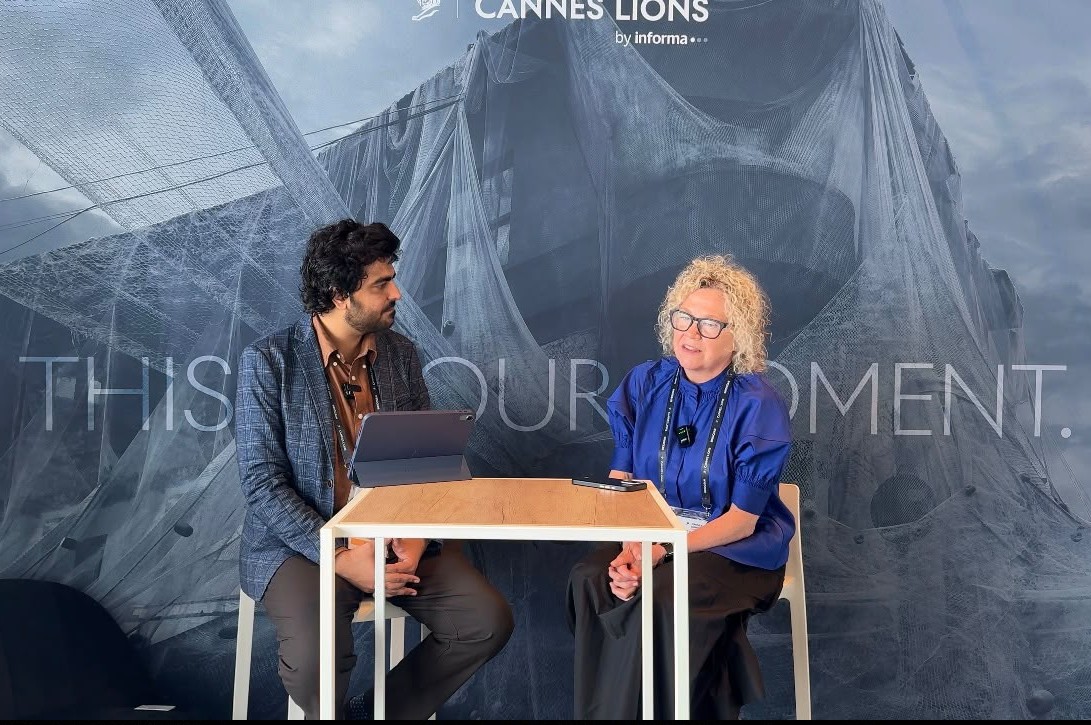
Sir Martin Sorrell does not waste time warming up. In a sharp conversation with Brij Pahwa, Editor Lead, MartechAI.com and exchange4media, at Cannes Lions 2026, the advertising veteran began with India, praised Prime Minister Narendra Modi’s leadership, joked that the UK should “rent” him as Prime Minister, and then turned his fire on the global advertising industry.
For Sorrell, India is no longer just a promising market. It is, in his words, “on fire” economically. Having visited the country for nearly five decades, he said he could not remember India looking this vibrant.
But the larger warning came when the conversation moved to Cannes Lions and AI. While much of the festival has been consumed by the impact of artificial intelligence on creativity, copywriting, visualisation and personalisation, Sorrell argued that the industry is missing the bigger shift. Cannes, he said, is “going down the wrong rabbit hole.”
The real battle, according to him, is not just whether AI can make better ads faster. It is about media concentration, platform power, transparency, agency pricing models, data integration and the changing economics of advertising itself.
Sorrell argued that Cannes has become too focused on the creative side of AI, particularly visualisation, copywriting and personalisation at scale. Those areas, he said, are already changing advertising by “collapsing the time to make an ad and the cost of it.” That, in turn, is pushing the agency business away from the traditional time-and-materials model towards unit pricing, multiple asset-use pricing and even subscription-style models.
Yet for Sorrell, that is only part of the story.
The bigger issue, he said, is media.
“They should be looking at media,” he said, arguing that questions of independence, proprietary trading, take rates and transparency deserve much more attention. His central warning was direct: the market is not becoming more fragmented, despite the way the industry often describes it. It is becoming more concentrated.
Citing his own estimates, Sorrell said the global advertising industry is around $1.2 trillion, with traditional media at roughly $300 billion and digital at around $900 billion. He pointed to the scale of Google, Meta, Amazon and TikTok to argue that a small number of platforms now command enormous influence over global advertising flows.
“So when you write that media is fragmenting, it’s not,” he said. “It’s concentrated.”
That concentration, according to Sorrell, is becoming even more important because the largest technology companies are not simply media owners anymore. They are also building the AI infrastructure that will define the next era of business, marketing and national competitiveness.
He cited Goldman Sachs forecasts suggesting that Microsoft, Alphabet, Meta and Amazon will spend trillions of dollars on AI-related capital expenditure between 2025 and 2030. For advertisers and agencies, that creates a new reality: they have “no choice” but to work with these platforms because their scale, infrastructure and technological leadership are too large to ignore.
Sorrell also connected this to geopolitics. Governments, he said, want strong technology companies because technological leadership in AI, blockchain and quantum computing is now tied to national power. Big tech, in his view, has also become fundamental to military and defence capability, as seen in conflicts such as Ukraine and the Middle East.
On AI itself, Sorrell laid out five areas of impact for the advertising and marketing industry: visualisation and copywriting, personalisation at scale, media planning and buying, cost reduction, and what he called the “democracy of knowledge.”
The first three, he said, are already visible. AI can generate, adapt and personalise creative assets faster and cheaper than before. But this creates a new problem: if everyone uses the same machines, how does one brand look different from another?
Sorrell recalled Coca-Cola Chairman and CEO James Quincey’s concern: if everyone is using the same technology, how do you differentiate Coca-Cola’s ads from anyone else’s?
His answer was simple: human creativity.
However, he added an uncomfortable caveat. “If machines become more powerful than people, then we’ve got trouble,” he said. Sorrell said he belongs to the camp that believes this will happen “at some point in time.”
The second major AI impact, according to him, will be media planning and buying. He compared advertising to financial services, pointing out that large-scale asset managers such as BlackRock do not operate manually at the same scale. They use algorithms. Advertising, he suggested, will move in the same direction.
The third impact is cost reduction. Sorrell said S4 is working through a joint venture involving NVIDIA, AWS and Adobe, where AI and cloud infrastructure are being used to reduce the cost of outside broadcasts. He said this could cut costs by about 80 to 90 percent.
But the most interesting area, he said, is the democracy of knowledge.
For Sorrell, AI’s real power is not just in generating ads. It is in giving more people access to knowledge, expertise and information at near-zero marginal cost. He compared it to the early impact of the internet, recalling a meeting in Mexico where he was told that the internet had transformed access to information for children in villages without libraries.
“Same with AI, but on steroids,” he said.
That democratisation, however, also changes how companies are organised. Sorrell argued that traditional hierarchies and capability-led structures are increasingly unfit for the AI era. He criticised agency models that separate businesses too sharply by function, saying they create internal fights over revenue, attribution and power.
He used a football analogy to describe the kind of talent the industry needs. Cristiano Ronaldo, he said, is a great player, but is often seen as someone who plays for himself. Lionel Messi, in contrast, is a great player who plays for the team. Sorrell said he prefers the Messi model.
In advertising, he said, the greatest people are not just talented. The rarest and most valuable people are those who share knowledge and collaborate.
That led to one of his clearest criticisms of the holding-company model. Sorrell said capability-led structures at major agency groups create internal competition when what clients increasingly need is integrated thinking. In his view, agencies cannot claim to operate as “one company” while their people are still judged by separate verticals, budgets and revenue lines.
On data, Sorrell pushed back against the idea that marketers simply do not understand it. The bigger problem, he said, is integration.
“The biggest problem is the difficulty of integrating data,” he said. He gave the example of luxury companies where one organisation may run data separately by brand while another consolidates it centrally. For AI to work properly, he argued, companies need integrated data, simplified workflows and serious change management.
“AI is firstly, it’s not about technology in a sense,” he said. “It’s about workflow. Simplify the workflow. Layer the technology on top of it.”
That may be the most important message from Sorrell’s Cannes interview. AI is not just a creative tool. It is not just a productivity layer. It is not just a way to make more ads faster.
It is changing the cost structure of advertising, the pricing model of agencies, the balance of power between platforms and marketers, the role of human creativity, the value of integrated data and the operating design of companies themselves.
For an industry still celebrating AI-generated creative assets on the Croisette, Sorrell’s warning was clear: the real disruption is not in the image or the copy. It is in the media, the money, the data and the model underneath.
Related Articles