
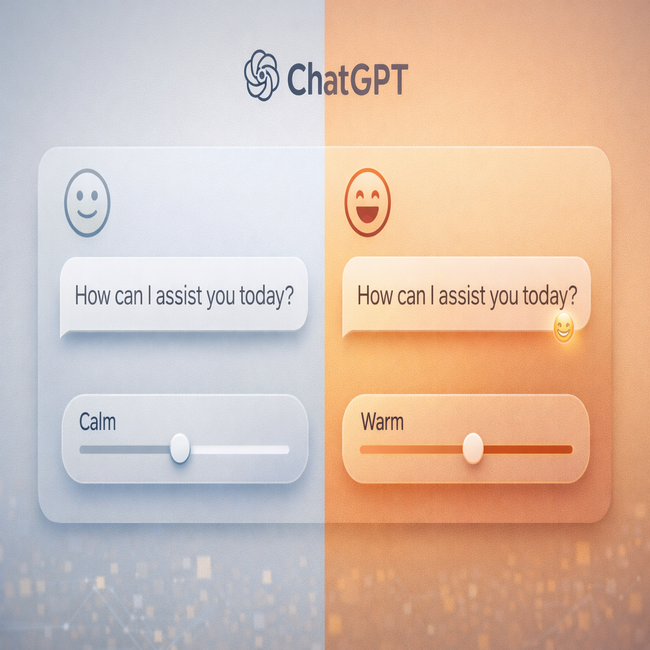

OpenAI has rolled out a new feature that allows users to directly adjust the tone of ChatGPT by controlling its warmth and enthusiasm, reflecting a broader shift toward more personalised and user-directed artificial intelligence experiences. The update gives users greater influence over how the AI communicates, moving beyond one-size-fits-all responses to interactions shaped by individual preferences.
The new controls enable users to fine-tune how expressive or restrained ChatGPT appears during conversations. By adjusting these settings, users can choose whether the AI responds in a more energetic and engaging manner or adopts a calmer and more neutral tone. OpenAI has positioned the feature as a way to make interactions feel more aligned with user expectations across different contexts.
The introduction of tone controls comes as generative AI tools become more deeply embedded in everyday workflows. ChatGPT is widely used for tasks ranging from professional writing and coding to customer support and personal assistance. As usage expands across diverse scenarios, the demand for flexibility in communication style has grown.
OpenAI has said that users often engage with ChatGPT for repeated tasks that benefit from consistency in tone. For example, a professional user drafting reports may prefer a straightforward and formal style, while another user seeking brainstorming support may want a more enthusiastic and encouraging response. The new settings aim to accommodate these varied needs without requiring repeated instructions in each conversation.
The update reflects a broader industry trend toward customisable AI behaviour. As AI systems become more capable, user experience and personalisation are emerging as key areas of differentiation. Allowing users to shape not only what an AI says but how it says it represents a step toward more adaptive and user-centric design.
OpenAI has emphasised that the warmth and enthusiasm controls affect style rather than substance. The underlying model capabilities and factual grounding remain unchanged, while the tone of responses is adjusted to better match user preferences. This distinction is important as concerns around AI reliability and accuracy continue to attract attention from users and regulators.
The company has also framed the feature as part of its ongoing efforts to improve transparency and user agency. By making aspects of AI behaviour more visible and adjustable, OpenAI aims to give users clearer expectations and a greater sense of control over interactions. This approach aligns with broader discussions around responsible AI design.
From a technical perspective, tone adjustment involves guiding how the model selects language, phrasing and expressive cues. While the changes may appear subtle, they can significantly influence how users perceive and trust AI responses. Studies in human computer interaction have shown that tone plays a critical role in user satisfaction and engagement.
The ability to adjust warmth and enthusiasm may also have implications for enterprise adoption. Businesses using ChatGPT through APIs or integrated tools often need AI systems to align with brand voice and communication guidelines. While OpenAI has not announced enterprise-specific enhancements tied to this update, the feature signals an awareness of the importance of tone consistency in professional settings.
OpenAI’s move follows increased scrutiny around how AI systems communicate and influence users. As AI assistants become more conversational, questions have emerged about emotional dependency, persuasion and user perception. Giving users explicit control over tone may help mitigate some of these concerns by reinforcing that the AI’s personality is configurable rather than inherent.
The update also reflects OpenAI’s iterative approach to product development. Over time, the company has introduced features that allow users to guide output length, formatting and content focus. Tone adjustment builds on this pattern by addressing another dimension of interaction that users have frequently commented on.
Industry observers note that such features may become standard expectations for conversational AI tools. As competition intensifies among AI providers, user experience refinements are likely to play a larger role in adoption and retention. The ability to personalise interactions without technical complexity could appeal to both individual users and organisations.
At the same time, OpenAI has indicated that safeguards remain in place to ensure appropriate use. Adjusting warmth and enthusiasm does not override content moderation or safety systems. Responses continue to adhere to usage policies designed to prevent harmful or misleading outputs, regardless of tone settings.
The introduction of tone controls also raises questions about future directions in AI personalisation. Beyond warmth and enthusiasm, users may eventually seek control over other aspects of communication such as formality, creativity or cultural context. OpenAI has not detailed plans for additional controls but has acknowledged that personalisation remains an active area of exploration.
For users, the feature offers a practical way to tailor interactions without extensive prompt engineering. Instead of repeatedly instructing the AI to be more concise or more upbeat, users can set preferences once and expect consistent behaviour across sessions. This could reduce friction and improve efficiency for frequent users.
As generative AI tools continue to evolve, the balance between adaptability and predictability will remain central. Features that allow users to customise interactions while maintaining reliability are likely to shape perceptions of trust and usability. OpenAI’s latest update reflects an effort to address these considerations through incremental, user-focused improvements.
The rollout of warmth and enthusiasm controls underscores how conversational AI is moving toward greater nuance in human-like interaction. While the technology remains fundamentally machine-driven, such refinements aim to make AI tools feel more responsive to individual needs without blurring the distinction between artificial and human communication.
As adoption grows, feedback from users will likely influence how the feature is refined and expanded. For now, the update marks another step in OpenAI’s effort to make ChatGPT more flexible and adaptable across a wide range of use cases.