
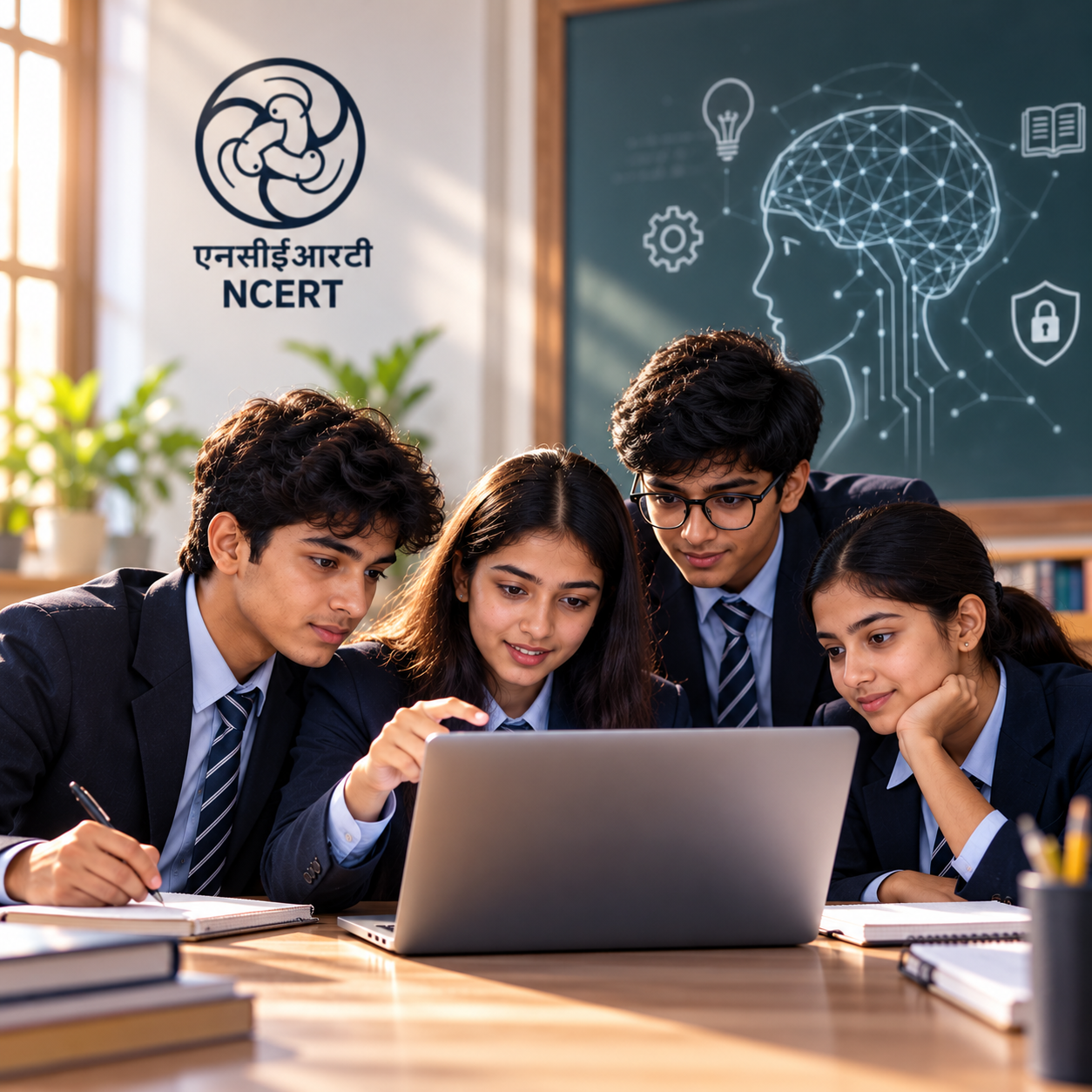

The National Council of Educational Research and Training (NCERT) has introduced a 20-hour introductory module on artificial intelligence (AI) and computational thinking for students in Classes 9 to 12, covering deepfake detection, data privacy, misinformation and responsible use of emerging technologies.
Developed in consultation with IIT Madras and IIT Jodhpur, the module aims to familiarise students with the functioning, applications and limitations of AI while strengthening their ability to evaluate AI-generated information.
The initiative introduces computational thinking as a structured approach to problem-solving and encourages students to understand how machines learn from examples. It also examines the use of AI in everyday applications, alongside the potential risks associated with automated systems.
According to NCERT, the module has been designed for students without prior knowledge of artificial intelligence. It uses an activity-based learning approach to introduce technical concepts through discussions, practical exercises, experimentation and reflection.
A key component focuses on identifying deepfakes and assessing the authenticity of digital content. Students will be encouraged to question information generated by AI systems rather than accepting automated responses without verification.
The curriculum also addresses ethical considerations surrounding AI, including fairness, the protection of personal information and the responsible handling of digital content.
These subjects form part of the module's broader emphasis on digital safety and the need for critical judgement when interacting with AI-powered tools.
NCERT has stated that the learning activities can be conducted with or without digital devices, allowing schools with varying levels of technological infrastructure to participate.
This approach is intended to make the introductory material accessible across different classroom environments without making specialised equipment a prerequisite for learning.
The module also seeks to develop creativity, analytical thinking and problem-solving abilities by introducing students to the principles underlying AI systems.
Rather than focusing exclusively on the technical use of AI applications, the material encourages learners to examine how such systems operate, where they can be useful and why their outputs may require human verification.
The introduction comes as AI-generated text, images, audio and video become increasingly accessible through digital platforms. The ability to distinguish authentic information from manipulated or automatically generated material has consequently become an important aspect of digital literacy.
For students, the module provides an introduction to both the practical applications of artificial intelligence and the responsibilities associated with its use.
NCERT has emphasised that human judgement, creativity and ethical responsibility remain central to the learning process, even as AI tools become more widely available.
The 20-hour programme is positioned as a foundational learning resource for senior school students, combining computational thinking with awareness of AI capabilities, limitations and responsible digital behaviour.
Disclaimer: This article may include information derived from interviews, press releases, public statements, research, company communications and other publicly available or third-party sources. Such material may be summarised, paraphrased or contextualised for journalistic and editorial purposes. All rights in third-party content remain with their respective owners.