
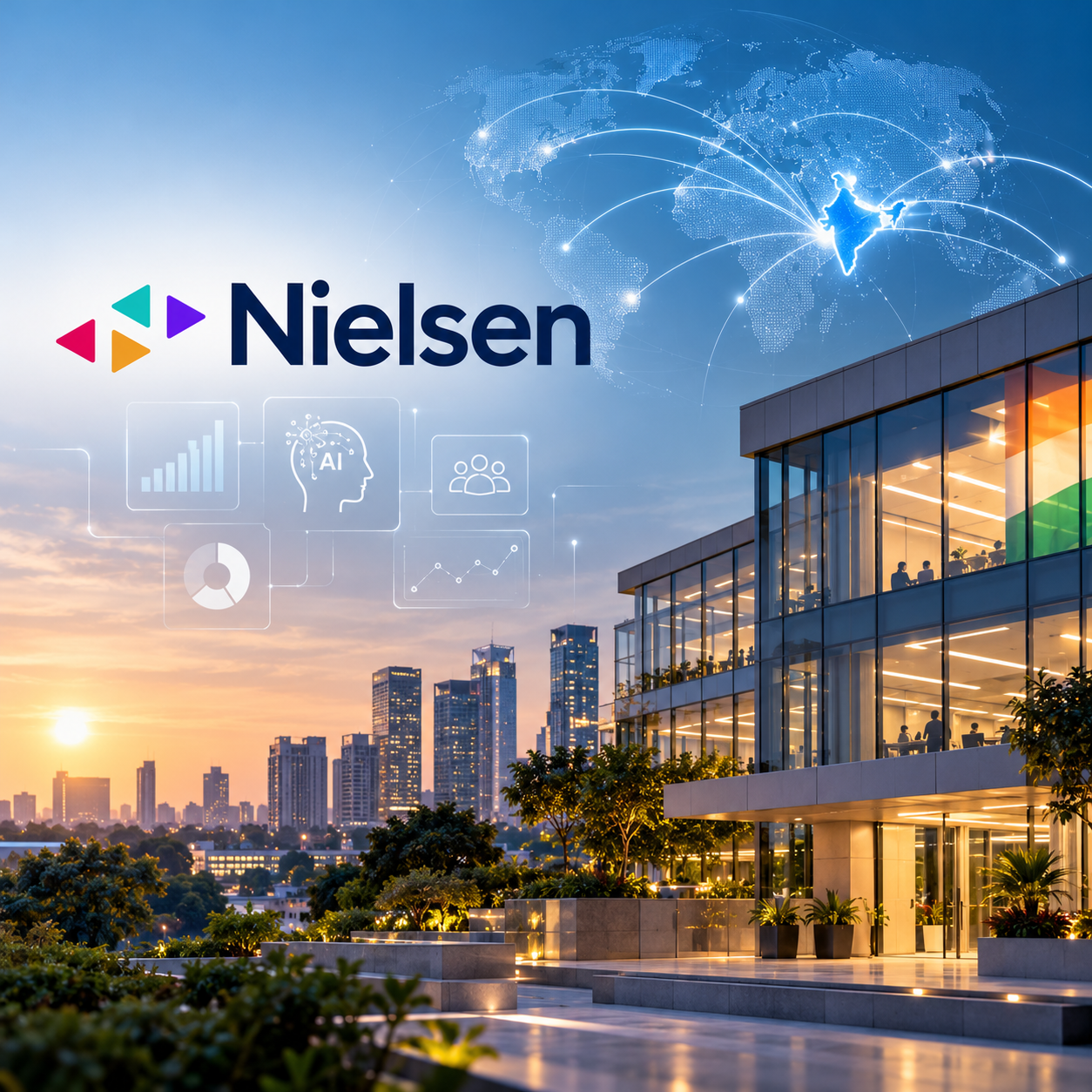

India now accounts for approximately 75% of Nielsen's global innovation activities, with the US-based audience measurement and data analytics company positioning the country as its primary centre for technology development, according to a recent report.
Nielsen employs more than 5,000 people in India, representing nearly half of its global workforce. Bengaluru serves as the company's largest innovation hub, supporting the development of artificial intelligence applications, advertising intelligence tools and audience measurement technologies.
Speaking to Moneycontrol, Nielsen Chief Technology Officer Anil Goel said the company's Indian operations were established to drive global innovation rather than function as a conventional global capability centre (GCC).
“We never really designed this (India operations) to be a global capability centre (GCC). We always designed it to be a global innovation centre,” Goel said.
Unlike traditional GCC structures, where local teams often support overseas operations, Nielsen's India-based teams lead product development, make technology decisions and engage directly with international clients.
Artificial intelligence has become a central component of this work, particularly in advertising intelligence, where Nielsen tracks advertising expenditure across television, radio, newspapers, magazines and outdoor media in approximately 30 to 40 major markets.
Previously, the company relied on a combination of automated systems and manual processing to collect and analyse advertising information. More than 1,000 employees were involved in handling tasks that existing technologies could not fully automate.
According to Goel, the adoption of AI and large language models has increased the proportion of work handled by machines from approximately 80% to 90% to between 97% and 98%, reducing the need for manual intervention in these processes.
Nielsen is also deploying AI to track brand visibility during sporting events and improve audience measurement across increasingly fragmented media environments.
These developments come as advertisers seek more comprehensive ways to evaluate campaign performance across television, streaming platforms, digital media and other channels.
The growing adoption of generative AI platforms, including ChatGPT, Gemini and Claude, is also changing how consumers discover information and interact with brands. AI-powered assistants and agents are introducing additional considerations for companies measuring audience engagement and advertising effectiveness.
Goel indicated that Nielsen is examining how its measurement systems can respond to these changes in consumer behaviour.
Although India currently contributes a relatively smaller share of Nielsen's global revenue, the company considers it among its top 10 markets for future growth potential.
Nielsen also expects its Indian operations to expand following the addition of DoubleVerify, which specialises in digital advertising verification, media quality and brand safety.
The company's emphasis on India-based product development places local engineering and technology teams at the centre of its international innovation activities.
For Nielsen, the strategy combines AI-led automation, advertising measurement and product development capabilities as it adapts its services to changes in media consumption and digital advertising.
Disclaimer: This article may include information derived from interviews, press releases, public statements, research, company communications and other publicly available or third-party sources. Such material may be summarised, paraphrased or contextualised for journalistic and editorial purposes. All rights in third-party content remain with their respective owners.