
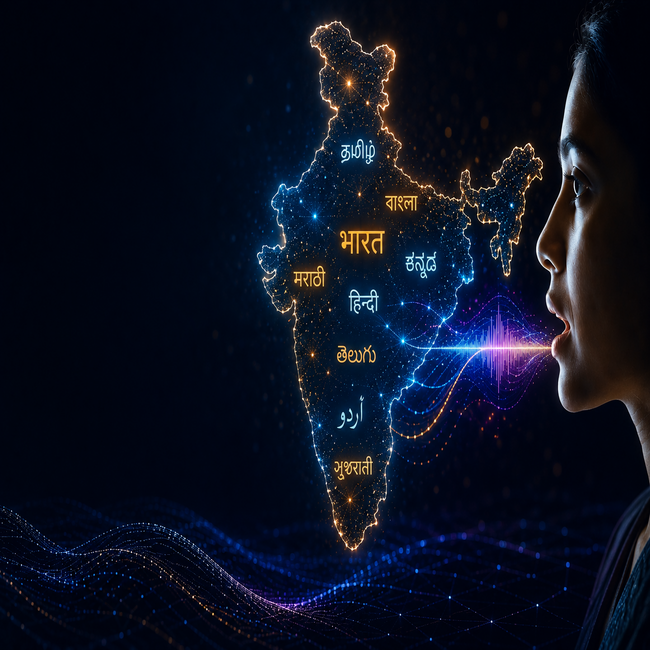

India's artificial intelligence ecosystem is moving towards multilingual and voice-first systems as developers, startups and government programmes seek to make AI accessible beyond English-speaking and text-heavy digital audiences.
The shift is increasingly visible across public digital infrastructure, agriculture, citizen services and locally developed foundation models, where voice and Indian-language capabilities are becoming central to product design.
India's linguistic diversity presents a distinct challenge for AI deployment. While conventional digital interfaces have historically relied heavily on English and typed interactions, emerging systems are being designed to understand spoken queries and respond across multiple Indian languages.
BHASHINI, India's national language technology platform, has become an important part of that infrastructure. Government data shows that the platform supports more than 36 text languages, 22 voice languages and over 350 AI language models. Its technology is being incorporated into public services to improve multilingual and voice-based access.
BharatGen represents another part of the domestic AI stack. Launched in June 2025, the government-funded sovereign multilingual and multimodal large language model supports 22 Indian languages and combines text, speech and document-vision capabilities. It has been developed using India-centric datasets for applications including governance, agriculture, healthcare and citizen services.
The voice-first approach is also moving into specific sectors.
Bharat-VISTAAR, an AI-powered Digital Public Infrastructure platform for agriculture, has been designed as a multilingual, voice-first service providing farmers with personalised information on crops, weather, markets and government schemes. Its first phase supports Hindi and English, with additional regional languages planned.
Voice interfaces can be particularly relevant for users with limited digital literacy or those who are more comfortable speaking than navigating conventional applications. In such cases, conversational AI can potentially reduce the number of steps required to access digital information.
India has also demonstrated an open-source multilingual AI prototype designed to operate in low or zero-connectivity environments. Developed in collaboration with the Digital India BHASHINI Division, Current AI and Kalpa Impact, the handheld device processes multilingual interactions locally rather than depending continuously on cloud connectivity.
The development of locally relevant AI also extends beyond language translation. Models intended for Indian users need to account for accents, dialects, cultural context and code-switching, where speakers move between languages during the same conversation.
For businesses and marketers, the transition could broaden how conversational interfaces are deployed across customer service, commerce, financial services and digital engagement. Instead of requiring consumers to navigate menus or type queries, brands could increasingly interact through conversational experiences in languages customers already use.
The change also has implications for AI product design. Global models can support multiple languages, but India's emerging AI infrastructure is placing greater emphasis on models and interfaces built around domestic datasets and local use cases.
As AI adoption moves beyond early users, accessibility is likely to become as important as model capability. India's expanding multilingual AI infrastructure suggests that the next stage of adoption may depend not only on what AI can do, but also on whether people can interact with it naturally in their own language.