
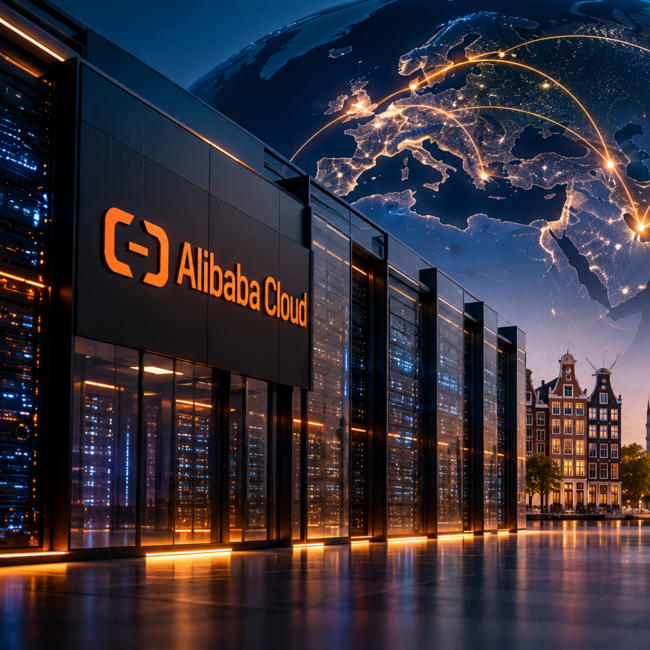

Alibaba Cloud is expanding its global infrastructure with new cloud regions and additional data centre capacity across Europe, the Middle East and Asia, as the company looks to support growing enterprise demand for artificial intelligence and cloud computing.
The cloud computing arm of Alibaba Group said it plans to establish its first cloud regions in Türkiye, Finland and the Netherlands over the next 12 months. It will also expand its existing data centre footprint in Germany, France, the United Arab Emirates, Malaysia and Hong Kong.
The expansion was announced at Alibaba Cloud's Apsara Conference 2026 in Hangzhou, China. The company said the additional infrastructure is intended to bring computing resources closer to customers and support enterprises moving AI applications from experimentation into larger-scale deployment.
The Netherlands is expected to be among the first markets covered under the latest expansion, with additional infrastructure planned across the other announced locations over the coming year.
Alibaba Cloud has been steadily increasing its international infrastructure as demand for computing capacity grows alongside generative and agentic AI adoption. Earlier this year, the company launched new infrastructure in markets including France, Malaysia, Japan and Brazil.
In France, Alibaba Cloud opened a cloud region with two availability zones in June, adding to its existing European infrastructure. The company has also been building capacity in other international markets as part of a previously announced $53 billion investment commitment covering AI and cloud infrastructure over three years.
The infrastructure push forms part of Alibaba's broader strategy to provide AI capabilities spanning computing infrastructure, cloud services, foundation models and enterprise applications. Its Qwen family of AI models is also being positioned as part of the company's full-stack AI offering.
Alibaba Cloud is additionally working with companies across different industries to expand the use of its cloud and AI technologies. At the conference, it announced collaborations involving companies including Panasonic Digital, Unity China, Indonesian logistics company Lion Parcel and Malaysia-based Loomi Entertainment Group.
For enterprises, having infrastructure closer to their operations can help address requirements around latency, resilience and data governance. These considerations have become increasingly relevant as organisations deploy AI applications that require substantial computing resources and process larger volumes of business data.
The latest expansion also increases Alibaba Cloud's presence in markets where global cloud providers are competing to supply the infrastructure required for AI workloads.
As enterprises move towards production-level AI deployments, Alibaba Cloud's planned infrastructure additions indicate a continued focus on extending its international cloud capacity while connecting its data centre network with its wider portfolio of AI models and services.
Disclaimer: This article may include information derived from interviews, press releases, public statements, research, company communications and other publicly available or third-party sources. Such material may be summarised, paraphrased or contextualised for journalistic and editorial purposes. All rights in third-party content remain with their respective owners.