
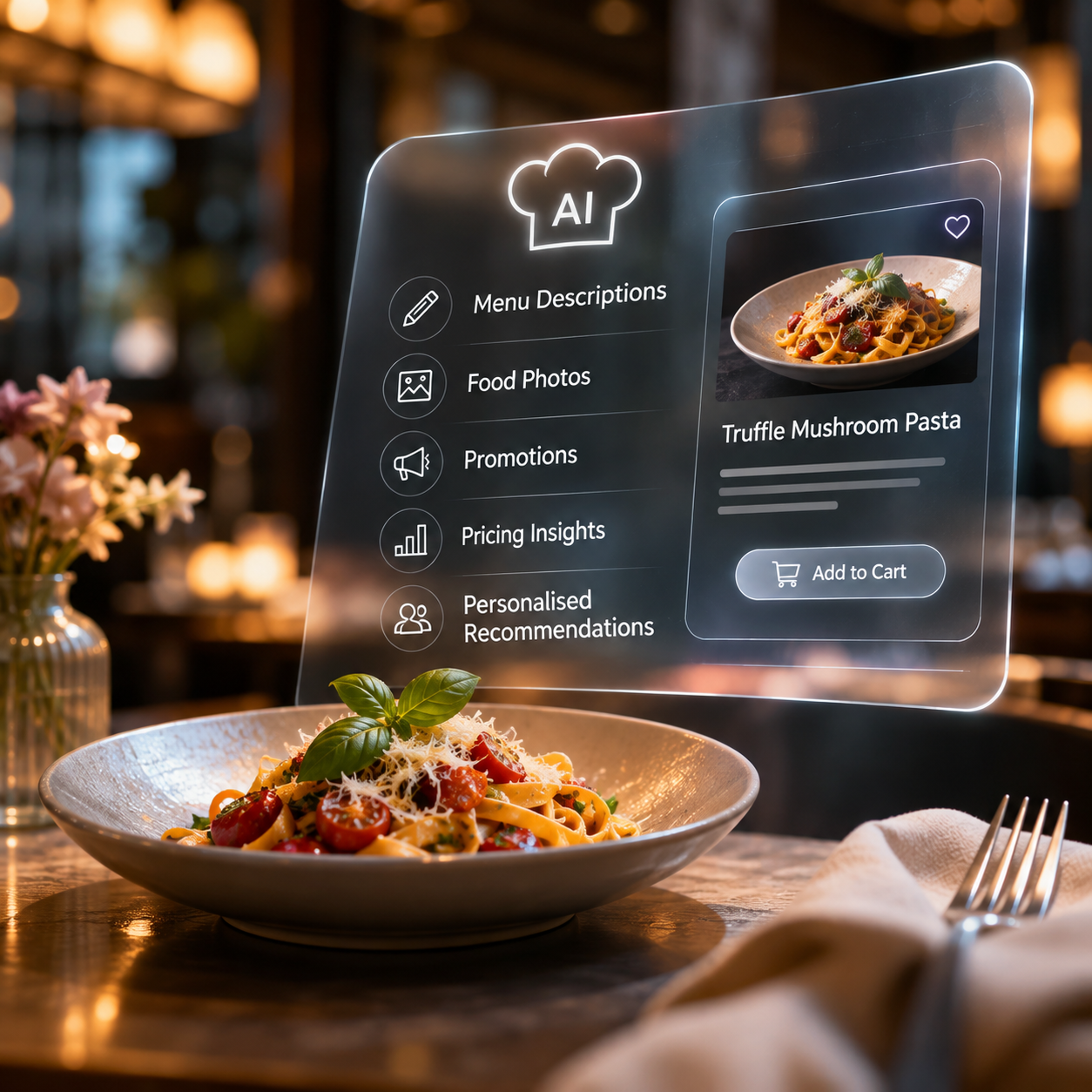

From writing food descriptions and improving menu photographs to recommending meals and creating personalised promotions, AI is becoming part of how restaurants market themselves. Recent 2026 research suggests that restaurants are increasingly using the technology to attract diners, manage digital menus and encourage repeat orders. However, questions remain about authenticity, pricing, customer trust and how much control operators should hand over to automated systems.
A customer scrolling through a food delivery application comes across a photograph of a burger, accompanied by a description highlighting its ingredients, flavour and portion size. The image looks appealing, the description is detailed and a meal combination appears below it.
What the customer may not know is that artificial intelligence could have helped create the photograph, write the description or recommend the combination.
Restaurants have traditionally relied on menu designers, photographers, copywriters and marketing teams to develop these materials. Smaller establishments often manage the same responsibilities themselves, alongside daily operations.
AI is beginning to change how that work gets done.
Restaurants can now use the technology to generate menu descriptions, improve food images, analyse popular dishes, prepare social media content and automate promotional messages. Some systems also help operators evaluate pricing and recommend changes based on ordering patterns.
The development is turning the restaurant menu into more than a list of dishes. It is increasingly connected to customer information, sales performance and digital marketing.
Toast’s 2026 Voice of the Restaurant Industry survey, conducted among 676 US restaurant operators and decision-makers, found that nearly nine in ten respondents were experimenting with AI.
Another 87% said they were comfortable using the technology, while 85% expected to increase their usage.
The survey covered businesses operating 16 or fewer locations, indicating that interest extends beyond major restaurant chains.
However, experimenting with AI does not necessarily mean restaurants have automated their menus or marketing operations.
The more immediate change is visible in the individual tasks operators are beginning to perform differently.
1. AI Is Changing How Restaurants Design, Describe and Price Their Menus
For restaurants, deciding what appears on a menu involves several considerations.
Operators must determine which dishes are popular, how prominently they should be displayed, whether combinations encourage additional purchases and how pricing affects profitability.
These decisions have traditionally depended on sales reports, customer feedback and periodic menu reviews.
AI can help analyse that information more frequently.
Flynn Group, a major restaurant franchise operator with more than 2,900 locations across brands including Taco Bell, Pizza Hut, Wendy’s and Applebee’s, has been exploring AI-powered consumer insights to inform menu and customer experience decisions.
Its approach combines information about purchasing behaviour, promotions, local circumstances and operational conditions.
Ashley Fenn, Vice President of Business Insights and Marketing at Flynn Group, explained the company’s ambition in a January 2026 interview with McKinsey.
“Being able to anticipate what customers want, when they want it, will hopefully lead to better customer engagement with the brand,” she said.
Such systems could eventually allow restaurants to highlight different items depending on customers’ preferences or previous orders.
For example, a customer regularly ordering vegetarian meals might receive more relevant recommendations, while someone purchasing food for a family could be shown larger combinations.
These are potential applications rather than features available at every restaurant.
AI is also being applied to menu performance analysis.
PepsiCo’s Menu platform uses information from ordering and point-of-sale systems to identify opportunities for operators to improve digital menus.
According to the company, the platform has supported more than one million menus. Its developing capabilities include suggesting meal combinations based on purchasing patterns, with accompanying descriptions, photographs and proposed prices for restaurant approval.
André Moraes, Head of the PepsiCo Digital Lab, described the technology’s role.
“AI is helping us deliver intelligence to our customers faster and scale these solutions,” he said.
The commercial significance lies in the connection between product presentation and ordering behaviour.
A dish placed prominently on a digital menu may attract more attention than one buried under several categories. Similarly, clearer descriptions or photographs may help customers understand what they are purchasing.
Pricing is another area attracting interest.
Popmenu’s 2026 restaurant trends research found that 31% of surveyed US restaurant operators were considering variable pricing based on factors such as demand, time of day or seasonality, compared with 22% the previous year.
However, variable pricing is not necessarily AI-driven. Operators may use conventional software or manual decisions to make such changes.
For restaurants experimenting with AI, the challenge is determining whether automated recommendations are commercially appropriate without confusing customers or undermining trust.
2. From Food Photos to Instagram Captions, AI Is Producing More Marketing Materials
A restaurant launching a new dish needs more than a menu description.
The same product may require photographs, delivery-platform listings, social media posts, promotional emails and advertisements.
Creating separate materials for every channel can be time-consuming, particularly for independent establishments with limited marketing resources.
Generative AI can assist by producing different versions of the same message.
A café introducing a seasonal dessert, for example, could use AI to draft its menu description, prepare an Instagram caption and create email copy announcing its availability.
The operator could then review and adapt those materials before publication.
Popmenu’s 2026 research, based on 328 US restaurant owners and operators and 1,000 consumers, found that 44% of surveyed operators had adopted AI.
Among operators surveyed, 55% reported using AI to write marketing content, while another 25% planned to adopt AI during the year.
The findings indicate that content production is becoming an established application of the technology among participating businesses.
Food photography is another area undergoing change.
AI-based image enhancement can improve lighting, presentation and backgrounds, while generative tools can produce new visuals for promotional materials.
In India, Swiggy previously introduced an AI-powered photoshoot feature to help restaurant partners improve menu images.
The initiative demonstrated how digital platforms can bring image-editing capabilities to operators who may not have access to professional food photographers.
However, enhancement and generation are not the same.
Improving the lighting in a photograph of an actual dish is different from creating an image that depicts food the restaurant has never prepared.
That distinction matters because customers use photographs to form expectations about portion size, ingredients and presentation.
Inaccurate images could lead to complaints when the delivered food looks substantially different.
Generated descriptions present similar concerns.
An AI tool might produce an appealing description but include an ingredient, dietary claim or preparation detail that is incorrect.
For customers with allergies or dietary restrictions, such mistakes can have consequences beyond dissatisfaction.
The availability of AI-generated marketing materials therefore increases the importance of human review, particularly where factual product information is involved.
3. Restaurants Are Now Competing for Visibility Inside AI Search
AI is also changing how customers discover restaurants before viewing a menu.
Instead of searching only through maps, delivery applications or conventional search engines, some consumers are asking conversational AI tools where they should eat.
A customer might request a quiet restaurant suitable for a family dinner, a café with vegetarian options or an affordable place serving a particular cuisine.
The AI system can then assemble recommendations using information available across digital sources.
DoorDash’s 2026 Restaurant Industry Trends Report, based on surveys of 3,001 US consumers and 509 restaurant operators, found that 22% of consumers had used tools such as ChatGPT or Gemini to help choose a restaurant.
The research also found that operators were responding by updating menu information, managing reviews and improving digital photographs.
This matters because restaurants can influence how accurately they are represented online, even though they cannot fully control which establishments an AI assistant recommends.
The menu becomes relevant beyond the restaurant’s website.
Opening hours, prices, dietary information, dish descriptions and customer reviews may all contribute to the information available for AI-generated responses.
The trend is also emerging in other markets.
An October 2026 report from hospitality technology provider Zonal and NIQ, involving more than 5,000 British consumers, found that 19% were already using AI tools to plan visits to pubs, bars or restaurants.
Half were considering using the technology.
Among existing AI users, 45% searched for reviews and ratings, 43% checked average food or drink prices and 38% used AI to view menus.
For restaurant marketers, the findings suggest another reason to maintain accurate digital information.
A customer asking an AI assistant for restaurants with gluten-free options, for example, may receive incomplete recommendations if menu information is missing or outdated.
The same applies to prices, locations and opening hours.
However, improving online information does not guarantee inclusion in AI-generated recommendations.
AI systems may draw from different sources, provide incomplete answers or display outdated information. Restaurants must therefore distinguish between making information accessible and controlling what the technology ultimately recommends.
4. Personalised Promotions Are Growing, but Human Oversight Remains Important
The influence of AI can continue after the customer places an order.
Restaurants increasingly collect information through reservations, loyalty programmes, digital payments and online ordering.
That information can help operators understand purchasing habits and develop more relevant promotional communications.
Instead of sending every customer the same discount, an AI-assisted system could recommend different offers based on ordering history or customer preferences.
Popmenu’s 2026 research found that 87% of surveyed operators were using technology to send personalised messages automatically, while 74% were conducting more location-specific marketing.
These figures describe technology-enabled personalisation and do not establish that every message was generated by AI.
Vaughan Dugan, Partner and Founder of Kapow! Noodle Bar and Craft & Counsel, described the importance of acting on customer information.
“Having data is one thing, but having the tools to follow up and do something with it is even more critical,” he said.
DoorDash’s research found that 63% of consumers said a personalised recommendation or follow-up had prompted them to return to a restaurant at least once during the previous six months.
The finding reflects self-reported behaviour, rather than independently measured incremental sales attributable to AI.
For restaurants, customer information can support more targeted campaigns, but frequent communication also creates risks involving consent, privacy and customer fatigue.
The wider industry is approaching implementation at different speeds.
The National Restaurant Association’s 2026 research, based on 212 restaurant operators, found that 38.6% were using AI tools.
Only 3.2% were implementing AI initiatives company-wide, while 20% were conducting smaller pilots.
Cost, complexity and customer acceptance were among the concerns identified.
Michelle Korsmo, President and CEO of the National Restaurant Association, described the transition.
“Restaurant technology is shifting from tools operators use to intelligence that helps run the business,” she said.
The findings suggest that widespread experimentation should not be confused with fully automated restaurant operations.
AI can assist with menu presentation, marketing production, customer recommendations and performance analysis. But restaurants still need employees to check information, assess customer responses and determine whether suggested actions suit the business.
A promotional photograph must resemble the food served. Menu descriptions must accurately reflect ingredients. Automated offers must be consistent with the restaurant’s pricing and customer policies.
For smaller establishments, AI may reduce the effort required to produce marketing materials. Larger chains may use it to coordinate decisions across locations.
Whether those applications improve sales, profitability or customer loyalty will depend on implementation and measurable results.
The restaurant menu is gradually becoming connected to a larger system of customer data, digital discovery and marketing activity. AI is helping operators decide how food should be described, presented and promoted, but the meal customers receive remains the test of whether those promises are accurate.
Disclaimer: All data points and statistics are attributed to published research studies and verified market research. All quotes are either sourced directly or attributed to public statements. This story uses five 2026 datasets from Toast, Popmenu, DoorDash, Zonal-NIQ and the National Restaurant Association, with four quotations from Ashley Fenn, André Moraes, Vaughan Dugan and Michelle Korsmo.