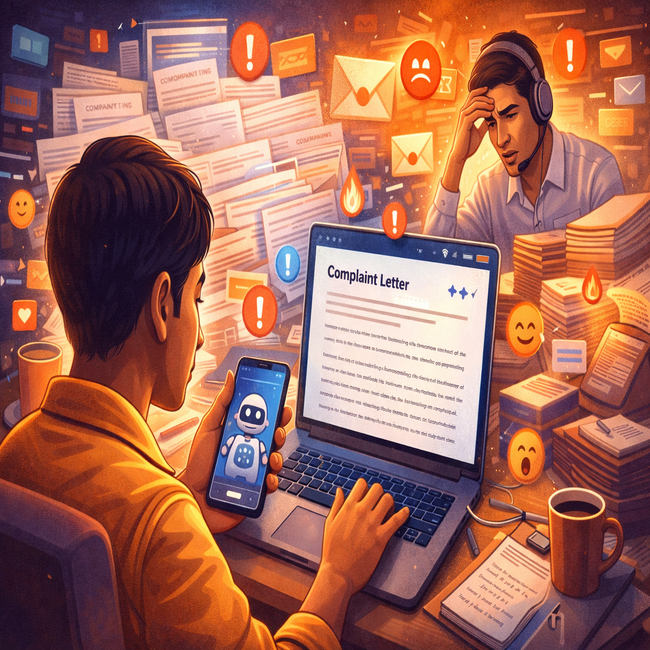

In call centers from Mumbai to New York, a new kind of customer grievance is appearing. Many complaints flooding into companies today are not written by angry customers themselves but by artificial intelligence. With a simple prompt, a frustrated shopper or bank customer can now generate a polished, legally toned, and highly persuasive complaint letter in seconds. This emerging trend of AI-powered customer complaint generation is reshaping relationships between brands and consumers, creating both new efficiencies and new anxieties in the service ecosystem.
For many consumers, this shift feels empowering. What once took time, skill and confidence can now be accomplished through a chatbot. But for companies, the sudden rise in detailed and formal complaints is a warning sign. Support teams are receiving messages that sound like they were drafted by lawyers, even when the underlying issue is minor. As a result, brands are being forced to re-examine how they identify, manage and respond to customer concerns in the era of generative AI.
The Global Surge in AI-Assisted Complaints
A major study by researchers at Yale University analyzed more than one million consumer complaints filed in the United States between 2020 and 2024. Their findings show a dramatic shift. Before 2022, essentially none of the complaints appeared AI-generated. By 2024, nearly one in ten showed clear signs of being written with the help of generative AI tools.
Even more striking, these AI-crafted complaints were more effective. The researchers found that AI-assisted grievances resulted in positive resolutions about half the time, compared to roughly forty percent for complaints written without AI support. This difference was not due to exaggeration or falsehoods but to improved clarity and structure. According to the study, generative models help consumers articulate issues more clearly and use correct terminology, improving their chances of a successful outcome.
In many ways, AI is leveling the playing field for consumers who struggle with writing, legal vocabulary or formal email tone. The study noted that large language models give people a stronger voice, especially those who previously lacked the language or confidence to challenge companies.
Companies are, however, beginning to feel the pressure. Customer experience consultant Andrew Moseley explains the dilemma. He has observed that service teams are dealing with higher volumes of longer, more complex complaints. According to him, the rise is not necessarily because real complaints have increased but because AI is extremely helpful and extremely thorough. A customer who once wrote two lines about a refund may now send a perfectly structured, multi-paragraph letter citing company policies and regulations because the AI automatically includes every plausible detail. Moseley describes this as the kitchen-sink effect, where AI includes every argument it can generate without knowing which points are relevant.
A New Twist in Public Services and Schools
This trend is not limited to corporations. Schools and local authorities in several countries have reported receiving AI-crafted complaints from parents about policies, assignments or administrative changes. These letters often read like legal briefs, packed with references to rights, regulations and procedural language. Administrators say such complaints require longer responses and sometimes legal consultation, even when the underlying issue is relatively minor.
Some principals describe hours spent crafting sensitive replies, only to receive a follow-up grievance clearly written by AI and ignoring their answers entirely. This pattern suggests a future where disputes could escalate into chains of AI-generated letters exchanged between parents and institutions, blurring the lines between genuine concern and automated escalation.
India’s Experience: A Rapid Increase in AI-Written Complaints
India, one of the world’s most active digital consumer markets, is already deep into this shift. Sectors like e-commerce, banking, fintech and telecom are reporting a sharp rise in AI-drafted complaints. A shopper waiting for a delayed refund or a frustrated mobile subscriber can now ask an AI tool to craft a strong complaint letter referencing guidelines, consumer rights or ombudsman rules. These messages used to be rare. Today, they appear in company inboxes daily.
The Indian government is responding proactively. The Ministry of Consumer Affairs has been working on integrating ChatGPT-powered complaint assistance into the National Consumer Helpline. The aim is to help ordinary citizens frame clear, formal complaints by simply describing their issue through chat or voice. Early results are dramatic. Monthly complaint volumes on the helpline have increased more than tenfold over the past decade, rising from around twelve thousand cases in 2015 to more than one hundred fifty thousand in late 2024.
AI has also accelerated resolution times. The average time taken to resolve consumer complaints has fallen from about sixty six days in 2023 to forty eight days in 2024 because AI tools help categorize issues faster and route them to the appropriate business or department.
Banks are under similar pressure. In a public address, Reserve Bank of India Governor Sanjay Malhotra noted that ninety five banks collectively received more than ten million consumer complaints in a single year. He warned financial institutions that complaint volumes will continue rising if they do not improve their systems. He encouraged them to use AI for pattern detection to identify emerging problems quickly before customers escalate matters publicly.
How Brands Are Responding
Companies are learning to adapt. Many are training customer service teams to remain calm when faced with highly polished complaint letters. A telecom customer service head explained that when tackling AI-generated messages, the priority is always to focus on the underlying issue, not the sophistication of the letter. He noted that if several customers send almost identical complaints, the company assumes they used the same AI prompt, but it still responds to each case on its merit.
Some brands are experimenting with AI detection, not to dismiss complaints but to add context for support staff. If an email appears unusually formal or contains legal language rarely used by consumers, agents are briefed on how to respond clearly and empathetically without sounding robotic in return. Companies fear that a mechanical reply to an AI-written complaint could create a negative impression if shared widely on social media.
Social media remains a sensitive battleground. Indian consumers frequently post screenshots of their grievances online. According to multiple customer service surveys, a large majority of Indians are willing to share negative experiences publicly if they feel ignored by a company. With AI assistance, these posts can be far more articulate and persuasive than before, increasing the reputational risk for brands.
ServiceNow India Managing Director Sumeet Mathur has pointed out that new AI tools have raised customer expectations sharply. According to him, more than eighty percent of Indian consumers now expect faster and more personalized service responses. This means brands must embrace AI not only to interpret complaints but to respond quickly and consistently.
Ethical Questions and Potential Misuse
While AI-enabled complaints empower consumers, the trend raises concerns. One issue is volume inflation. If it becomes too easy to write a compelling complaint, consumers might submit grievances for minor inconveniences, overwhelming support teams and delaying legitimate cases.
Another question is authenticity. If companies begin to doubt the sincerity of highly polished complaints, they may respond more cautiously or skeptically, weakening trust between consumers and businesses. There is also the risk of malicious use. A disgruntled individual could flood a company with dozens of AI-authored complaints, creating an illusion of widespread dissatisfaction.
Legal and HR experts warn that clarity is crucial. One HR official commenting on AI in grievance processes noted that overly formal AI-generated complaints can be misleading because they magnify issues that may not be as serious as implied. He urged organizations to focus on factual claims rather than the tone of the message.
On the positive side, AI can be a powerful accessibility tool. Consumers who struggle with literacy, disabilities or language barriers can now express concerns clearly. This could lead to fairer outcomes and force companies to improve service quality consistently.
A Future of AI to AI Interactions
Industry insiders believe that routine disputes may soon be handled by AI systems end to end. A customer could describe a billing issue, and the system would generate a formal complaint. A company AI could respond instantly with a resolution or request for clarification. Human agents would intervene only for complex or sensitive cases.
But most experts agree that human oversight will remain essential. Consumers still prefer dealing with people for serious financial or health related issues. Without careful oversight, two AI systems could misunderstand each other and escalate a simple issue into a more complicated dispute.
Marketing leaders are emphasizing the need to balance automation with empathy. As one Indian customer experience executive put it, happy customers are loyal customers regardless of whether their gratitude was typed by a person or suggested by an AI tool. Companies that can combine efficient AI workflows with human sensitivity will be best positioned to navigate this new age of empowered complaining.
AI-powered customer complaint generation represents a major shift in how consumers interact with brands. It gives individuals new confidence and clarity. It challenges companies to respond faster and more thoughtfully. And it raises important questions about fairness, authenticity and responsibility.
The companies that succeed in this new environment will be those that take complaints seriously, invest in responsive systems and treat every grievance as an opportunity to learn. As AI becomes a standard part of how people voice concerns, brands must evolve while keeping their core promise intact. Listening, acknowledging and resolving issues promptly will matter more than ever in a world where every customer now has the power of perfect writing at their fingertips.
Disclaimer: All data points and statistics are attributed to published research studies and verified market research. All quotes are either sourced directly or attributed to public statements.
Related Articles