
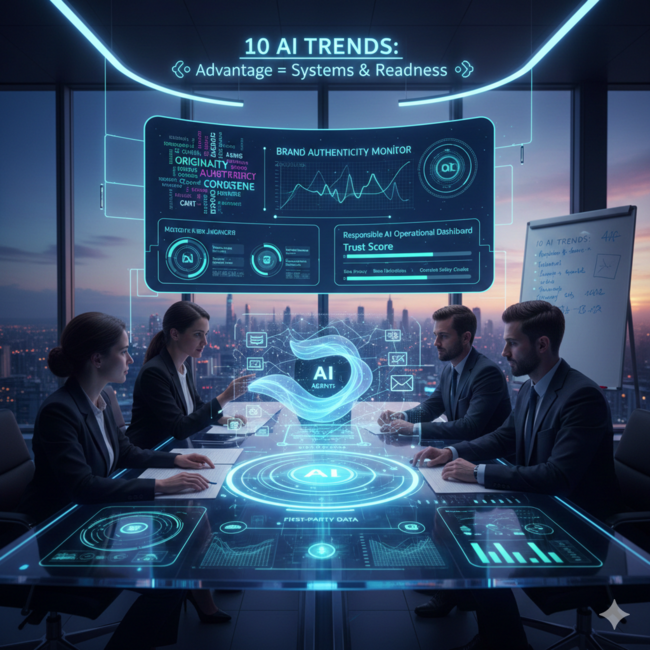

AI in marketing has officially moved past the “wow” phase. The novelty of generating a campaign headline in seconds is no longer the story. The real shift is happening deeper inside organizations, where AI is changing how marketing teams operate, how work gets executed, how decisions get made, and how customer experiences get designed.
What defines the next era is not simply adoption. It is advantage. And advantage will belong to the brands that build AI into systems, workflows, governance, and measurement, not just into content creation.
Here are 10 trends that are shaping what marketing will look like next.
1) From AI assistants to AI agents that execute marketing work
The first wave of AI in marketing was assistive. It helped teams draft content, summarise insights, generate ideas, or speed up repetitive tasks. The next wave is more consequential. AI is increasingly being deployed as agent-like systems that can plan, coordinate, and complete multi-step workflows.
In marketing terms, that means AI is moving from “help me do this” to “do this end-to-end under my supervision.” Instead of generating a campaign concept, AI systems are being designed to create a full journey: build segments, recommend channels, draft creatives, run variations, monitor performance signals, and flag what needs intervention.
This is not full autonomy. Human oversight still matters. But the direction is clear: marketing execution is becoming faster, more continuous, and more system-driven.
2) The competitive edge will come from workflow redesign, not AI access
Many teams now have access to similar AI models and tools. The difference between winners and everyone else is shifting toward operating model maturity. AI does not automatically make marketing better. It makes marketing faster. And speed without structure creates chaos.
High-performing teams are redesigning workflows around AI. They are changing how briefs are written, how creative is reviewed, how approvals work, how experimentation happens, and how learning loops are institutionalised. In practical terms, they build repeatable playbooks. They define where human judgement is mandatory. They enforce quality checks. They align AI output to brand voice and legal requirements.
AI success is becoming less about which tool you use and more about how your organization works.
3) Personalisation will become deeper, and more complex
Personalisation is entering a new phase. For years, marketing teams personalised based on segments, product recommendations, and triggered journeys. Now AI is enabling more dynamic, contextual personalisation across interactions.
Customers increasingly expect brands to remember preferences, make recommendations that feel accurate, and reduce friction across channels. AI can help create that experience at scale by generating content variants, adapting messaging by context, and optimising next-best actions.
But deeper personalisation brings complexity. It raises questions about consent, relevance, and customer comfort. The line between helpful and intrusive is thin. The brands that win will be the ones that personalise with restraint, transparency, and control.
4) First-party data strategy will separate serious marketers from casual adopters
AI needs fuel. The quality of outputs depends on the quality of inputs. In marketing, that input increasingly depends on first-party data: customer behaviour, preferences, transactions, intent signals, support interactions, and consented profile information.
As third-party cookies and external signals become less reliable, brands are doubling down on building direct customer relationships, improving data collection ethics, and strengthening identity resolution.
The next era of AI marketing will not be driven by the best prompts alone. It will be driven by the best data foundation.
5) AI will become a native layer inside the marketing stack
AI is not just being bolted onto marketing tools anymore. It is becoming embedded across the stack.
This shift matters because it changes how marketing works day-to-day. AI becomes the default interface for segmentation, reporting, journey creation, and creative iteration. Marketers will increasingly operate through natural language prompts and guided workflows rather than complex dashboards.
The stack will also reorganise itself around AI readiness: unified data pipelines, real-time activation, strong governance, and a clean integration layer across CRM, CDP, analytics, commerce, and media systems.
In short, AI will stop being “a tool marketers use” and start becoming “the operating system marketers work within.”
6) Adtech and martech will converge faster than most teams are ready for
The boundary between performance marketing and lifecycle marketing has been blurry for years. AI will accelerate that convergence.
Marketers are increasingly expected to connect acquisition, conversion, retention, loyalty, and advocacy into one measurable growth system. AI makes this possible because it can model cross-channel paths, recommend budget shifts, and attribute impact more intelligently than traditional rule-based systems.
This convergence also forces a cultural shift. Performance teams and CRM teams can no longer operate in silos. If a brand wants unified customer journeys, unified measurement must follow. And that requires new cross-functional workflows and shared KPIs.
7) Marketing measurement will evolve from reporting to prediction
For decades, measurement has been backward-looking. Dashboards tell you what happened. AI changes the purpose of analytics from “explain the past” to “predict the future.”
Marketing teams will increasingly rely on AI to forecast outcomes: which segments are likely to churn, which customers are likely to convert, which campaigns will saturate, and which channel combinations will deliver incremental lift.
The shift to predictive insight changes planning cycles. It also changes resource allocation. Instead of reacting late, marketers will act earlier, intervening before performance declines.
However, prediction introduces risk when teams blindly trust outputs. The best teams will validate models, monitor drift, and treat AI predictions as decision support rather than certainty.
8) Content supply will explode, but brand authenticity will become the differentiator
Generative AI makes content abundant. Brands can now create thousands of variations of ads, emails, landing pages, and social formats rapidly.
But abundance creates a new challenge. When everyone can produce more content, content volume stops being an advantage. The differentiator becomes clarity. Brand voice. Distinctiveness. Creative originality. Consistency.
In the next era, marketing leaders will build systems that scale content while protecting identity. The best brands will have strong content governance, defined tone frameworks, and clear creative guardrails. AI will help create more, but humans will remain responsible for what matters: taste, differentiation, and trust.
9) Responsible AI will become operational and unavoidable
Responsible AI is moving from a compliance conversation into day-to-day marketing operations.
This includes issues like hallucinated claims in copy, biased targeting logic, unsafe creative outputs, misuse of customer data, lack of transparency, and brand safety risks. Marketing is one of the fastest areas where AI touches the public directly, which makes accountability critical.
The next era will see stronger governance models inside marketing teams: clear review processes, safety checks, approvals for sensitive content, policies for data use, and training for marketers to understand risks.
Responsible AI will not slow innovation. It will make it scalable.
10) The marketing organization will change: new roles, new skills, new expectations
AI will change what marketing teams look like. Not just in tools, but in talent.
Some roles will become more strategic because execution gets automated. Others will become more technical because AI requires system thinking. Teams will need people who can design workflows, manage data, evaluate model outputs, run experiments, and build learning loops.
We will also see the rise of hybrid profiles: marketers who understand analytics deeply, product marketers who can operate AI agents, creative leaders who can guide generative pipelines, and growth teams who can combine automation with experimentation.
AI will not replace marketing. But it will redefine who thrives in marketing.
What this means for marketing leaders
The next era of marketing will not be won by AI adoption alone. It will be won by readiness. Readiness in data, workflows, governance, measurement, and talent.
AI is turning marketing into a system that learns faster, executes faster, and scales faster. The brands that treat AI as a strategic transformation, rather than a productivity hack, will build compounding advantage.
Because the future of AI marketing is not about doing the same things faster.
It is about doing different things entirely.
Disclaimer: All data points and statistics are attributed to published research studies and verified market research. All quotes are either sourced directly or attributed to public statements.
Related Articles


