
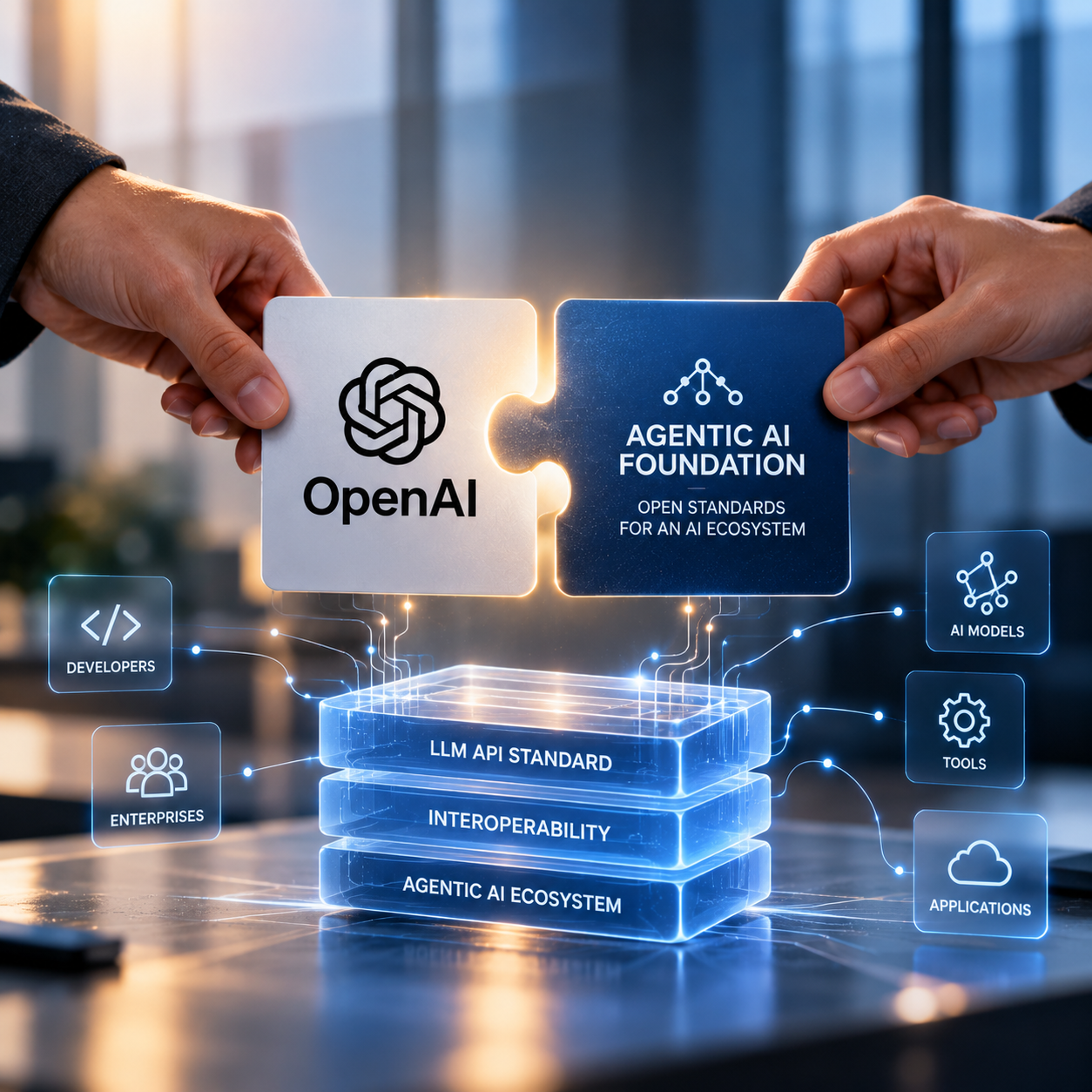

OpenAI has donated its Open Responses API specification to the Agentic AI Foundation (AAIF), an open-source initiative under the Linux Foundation, in a move aimed at simplifying how developers integrate large language models (LLMs) from different providers into applications.
Announced on October 22, 2026, the contribution seeks to establish a common interface for interacting with AI models, reducing the need for developers to maintain separate integrations for different platforms.
The Open Responses specification defines shared formats for core functions such as messages, tool calls, function calling and streaming responses. These capabilities are widely used across LLM platforms, although providers often implement them through different API structures.
By introducing a standardised approach, the specification aims to make it easier for developers to build applications that work across multiple AI models without extensively modifying their existing integrations.
The initiative is particularly relevant to enterprises developing AI agents and automated workflows that depend on different models, tools and external systems.
According to OpenAI, Vercel AI Gateway and Databricks Model Serving have already implemented the specification. Other supporters include Amazon Web Services, Hugging Face, NVIDIA, Red Hat, Ollama, LM Studio, OpenRouter and open-source projects such as vLLM.
The contribution places Open Responses under the foundation's vendor-neutral governance structure, allowing developers and technology providers to participate in its continued development.
The Agentic AI Foundation was established in December 2025 by OpenAI, Anthropic and Block, with support from companies including Google, Microsoft, AWS, Bloomberg and Cloudflare.
Its initial projects included Anthropic's Model Context Protocol (MCP), OpenAI's AGENTS.md and Block's open-source AI agent framework, goose.
Alongside Open Responses, the foundation has announced the addition of three other projects: Anthropic's Agent Skills, Hugging Face's OpenEnv and Alibaba's OpenSandbox.
These projects address different components of agentic AI development, including reusable agent capabilities, training environments and secure execution infrastructure.
The latest additions bring the foundation's portfolio to 10 hosted projects, reflecting growing industry interest in shared technical standards for AI systems.
However, the Open Responses specification has not been universally adopted. Anthropic continues to maintain its Messages API, while Google provides its Interactions API for developers.
The existence of different interfaces means developers may still need provider-specific integrations, depending on the models and services they use.
For enterprise technology teams, a common API specification could reduce integration complexity when deploying AI applications across multiple providers. It may also support greater flexibility when evaluating or changing models within existing workflows.
The development comes as businesses increasingly explore agentic AI for software development, customer service, workflow automation and other operational functions.
Open Responses will now be developed within the foundation's collaborative governance framework, with broader adoption dependent on implementation by model providers, developers and enterprise technology platforms.
Disclaimer: This article may include information derived from interviews, press releases, public statements, research, company communications and other publicly available or third-party sources. Such material may be summarised, paraphrased or contextualised for journalistic and editorial purposes. All rights in third-party content remain with their respective owners.