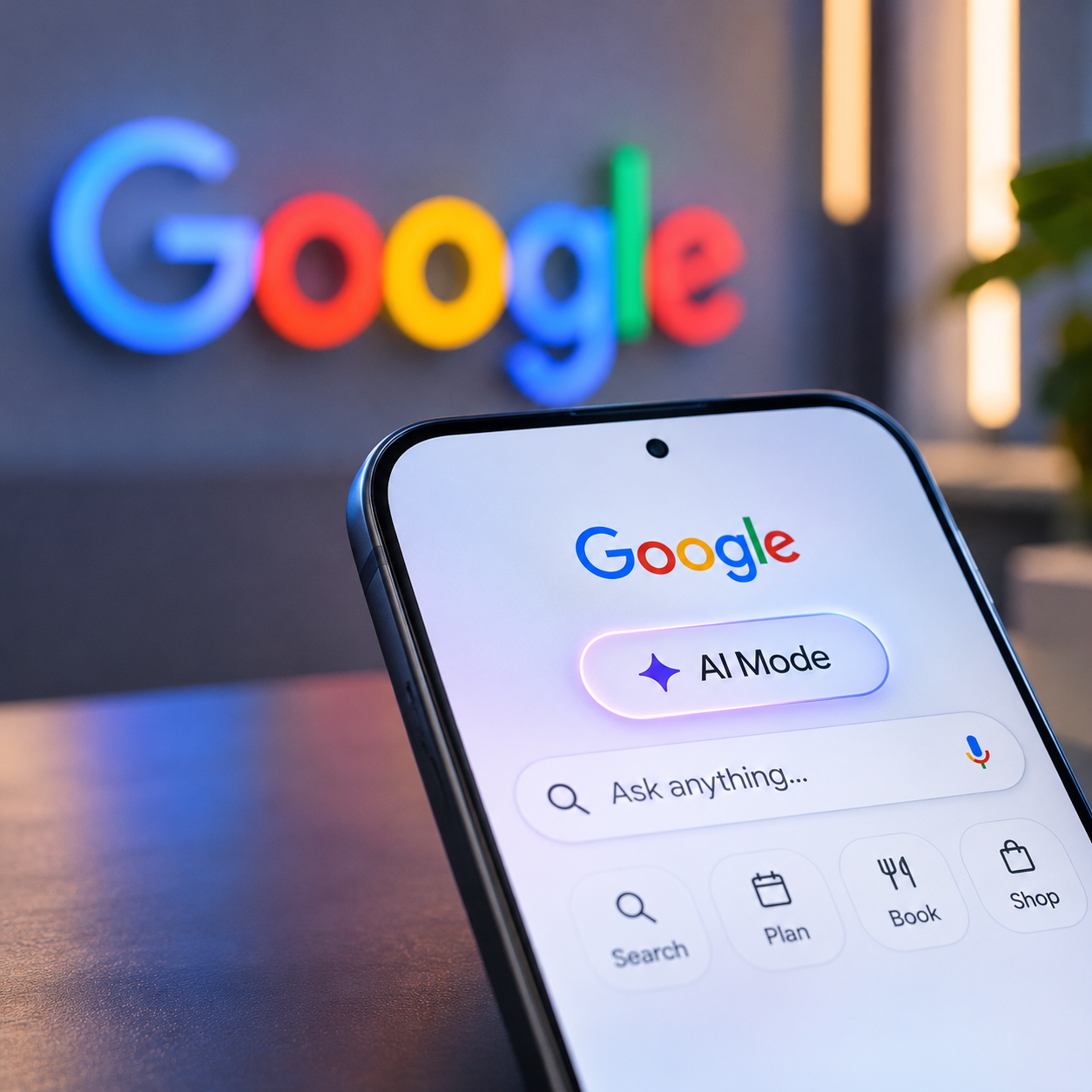

Google has reported its strongest year-on-year search query growth in five years, driven partly by increased usage of artificial intelligence-powered search features. However, the company acknowledged that its AI Mode currently generates lower advertising revenue per query than traditional Search, highlighting differences in how the two experiences are monetised.
During Alphabet's third-quarter 2026 earnings call, Google executives outlined plans to expand AI-powered search capabilities while introducing more advertising formats and developing AI agents capable of completing tasks on behalf of users.
Google Chief Executive Officer Sundar Pichai said the company's investments in AI were contributing to increased search activity, including queries with commercial intent.
"Search has strong momentum. Our AI investments are driving increased usage and overall query growth, including commercial queries," Pichai said.
The company reported that Google Search revenue increased 12% year-on-year to $63 billion during the quarter. However, growth moderated compared with the previous quarter.
Philipp Schindler, Google's Senior Vice President and Chief Business Officer, attributed the slowdown primarily to foreign exchange movements. He also acknowledged that growing AI Mode usage affected revenue growth because the feature was generating lower monetisation rates.
Google is expanding advertising within AI Overviews and AI Mode to additional users and search queries. The rollout includes international markets and multi-turn advertisements in the United States, where advertising can appear during extended interactions with AI-powered search.
The company said early advertising experiments had produced encouraging results, although it did not disclose a timeline for AI Mode to achieve monetisation levels comparable with conventional Search.
Beyond advertising, Google is developing Search into a platform that can help users complete tasks rather than only retrieve information.
Pichai outlined applications including restaurant reservations, appointment scheduling, form completion and purchases. These functions would allow users to move from requesting information to taking action through AI-powered interfaces.
The company plans to extend these capabilities across Google Search, Gemini, Chrome, Android and Workspace, connecting AI agents with its existing products.
According to Pichai, agents will operate as a common layer across these services, enabling users to carry out more complex activities through Google's ecosystem.
The transition also raises questions for publishers and website operators whose traffic depends on referrals from traditional search results.
As AI-powered interfaces provide answers and increasingly support transactions directly, users may have fewer reasons to visit external websites for certain activities. However, Google did not provide specific figures on how these developments have affected publisher referral traffic.
The earnings discussion indicates that Google is pursuing two priorities: increasing AI-driven search engagement and developing advertising formats that can support the changing experience.
For advertisers, publishers and search marketers, the expansion of AI Mode and agent-based services introduces changes to how users discover information, interact with businesses and complete commercial activities online.
This captures the central earnings disclosure and uses search-relevant terms without implying that Google's overall search advertising revenue declined.
Disclaimer: This article may include information derived from interviews, press releases, public statements, research, company communications and other publicly available or third-party sources. Such material may be summarised, paraphrased or contextualised for journalistic and editorial purposes. All rights in third-party content remain with their respective owners.
Related Articles