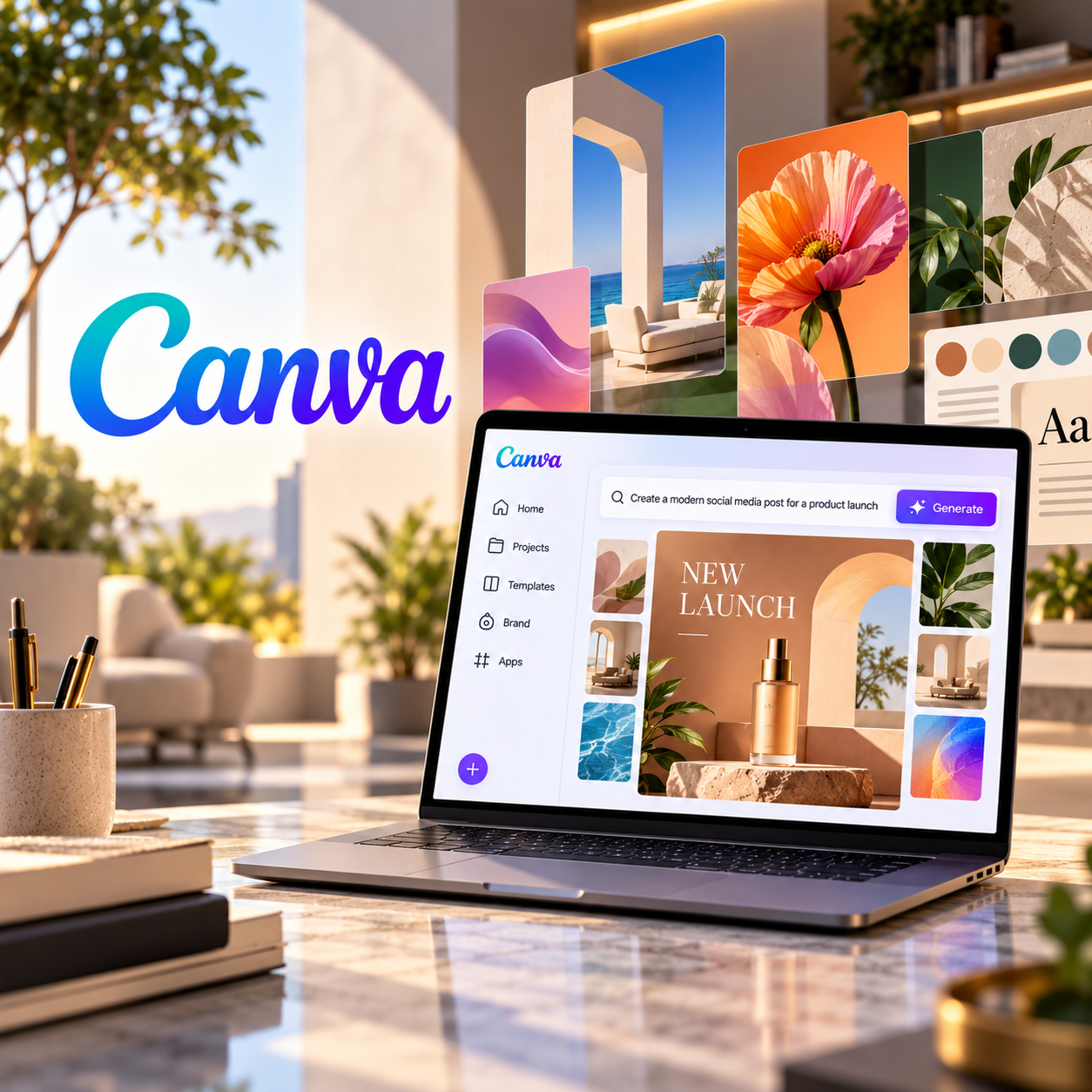

Design platform Canva has launched Canva Craft, its first in-house artificial intelligence image generation model, as the company expands its generative AI capabilities and enters a market currently served by technology companies including OpenAI, Google, Meta and ByteDance.
Developed by Canva's research team, the model is designed to generate images for creative and professional applications, including marketing campaigns, social media content, presentations and other visual communication formats.
Unlike conventional image generation systems that primarily focus on producing photographs or illustrations, Canva Craft has been developed with an emphasis on design composition, text placement and the ability to modify individual elements.
According to the company, the model follows a two-stage generation process. It first interprets a user's prompt and develops a plan covering the arrangement of objects, their relative sizes, visual hierarchy and text requirements.
The second stage uses this information to generate an image with a resolution of up to 2K across approximately 30 aspect ratios, allowing users to create content for different digital platforms.
Canva said the approach is intended to improve the accuracy of visual details and text rendering while enabling users to make targeted changes without affecting unrelated elements of a design.
The company has also taken a different approach to training the model. Rather than relying primarily on photographic datasets, Canva Craft was trained using human-created designs from its existing template library.
These include posters, social media graphics, presentations, infographics, menus and other layouts containing typography and multiple visual elements.
Images produced using Canva Craft can be converted into editable layered designs through Canva Magic, the company's image-to-design technology. This allows users to modify elements of AI-generated visuals within Canva's existing editing environment.
The model is available to Canva users through the Dream Lab section of the platform, with access also being extended through the Canva API.
Canva plans to support image generation through third-party AI assistants, including ChatGPT and Google Gemini, using its Model Context Protocol integration.
The company has also announced plans to introduce two additional versions, Craftfast and Craft-ultrafast, which are being developed to offer more cost-efficient image generation.
Researchers from Leonardo.ai, the generative AI company acquired by Canva in 2024, contributed to the development of the new model.
By developing its own image generation technology, Canva aims to gain greater control over processing costs, output quality and generation speed, reducing its dependence on external AI model providers.
The launch comes as design software companies increasingly integrate generative AI into creative workflows, particularly for businesses producing digital marketing materials at scale.
Canva has not announced a release date for the two faster model variants or confirmed when third-party chatbot integrations will become available.
Disclaimer: This article may include information derived from interviews, press releases, public statements, research, company communications and other publicly available or third-party sources. Such material may be summarised, paraphrased or contextualised for journalistic and editorial purposes. All rights in third-party content remain with their respective owners.