
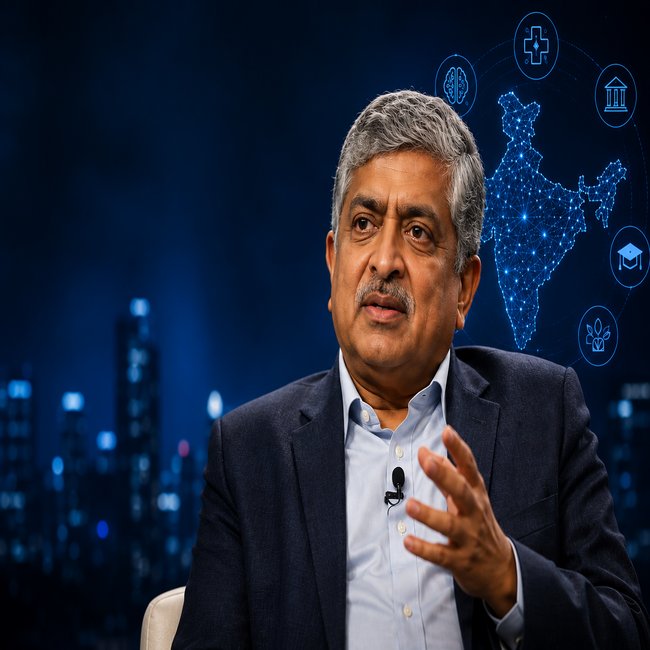

India should focus on becoming the world's leading hub for artificial intelligence use cases rather than attempting to compete in semiconductor manufacturing, Infosys co-founder and chairman Nandan Nilekani has said, arguing that the country's biggest opportunity lies in building AI applications that solve real-world problems at scale.
Speaking at an AI-focused event, Nilekani said India should leverage its digital public infrastructure, entrepreneurial ecosystem and large user base to accelerate AI adoption across sectors such as healthcare, education, agriculture, financial services and governance. Instead of entering the capital-intensive race to manufacture advanced AI chips, he said India can create greater economic value by developing practical AI-powered solutions that address everyday challenges.
According to Nilekani, the next phase of artificial intelligence will be defined not only by breakthroughs in foundation models but also by the ability to deploy those technologies effectively across industries. He said India has the potential to become the global centre for AI experimentation, where governments, startups and enterprises collaborate to develop scalable applications that reach millions of users.
His comments come as countries worldwide continue investing heavily in semiconductor manufacturing to secure AI infrastructure. While governments including the United States, China and members of the European Union have committed billions of dollars to chip fabrication and advanced computing capacity, Nilekani suggested that India's comparative advantage lies elsewhere. Rather than competing directly with established semiconductor ecosystems, he said India should prioritise innovation in AI deployment and digital services.
Nilekani has consistently advocated an application-first approach to AI. Earlier, he said India should not attempt to win the race to build the next generation of large language models, but instead focus on ensuring AI technologies become widely accessible and useful for citizens, businesses and public institutions. He has also argued that open digital infrastructure and widespread experimentation will play a crucial role in accelerating AI adoption across the country.
The remarks align with his broader vision of building population-scale AI applications on top of India's existing digital public infrastructure, including Aadhaar, Unified Payments Interface (UPI), DigiLocker and the Open Network for Digital Commerce (ONDC). Industry observers believe these platforms provide a foundation for creating AI-powered services that can operate at national scale while addressing local needs.
India has stepped up its AI ambitions over the past year through initiatives under the IndiaAI Mission, investments in computing infrastructure and support for indigenous AI models. Several startups and technology firms are also building AI solutions tailored to Indian languages, financial services, healthcare and public administration. Analysts note that while semiconductor manufacturing remains strategically important, AI adoption across enterprises and public services could deliver faster economic impact in the near term.
Nilekani also highlighted the importance of widespread participation in AI development. He said startups, established enterprises, academic institutions and government agencies should all contribute to building practical AI applications that improve productivity and public service delivery. Broad-based experimentation, he argued, will enable India to create solutions that can later be adapted for international markets.
The emphasis on AI use cases reflects a growing trend across the global technology industry. As foundation models become more widely available, competitive differentiation is increasingly shifting towards industry-specific applications, workflow automation and enterprise deployment. Organisations are placing greater focus on demonstrating measurable business outcomes rather than developing foundational AI models from scratch.
Nilekani's comments add to the ongoing discussion around India's role in the global AI ecosystem. While the country continues to invest in digital infrastructure and computing capabilities, he believes its greatest opportunity lies in building scalable, inclusive AI applications that can solve problems for businesses, governments and citizens, positioning India as a global leader in AI implementation rather than chip production.