
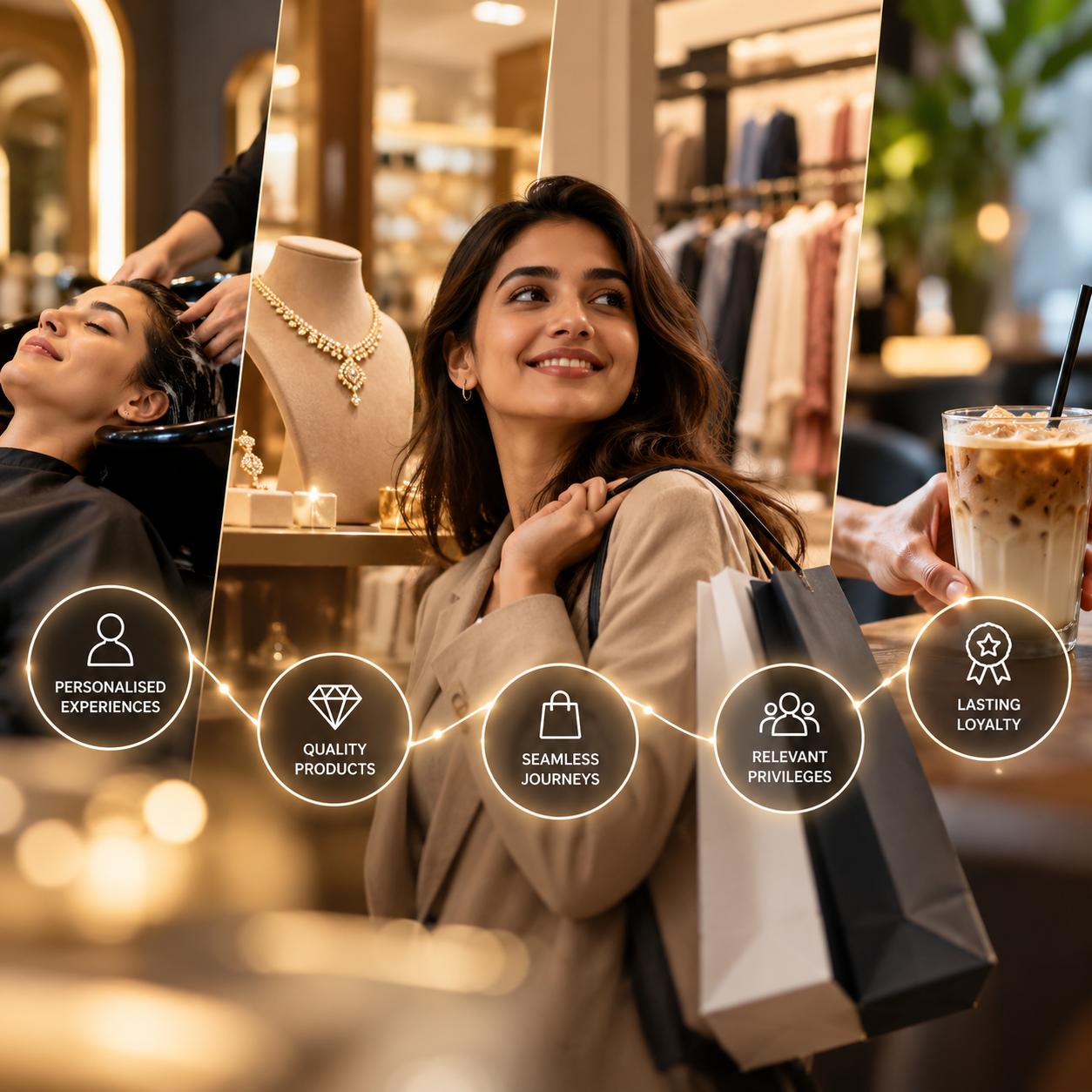

A familiar welcome, an effortless purchase, a product that keeps its promise-Customer Experience Leaders share their insights on why customers return long after the offer ends
A customer returns to a salon because someone remembers how they like their hair. They choose a jeweller because the brand understands the traditions behind the purchase. They order their favourite drink again because it tastes just as they remember and there is something new to try. None of these moments needs a points balance. Each gives the customer a reason to stay. For years, loyalty programmes followed a familiar rhythm- Collect points, unlock a discount, repeat. Rewards still have their place. But the perspectives of leaders across beauty, jewellery, luxury, retail and food suggest that the more enduring relationship is built between redemptions, in the quality of a product, the ease of an interaction and the feeling of being recognised.
An incentive can bring a customer back. What happens next determines whether returning becomes a habit.
Experience is the new currency in this modern era
In a salon, the experience is personal by its very nature. The customer places their appearance, time and confidence in someone else’s hands. Familiarity matters, but so does the assurance that every visit will deliver the same care. Samir Srivastav, CEO, who plays a dual role of also Customer Relations at LOOKS Salon, highlighted, "Today's customer doesn't stay loyal simply because of points or discounts; they stay where they consistently feel understood, valued and cared for. We strongly believe loyalty is built through the quality of every interaction, from the expertise of our professionals to the personalised experience we create for every guest. When the experience becomes a habit and the relationship becomes personal, loyalty follows naturally."
Knowing the customer means knowing the context, too. That sense of being understood takes a different form in jewellery, where preferences can reflect geography, tradition and the occasion behind a purchase. Hemant Chavaan, Customer Relations Management and Head of Marketing, E-commerce at PNG Jewellers, explained further, "Modern customers stay when a brand understands them beyond the transaction or loyalty points. Building familiarity through meaningful experiences, consistent service, and a deep understanding of customer's evolving local trends & preferences, which vary significantly across geographies, help create familiarity and trust across diverse customer groups. This creates lasting relationships. Loyalty, ultimately, is earned when every interaction makes the customer feel recognised, valued, and confident in their choice. Hence, the real measure of loyalty is when customers return because of the experience, not just the incentive."
Across both perspectives, recognition is more than remembering a name. It is making the customer’s preferences visible in the service they receive. Familiarity earns its value when it leads to a better experience.
When a Brand becomes a part of Everyday Life
Some relationships deepen because a product finds a lasting place in the customer’s life. The purchase may be a single moment; its usefulness, quality and relevance are tested repeatedly afterwards. Aditi Sharma, Growth Head, who takes care of end-to-end customer support and services at GADOTT, observes: "Today's luxury consumers are increasingly prioritising experience and quality over loyalty programmes when choosing the brands they engage with. In the luxury industry, a brand's reputation for innovation, quality, reliability, and integrity plays a key role in building lasting loyalty. Consumers develop stronger connections with brands when their products go beyond a purchase and become an integral part of their lifestyle." Her perspective places loyalty in the life of the product after checkout. A brand’s reputation must hold up through use, service and the expectations that accompany a luxury purchase.
For Mr Amjad Ali Khan, Chief Customer Officer, Fab India, the relationship also grows through discovery and relevant privileges, says, "Today's customers look beyond transactional rewards; they value experiences, discovery and a sense of being recognised by the brands they choose. At Fab India, we believe loyalty is about building a meaningful relationship with our customers through relevant privileges and experiences."
The Product must keep its promise
Personal recognition and thoughtful privileges can enrich an experience. The product still has to deliver. Priiyanka Nalawade, Customer Service Head, Venii, captures that expectation succinctly: "Excellent Product Quality and Service backed by constant innovations can help ensure long term customer loyalty! It's about delighting and not just satisfying customer desires and aspirations!" Her emphasis brings the conversation back to the foundation beneath every loyalty initiative. Customers need a reason to feel pleased with their choice each time they use the product or seek support.
Delight can begin with something memorable. Sustaining it requires the less glamorous work of maintaining quality, responding well and continuing to improve. A compelling promise attracts attention; dependable delivery gives that promise credibility.
Understanding the return visit
For growing brands, a repeat purchase offers a useful question: What, precisely, brought the customer back? The answer could be a favourite product, the freedom to customise, the pleasure of discovery or the comfort of knowing what to expect. Understanding those motivations helps a brand preserve what customers value as it expands.
Atharv Johri, Senior Manager, Customer Relations & Founder Office, Boba Bhai, describes the approach and states, "Customer loyalty today is built not only through points, offers or rewards; it is built through the experience a customer consistently associates with the brand. At Boba Bhai, we look at what makes people want to return, whether that is a product they enjoy, the freedom to customise their experience, discovering something new or simply the familiarity they develop with the brand. We also use AI-enabled monitoring of in-store experiences to understand customer patterns, interactions and reactions, which helps us identify what is resonating and where the experience can be improved. As we grow across markets, these behavioural signals help us create relevant experiences that give customers a reason to return, even without an immediate incentive attached to the purchase."
This shifts attention from counting return visits to understanding them. The value of customer signals lies in what a brand does with them: improving an interaction, retaining a popular choice or identifying where the experience falls short. Technology can also address a more immediate obstacle, the effort required to enjoy a reward.
Vivek Charde, Chief Experience and Marketing Officer at Loylty Rewardz, identifies that friction and states "The modern customer wants reduced cognitive load. If they have to search for discount codes, compare payment offers, and go through multiple steps to redeem points, those points alone won't cut it anymore. Brands must make all these journeys easier for them. And now, AI can help by personalising every journey based on what the customer buys and cares about. Native integrations put rewards right inside the apps they use every day. Bring it all together in one place, keep it simple, and customers will stay." A reward loses some of its appeal when accessing it feels like work. Personalisation and integration, in this view, serve a practical purpose: helping customers find and use something valuable with less effort.
Together, these perspectives give technology two clear roles in loyalty, helping brands understand the experience and making that experience easier to navigate.
When Values influence the Choice
The reasons for staying can reach beyond convenience, recognition and product quality. For customers who consider environmental responsibility in their purchases, the relationship also depends on whether a brand’s actions support its claims.
Interestingly, JS Water Energy Life also highlights, "Today's customers increasingly stay with brands that align with their values, particularly around sustainability and environmental responsibility. Beyond product performance, they look for solutions that are effective, safe and environmentally friendly, without compromising on everyday convenience. What is also changing is that consumers are looking beyond 'green' claims and increasingly valuing brands that can demonstrate tangible environmental impact through what their products replace, reduce or restore. For brands, earning long term loyalty will increasingly depend on delivering genuine value while creating a measurable positive impact on people and the planet, a philosophy we follow at JS WEL as we develop environmentally responsible solutions that combine innovation, effectiveness and sustainability."
The emphasis is on demonstrable impact alongside everyday performance. Shared values can deepen a relationship when customers can understand how those values translate into the product they use. Here, too, loyalty comes back to the promise and the evidence supporting it.
Across these businesses, the reasons for loyalty are often found in ordinary moments: a preference remembered, a reliable product, a useful privilege, a reward redeemed without difficulty. These moments accumulate. They give customers confidence in what the next interaction will feel like and a reason to choose the brand again. Points and privileges remain useful parts of that relationship. Their strength depends on the experience surrounding them. A generous offer can encourage a return visit, but it cannot carry the relationship indefinitely if the service disappoints or the product falls short. The stronger test will come when there is no offer to redeem: Does the customer still have a reason to return?
Disclaimer: This article may include information derived from interviews, press releases, public statements, research, company communications and other publicly available or third-party sources. Such material may be summarised, paraphrased or contextualised for journalistic and editorial purposes. All rights in third-party content remain with their respective owners.
Related Articles


