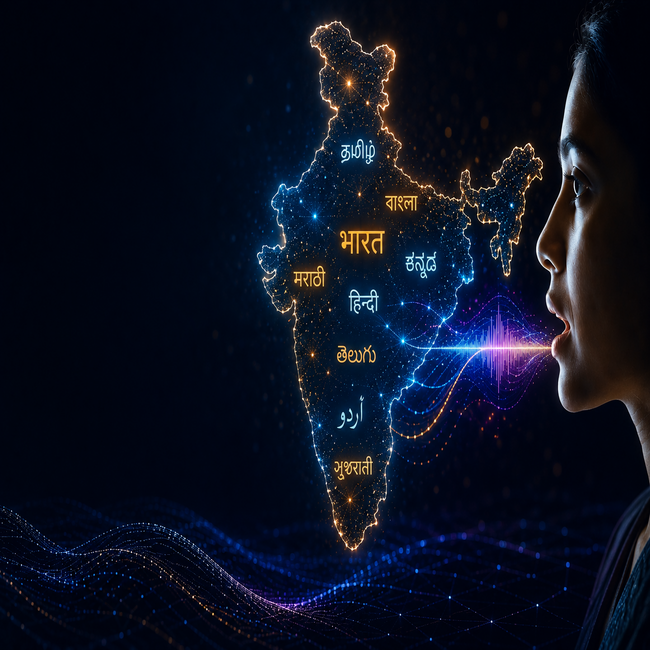
As India marks its 79th Independence Day, a new question of sovereignty is taking shape. In the age of artificial intelligence, control over compute, data and models could determine how much of the country’s digital future it truly owns.
When India became independent in 1947, sovereignty meant control over territory, institutions, resources and the decisions that shaped the country’s future.
Seventy-nine years later, that definition is expanding.
As artificial intelligence moves from an experimental technology to infrastructure underlying businesses, governments and everyday digital services, countries are confronting a new form of technological dependence. The critical resources are no longer only oil, minerals, factories or telecommunications networks. They increasingly include graphics processing units, data centres, datasets and the AI models that turn those resources into intelligence.
For India, this creates an unusual contradiction.
The country has more than 1.4 billion people, a vast technology workforce and one of the world’s largest digital economies. India has also demonstrated through digital public infrastructure such as Aadhaar and UPI that technology built for Indian conditions can operate at extraordinary scale.
Yet some of the most important components powering the global AI revolution, particularly advanced computing hardware and many of the world’s leading foundation models, originate outside India.
That is why India’s AI ambitions are increasingly moving beyond simply adopting artificial intelligence.
The larger question is whether India can control enough of the AI stack to determine its own technological future.
Three components are emerging as particularly important: compute, data and models.
Together, they could become the tricolour of India’s AI sovereignty.
Compute: The infrastructure behind intelligence
Every major AI ambition eventually encounters the same physical constraint: computing power.
Training and operating sophisticated AI models requires enormous computing capacity. GPUs have consequently moved from being specialised pieces of technology hardware to strategically important infrastructure.
India has begun attempting to lower the barrier to accessing that infrastructure.
The Union Cabinet approved the IndiaAI Mission in March 2024 with an outlay of ₹10,371.92 crore over five years. The original plan included establishing AI computing infrastructure of 10,000 or more GPUs, alongside initiatives covering datasets, indigenous models, skills, startups and responsible AI.
The scale of the compute programme has since expanded substantially.
As of 2026, 38,231 GPUs have been onboarded from 14 empanelled service providers under the IndiaAI Compute Capacity framework.
The government is providing access to this infrastructure to eligible users at subsidised rates, with the average rate at approximately ₹65 per GPU per hour, except for select high-end GPUs.
That number matters beyond the headline.
Building AI systems is expensive. If advanced computing capacity remains accessible primarily to the world’s largest technology companies, Indian researchers and smaller startups risk being locked out of the most computationally intensive stages of AI development.
Shared infrastructure can change that equation.
The physical infrastructure surrounding AI is expanding as well. India’s total data-centre capacity increased from about 375 MW in 2020 to around 1,500 MW by 2025, according to government figures. That represents roughly a fourfold expansion in five years.
And private investment continues.
On August 13, Larsen & Toubro announced that it had secured an order worth up to ₹150 billion, or approximately $1.57 billion, from US-based Together AI to host an AI data centre in India using NVIDIA’s high-performance chips.
The development illustrates both India’s opportunity and its continuing dependency.
India can build data centres, cloud infrastructure and large-scale computing capacity domestically. But the advanced chips at the heart of much of the current AI boom continue to be dominated by overseas semiconductor companies.
AI sovereignty, therefore, cannot simply mean having GPUs physically located inside India.
The longer-term question is how much of the underlying computing ecosystem, from data centres and cloud infrastructure to processors and accelerators, India can develop, operate or access without being dangerously dependent on a limited number of external suppliers.
Data: India’s scale becomes a strategic asset
If compute provides AI with power, data helps determine what it understands.
This is where India’s scale and diversity could become an extraordinary advantage.
India is not simply a market of more than 1.4 billion people. It contains hundreds of languages and dialects, enormous cultural diversity and dramatically different consumption, financial and behavioural patterns.
Yet the internet, and consequently much of the material historically available for training large language models, does not represent every language or culture equally.
An AI system designed primarily around English-language information may be capable of operating in India without necessarily understanding India particularly well.
That distinction becomes increasingly important as AI enters banking, healthcare, agriculture, government services, commerce, advertising and customer experience.
S Krishnan, Secretary at the Ministry of Electronics and Information Technology, captured one of the strategic concerns around sovereign AI at the India AI Impact Summit earlier this year.
“As AI systems mature, you do not want to be in a situation where somebody else holds the kill switch,” he said while discussing India’s need for greater control over its AI infrastructure.
The phrase captures what technological sovereignty increasingly means.
The question is not whether India should disconnect itself from global technology. It is whether strategically important systems can continue operating if access to a foreign technology, model or platform changes.
Data is central to that equation.
India is building AIKosh as a national repository designed to bring together datasets, models and other AI resources from government and non-government sources.
By February 2026, AIKosh had grown to more than 7,500 datasets and 273 AI models, spanning multiple sectors.
The significance of such infrastructure goes beyond creating another government technology platform.
India-specific datasets could help developers build systems that perform better across Indian languages, local contexts and use cases where global datasets may provide inadequate representation.
This is also increasingly relevant to marketers.
As generative AI enters CRM, customer service, content generation, search, recommendation engines and personalisation, companies will have to make decisions about where customer information is processed, what models can access it and how much control they retain over the resulting intelligence.
Data sovereignty could consequently become as much a boardroom and CMO issue as a government one.
Models: Does India need its own ChatGPT?
The third component of the AI tricolour is the most visible: the models themselves.
The first phase of the generative AI boom was dominated by companies outside India. This raised a fundamental strategic question for the country.
Should India spend enormous resources attempting to build foundation models, or should it concentrate on creating applications using the best models available globally?
India increasingly appears to be pursuing both.
The IndiaAI Mission explicitly includes the development of indigenous large multimodal and domain-specific foundation models.
Among the companies emerging from this push is Bengaluru-based Sarvam AI.
In March 2026, Sarvam released Sarvam 30B and Sarvam 105B, open-source reasoning models with 30 billion and 105 billion parameters respectively.
What makes the development particularly relevant to the sovereignty debate is where and how they were built.
Sarvam says both models were trained from scratch using datasets curated in-house, with training conducted entirely in India on compute provided under the IndiaAI Mission.
Other Indian companies and research efforts are pursuing different parts of the same opportunity.
Krutrim, founded by Bhavish Aggarwal, has positioned itself around developing an Indian AI computing stack and models designed for Indian languages and use cases.
Government-backed initiatives and teams including BharatGen and others are also working on indigenous models and multilingual AI capabilities.
The objective does not necessarily have to be producing the world’s biggest model.
Electronics and IT Minister Ashwini Vaishnaw has repeatedly argued for an approach focused on practical deployment and efficient models rather than treating parameter count as the sole measure of AI capability.
At Davos in January 2026, Vaishnaw said India expected that within a year, most of its AI-related work should be capable of being handled using sovereign models.
Whether India can achieve that ambition across the breadth of enterprise and consumer AI remains to be seen.
But the direction is important.
A country with domestic models gains another option.
If the price of accessing a foreign model rises, its usage conditions change, certain capabilities are restricted or geopolitical circumstances affect availability, an indigenous ecosystem provides an alternative.
That does not mean every model used by an Indian company needs to be Indian.
The world’s technology ecosystem is too interconnected for complete technological self-sufficiency to be a realistic or necessarily desirable objective.
The more meaningful definition of sovereignty is optionality.
India should be able to use the world’s best technology while retaining enough domestic capability that access to intelligence is not determined entirely elsewhere.
India’s digital history offers a useful precedent.
The country did not create an isolated internet or attempt to replace every international technology company. Instead, it developed digital public infrastructure such as Aadhaar and UPI that created foundational rails upon which public and private innovation could operate.
AI may require a similar philosophy.
Build accessible compute. Develop Indian datasets. Support indigenous models. Create domestic infrastructure while remaining connected to global innovation.
The challenge will be considerably harder. AI infrastructure is capital-intensive, advanced semiconductor supply chains are globally concentrated and frontier technology is moving at extraordinary speed.
There will also be questions about energy consumption, economics, model quality, data rights, privacy and whether government-backed infrastructure can keep pace with private-sector innovation.
But the strategic direction is becoming clearer.
On India’s 79th Independence Day, technological sovereignty does not have to mean technological isolation.
It means having choices.
And in an economy increasingly shaped by artificial intelligence, countries that possess meaningful control over their compute, data and models may ultimately have greater control over everything built on top of them.
For India, the next chapter of independence may therefore be written not only in factories, institutions or policy documents, but inside data centres, datasets and billions of parameters.
Disclaimer: All data points and statistics are attributed to published research studies and verified market research. All quotes are either sourced directly or attributed to public statements.
Related Articles