

AI assistants are helping shoppers choose before they reach a retailer. Five recent datasets show why that could change the brand website’s role in discovery, checkout and the customer relationship.
A shopper may choose a product before a brand ever records a website visit.
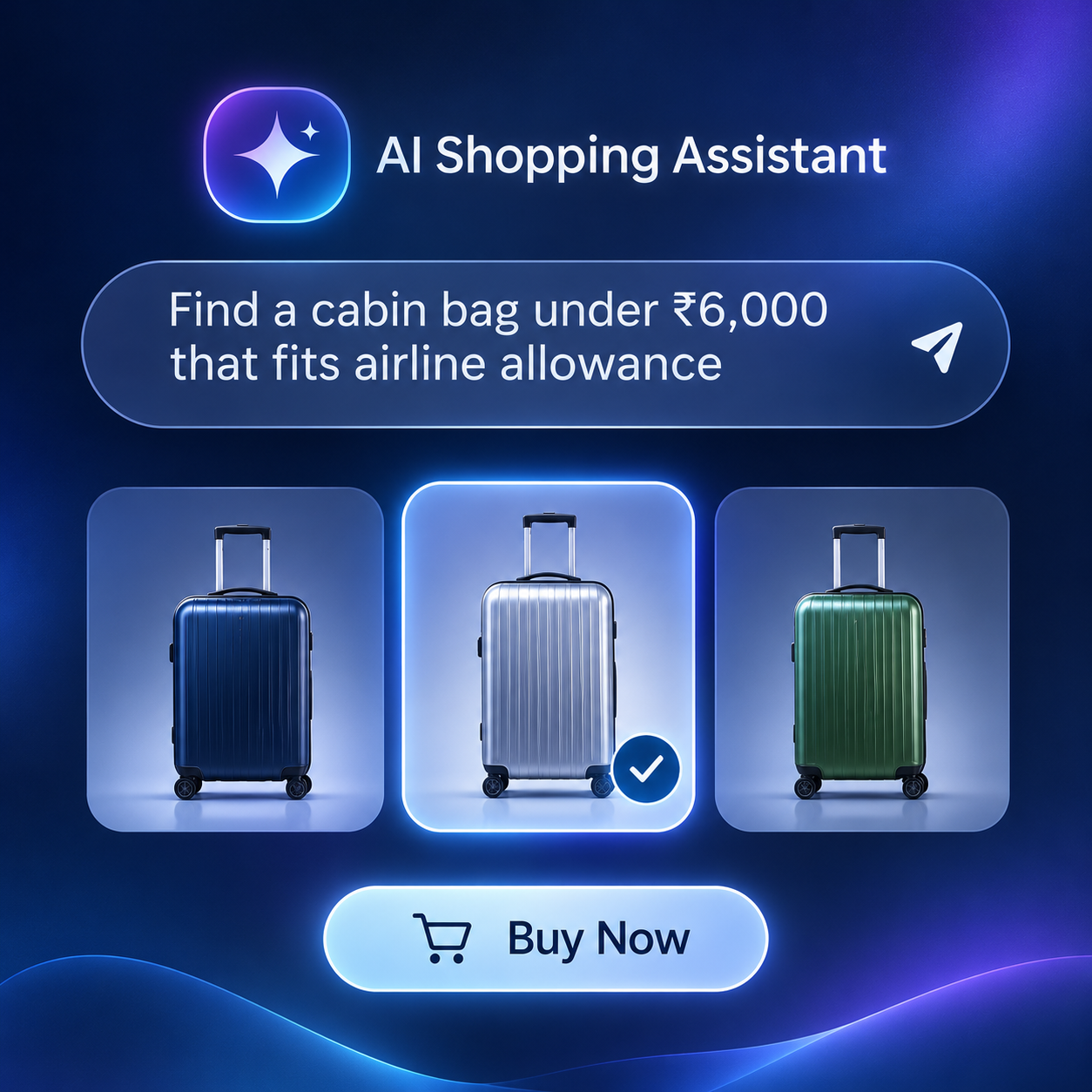
Consider someone looking for a cabin bag that fits an airline’s allowance, costs less than ₹6,000 and will arrive before a weekend flight. An AI assistant can help organise those requirements, compare options and explain the differences. By the time the shopper reaches a retailer, much of the browsing may already be over.
For a marketing team, that changes when it gets to influence the decision.
The homepage, campaign landing page and carefully arranged product categories may play a smaller part in that particular journey. The customer could arrive with one product in mind, needing only to confirm the price, delivery date and payment options.
Does that make the brand website redundant?
Current evidence points to a redistribution of its work. Research is moving into conversational interfaces, while merchants continue to provide the information, transaction systems and service that make a purchase possible.
McKinsey’s Agentic Commerce Consumer Survey, fielded in June 2026, found that 53% of surveyed adults across 11 markets had used AI for at least one shopping task during the previous three months. That estimate came from a weighted sample of 9,988 adults. Separately, 14% of AI users reported completing a purchase directly with an AI tool.
These measure different stages of adoption. Asking for recommendations, following a product link and authorising an agent to buy are distinct activities, with different implications for the retailer.
The shortlist is moving outside the store
Conversational shopping starts with a situation rather than a catalogue.
A customer can describe the intended use, budget and compromises they are prepared to make. That allows an assistant to narrow the field before the customer examines individual product pages.
Google’s April 2026 shopping update brought product listings, comparison tables and prices into Gemini in India, alongside richer shopping responses in AI Mode. These features bring discovery into the conversation, although purchasing options depend on the service, merchant and market.
For brands, this makes product information a marketing concern beyond the website’s presentation. An assistant needs to distinguish the correct size, model, material and warranty. Missing or inconsistent information can make the offer harder to assess.
OpenAI’s approach shows how discovery and checkout can remain separate. In March, it said its initial Instant Checkout design had not provided the flexibility it wanted. It shifted emphasis towards product discovery while allowing merchants to use their own checkout experiences.
“Millions of Shopify merchants are open for business in ChatGPT,” said Mani Fazeli, Vice President of Product at Shopify, in the announcement.
Shopify product information reaches ChatGPT through its catalogue integration, while purchases can be completed on the merchant’s store through an in-app browser.
Walmart’s ChatGPT experience also preserves a Walmart environment, including account linking, loyalty and Walmart payments. Daniel Danker, its Executive Vice President for AI Acceleration, Product and Design, said the partnership combined conversational AI with “the decades of retail expertise we’ve built serving customers”.
These arrangements suggest that shopping inside AI can still rely heavily on merchant-controlled systems. The interface changes, but the retailer remains involved in converting interest into an order.
The visitors who arrive may be closer to buying
Adobe’s October 2026 retail analysis offers an important counterpoint to predictions that websites will lose their commercial purpose.
Its research covered more than one trillion visits to US retail websites, spanning 100 million products across 18 categories. In September, traffic referred by AI increased 71% year on year.
Those visits converted at a rate 90% higher than non-AI traffic and generated 83% more revenue per visit.
The qualification is central: Adobe was measuring shoppers who clicked through to retailers’ websites. Its findings describe the value of those visits, rather than purchases completed entirely inside an external assistant.
They also do not establish that AI caused customers to spend more. People arriving after detailed research may already be more inclined to purchase. Nor do the US findings establish equivalent results in India.
For a retailer, however, the distinction has practical consequences. A website receiving a shopper with a settled shortlist may need to resolve the final doubts quickly.
Is this the exact variant recommended? Does the advertised price include everything? Can it be delivered to the customer’s postcode? What happens if it does not fit?
An attractive homepage cannot answer those questions on its own.
Product pages, inventory records and checkout systems become particularly important when the assistant’s recommendation and the retailer’s offer have to match. A discrepancy can interrupt an otherwise promising purchase.
There is also a measurement problem. A customer might compare products in an AI conversation, visit a store later and buy through its app. The final transaction record alone would not explain what influenced the choice.
Revenue per visit therefore belongs alongside measures such as completed orders, returns, repeat purchases and acquisition costs. A valuable referral does not, by itself, establish that an entire channel is profitable.
Shoppers still want a say in the handover
The movement towards AI shopping does not necessarily mean consumers want to leave familiar retail environments.
LocalCircles’ February 2026 research collected more than 75,000 responses across 332 Indian districts. Among 18,438 responses to its question about where people wanted to begin an AI shopping journey, 49% chose an e-commerce app or website, compared with 17% choosing a general AI prompt interface.
This was a survey of registered platform users, rather than a nationally representative probability sample. It measures stated preferences, but offers a useful indication that demand for AI assistance can coexist with demand for familiar shopping destinations.
Amazon’s Indian rollout illustrates that model. On November 12, it began introducing Alexa for Shopping on selected storefronts within its app and website. The assistant supports product comparison, price research and basket management inside the retailer’s existing environment. That keeps shopping within Amazon, without necessarily bringing users to individual brands’ websites.
Delegating the final decision is a separate question.
Gartner’s January 2026 survey of 322 US consumers found that willingness to let AI make purchase decisions reached no higher than 11%, even in lower-stakes categories such as household supplies.
“Consumers are not looking to outsource shopping decisions to AI,” said Kate Muhl, Vice President Analyst in Gartner’s marketing practice.
There are technical limits as well. Visa’s November 2026 benchmark tested 22 AI models from 12 laboratories across 15 shopping scenarios. Models passed 57.2% of test runs overall.
The tests simulated conversations between an AI shopper and an AI assistant. They did not involve real purchases. A successful run required identifying the customer’s requirements and reaching an appropriate product or no-purchase decision.
In 54% of failed runs, the simulation still ended in a product selection despite unmet or undiscovered requirements.
“AI agents have the potential to power the next era of commerce, but trust is key to making it work,” said Rubail Birwadker, Visa’s Global Head of Growth.
The benchmark exposes a problem that polished recommendations can obscure. A product can sound suitable before the system has established whether it meets the buyer’s actual needs.
For a merchant, an incorrect recommendation could become a return, a complaint or a customer-service cost.
The website’s job gets more specific
The commercial tension is less about whether a website exists than about who controls each part of the relationship.
A brand that meets customers mainly through an external assistant has fewer opportunities to explain its proposition directly. Research conducted outside its own channels may also leave it with less information about what shoppers considered or rejected.
Product feeds help communicate factual details, but a comparison table cannot carry every aspect of a brand’s identity. Provenance, craftsmanship, service and specialist expertise may need fuller explanation, particularly for expensive or unfamiliar purchases.
That gives the owned website a continuing role as a place to examine claims, understand the business and seek help.
It also creates a reason to connect marketing, commerce and customer-service teams more closely. If an assistant recommends a product using one description while the website shows another, the customer experiences one inconsistent brand.
Consider a clothing purchase. The assistant may identify a jacket by price and material. The retailer still has to make sizing clear, confirm availability and explain exchanges. After delivery, the relationship depends on whether the product matches the description and whether problems are resolved.
Account connections and loyalty arrangements, such as those included in Walmart’s integration, show one way retailers are trying to preserve that continuity across interfaces.
Personalisation also depends on what information crosses between the retailer and the assistant. A customer may want loyalty benefits recognised without sharing an entire purchase history. The scope of account linking therefore matters: convenience depends on access, while preserving a direct customer relationship also requires explaining what is shared, why it is needed and how the customer can control it.
For marketing teams, this broadens the meaning of website performance. Homepage traffic alone says little about whether products are represented accurately elsewhere, whether referred customers complete purchases or whether they return.
The available evidence does not support declaring the brand website dead. It supports a change in where customers first encounter the brand and how much research they complete before arriving.
AI may decide which products enter the conversation. The merchant still has to deliver the product, honour the promise and give the customer a reason to come back.
Disclaimer: All data points and statistics are attributed to published research studies and verified market research. All quotes are either sourced directly or attributed to public statements.