
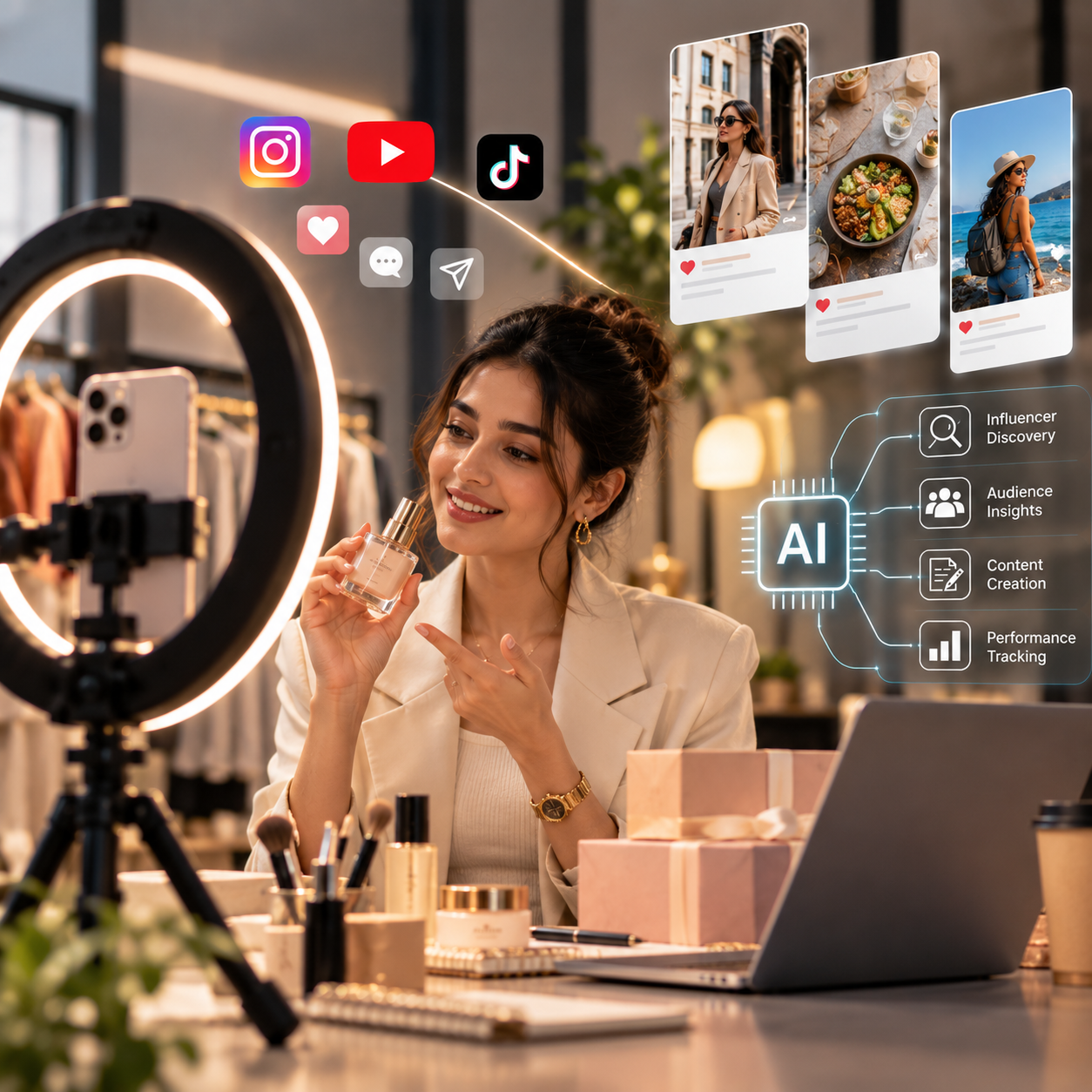

India’s influencer economy is moving beyond the period when celebrity status and follower counts could largely define a creator’s value. Brands are looking more closely at relevance, regional reach, engagement and business outcomes, while creators are becoming commerce channels in their own right. Now, AI is entering the equation, changing how influencers are discovered, how content is produced and, increasingly, what an influencer can actually be.
There was a time when influencer marketing in India was relatively easy to understand.
Before Instagram creators and YouTube personalities became part of marketing plans, influence largely belonged to film stars, cricketers and television celebrities. Brands borrowed their fame, put their faces on campaigns and used mass recognition to reach consumers.
Social media initially carried much of the same logic online. The bigger the follower count, the more valuable the creator appeared to be.
That hierarchy has not disappeared. A celebrity or large creator can still deliver the kind of reach that smaller accounts cannot. But India’s influencer ecosystem is becoming harder to measure by fame alone.
A personal-finance creator may make more sense for a fintech campaign than a lifestyle celebrity. A regional food creator may help a brand enter a particular market. A technology reviewer may influence a smartphone purchase long after the campaign impression has been counted.
At the same time, influencer marketing itself is becoming more commercial and more measurable. Affiliate links, creator-led shopping, long-term brand partnerships and performance-linked campaigns are bringing creators closer to the transaction.
And now AI is entering both sides of the screen.
It is helping brands identify creators, analyse audiences and measure campaigns. Creators are using it to generate ideas, edit content and localise material. At the other end of the spectrum, brands are experimenting with virtual personalities that do not physically exist.
The result is not the end of traditional influencer marketing. It is a market being rebuilt around a broader definition of influence.
Here are four shifts explaining how India got from fame to AI.
- Follower count is losing its monopoly on influence
The first phase of social media influence rewarded scale.
Follower counts offered marketers an immediately visible metric. An account with one million followers appeared to provide greater reach than one with 20,000, making creator selection relatively straightforward.
But follower numbers say little about why people follow someone, how actively they engage or whether the audience has any relationship with the category being advertised.
Recent data suggests brands are beginning to look beyond that number.
WPP Media and Kantar’s 2025 India Influencer Marketing Report valued India’s influencer marketing industry at around ₹3,600 crore in 2024, with the market expected to grow 25% in 2025. The study also found that 72% of brands preferred long-term relationships with creators, while engagement and content quality were becoming important considerations alongside reach.
“We are witnessing the evolution of influence from a marketing channel to a cultural force,” Ashwin Padmanabhan, COO, WPP Media South Asia, said when the findings were released.
The same research exposed a problem created by the industry’s expansion. Around 83% of marketers reported difficulty finding the right influencer.
More creators have therefore not necessarily made influencer selection easier.
The challenge is increasingly about matching the right audience, category, language and content style to the campaign.
The study found that 63% of users turned to influencers for product discovery, 69% for information and 60% for action. Those behaviours suggest creators can occupy different positions in the consumer journey rather than serving only as an awareness channel.
For brands, this changes the question.
Instead of simply asking who can reach the most people, marketers can ask who is credible for the particular conversation they are trying to enter.
A skincare specialist explaining ingredients may offer one kind of value. A fashion creator demonstrating how a product looks may offer another. A finance educator discussing a banking product has a different role from a celebrity appearing in a mass campaign.
Puneet Avasthi, Director, Specialist Businesses, Insights Division at Kantar, described the shift as one from reach towards “relevance, resonance, and results”.
That transition is particularly significant outside India’s largest creator markets.
Kofluence’s 2026 research, drawing on data from more than two million creators alongside over 1,000 surveys and more than 50 industry interviews, found 61.1% of surveyed creators fell into the nano category, with between 1,000 and 10,000 followers.
More than 62% of creators also reported an increase in regional and vernacular campaign briefs.
The figures point towards a more fragmented influencer economy, where a creator does not necessarily need a national audience to become commercially useful.
For a brand trying to reach consumers in Jaipur, Kochi or Indore, a smaller creator speaking the audience’s language may offer something that a larger national account cannot easily reproduce.
Scale still matters. It is simply no longer the only currency.
- Influencers are becoming businesses, not just advertising inventory
The second transformation is happening behind the post.
India’s creator ecosystem is increasingly connected to commerce rather than simply content.
Boston Consulting Group estimated in 2025 that India had between two million and 2.5 million monetised content creators influencing $350 billion to $400 billion in consumer spending. Based on research involving more than 1,900 consumers and over 60 brands, it projected creator-influenced consumption could exceed $1 trillion by 2030.
The numbers illustrate the economic reach of creators, but also reveal the limits of the creator boom. BCG estimated only around 8% to 10% of India’s wider creator base was monetising.
Becoming a creator and building a sustainable creator business remain very different propositions.
For those who do monetise, however, sponsored posts are only one potential source of income.
Creators can use affiliate links, subscriptions, social commerce, live shopping and platform monetisation alongside brand partnerships. Some develop their own products or businesses. Others move towards longer relationships in which they effectively become recurring media partners for brands.
That is also changing how marketers evaluate influencer spending.
Kofluence’s 2026 research found 13.3% of brands were directly linking influencer expenditure to formal revenue targets, while another 46.4% were applying performance accountability at campaign level.
Around 62% of surveyed brand professionals said longer-term creator relationships generated better returns than one-off activity.
These are industry platform findings rather than a universal measurement of every Indian campaign. But they illustrate a larger change in the conversation around influencer marketing.
Views, likes and comments remain useful indicators, particularly when the objective is awareness. Increasingly, however, marketers can also examine searches, leads, affiliate purchases, downloads or other actions.
Not every influencer campaign should be judged by immediate sales. A brand-building campaign and a performance campaign serve different purposes.
What is changing is the expectation that influencer spending should have a clearer objective and evidence of whether that objective was achieved.
In other words, the influencer is increasingly entering the same accountability system as the rest of the media plan.
- AI is becoming the invisible engine behind influence
If the first evolution of influencer marketing changed who could become famous, AI could change how influence itself is produced.
Its most immediate role is relatively practical.
A creator can use generative AI to brainstorm video ideas, develop captions, translate content, create visual elements, research subjects or accelerate editing. Agencies and brands can use AI-assisted systems to search creator databases, examine audience characteristics, identify potential matches and analyse campaign performance.
Kofluence’s 2026 study found 59% of creators were using AI tools either regularly or occasionally, with content ideation emerging as the leading application.
Adobe’s 2026 Creators’ Toolkit research offers another indication of how deeply AI is entering creator workflows. The study surveyed more than 16,000 creators across eight markets, including India.
Among Indian creators who had used or experimented with creative AI, 85% said it had become integrated into or essential to their workflow, while 96% said it had accelerated the growth of their business or audience.
The findings need context. They represent creators already using or trying creative AI rather than every Indian creator.
They also show why AI adoption does not automatically mean complete automation.
Around 72% of Indian respondents said AI-generated outputs generally required moderate or extensive editing before they were ready to publish. Another 87% said the final creative decision should remain with the creator.
That distinction goes to the centre of influencer marketing.
AI can shorten production time, but the creator’s personality, judgement and relationship with the audience are often part of what the brand is purchasing.
The more radical experiment begins when AI moves from behind the camera to becoming the personality in front of it.
India has already seen experiments with virtual influencers and computer-generated brand personalities. Digital personalities such as Naina have participated in commercial collaborations, while Mankind Pharma introduced virtual personality Myra Kapoor for Manforce.
For brands, synthetic personalities offer obvious operational possibilities. They can potentially appear in multiple formats, operate without conventional production schedules and be adapted for different creative environments.
But that does not mean virtual influencers are replacing human creators.
“We’re still at the pilot stage with AI influencers, not a committed media line yet,” Kofluence co-founder Ritesh Ujjwal has said, noting that virtual influencer briefs were emerging alongside human creator rosters.
For now, AI’s larger influence on influencer marketing may therefore be less visible.
It is becoming part of the infrastructure that helps decide who gets selected, what gets produced and how performance gets measured.
- The more synthetic content grows, the more trust matters
There is one problem technology cannot easily optimise away.
Influencer advertising depends heavily on credibility.
A traditional advertisement is clearly understood as communication from a brand. Influencer content operates differently because the commercial message appears inside an existing relationship between a creator and an audience.
That makes transparency particularly important.
The Advertising Standards Council of India’s 2025 Top Influencer Compliance Scorecard found 69% of the Top 100 Digital Stars it reviewed initially failed to meet influencer advertising disclosure requirements.
Together, those creators had a reach exceeding 110 million followers. Following ASCI’s intervention, overall compliance reached 93%.
The sample was deliberately focused on prominent creators, so the 69% figure cannot be extended to India’s entire influencer industry. It does, however, demonstrate that disclosure problems can persist even at the most visible end of the market.
“Even top influencers have a disappointing rate of adherence” to transparency requirements, ASCI CEO and Secretary-General Manisha Kapoor said.
AI creates another layer of transparency.
Adobe’s 2026 India findings showed that 52% of surveyed creators said they always or often disclosed their use of AI, while 16% said they rarely or never did so. Meanwhile, 93% said audience expectations around AI disclosure were either increasing or remaining steady.
The issue is likely to become more complicated as AI tools improve.
A creator might use AI only to brainstorm a caption. Another may generate the background of a video. A third could create an entirely synthetic spokesperson. Those are very different forms of AI involvement, even though all could technically be described as AI-assisted content.
Brands will therefore have to navigate not only whether AI is being used, but how much of what consumers see is synthetic and when that information should be disclosed.
That makes trust increasingly important at the same moment that content becomes easier to manufacture.
India’s influencer economy has not followed a simple path from celebrities to creators and then to AI personalities.
Instead, each layer is remaining in the market.
Celebrities still provide mass visibility. Large creators bring established digital communities. Micro and nano influencers can provide category, linguistic or geographical relevance. AI is helping creators and marketers operate faster, while virtual influencers are emerging as another experimental format.
What has changed most is what sits behind the word “influence”.
Follower counts are being supplemented by audience fit. Sponsored posts are being joined by commerce. Short campaigns are, in some cases, turning into longer creator relationships. Engagement metrics are being asked to sit alongside measurable business outcomes. And AI is becoming part of the machinery connecting all of them.
India’s influencer marketing industry began by borrowing the logic of fame.
As it moves deeper into AI, performance marketing and creator commerce, the harder question for brands may no longer be simply who has the biggest audience.
It may be who can still make that audience pay attention, take action and believe what they are seeing.
Disclaimer: All data points and statistics are attributed to published research studies and verified market research. All quotes are either sourced directly or attributed to public statements.