
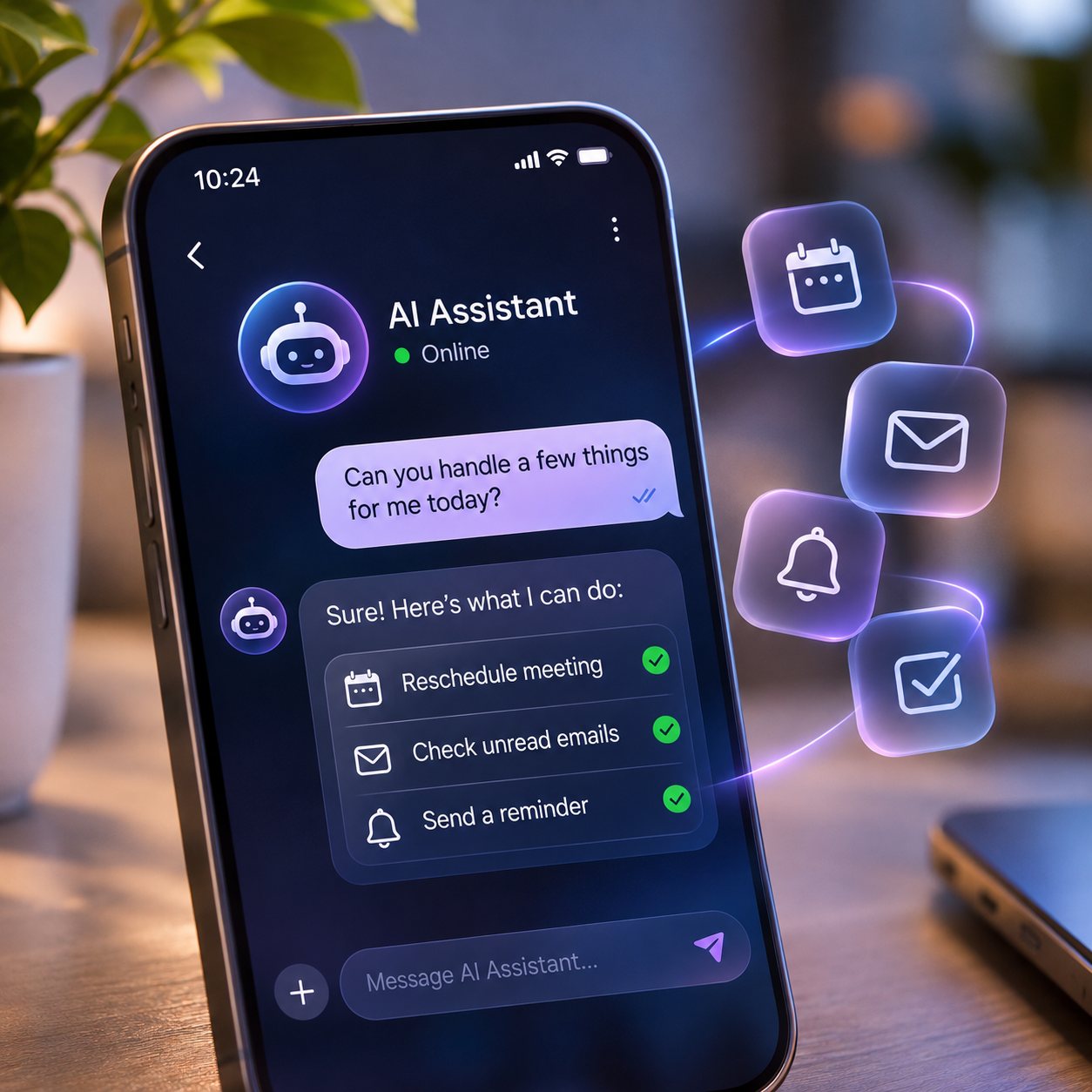

From scheduling meetings and managing emails to researching information and sending reminders, AI agents are moving into everyday messaging apps. A new generation of assistants is bringing task automation to iMessage, RCS, SMS and other chat platforms, raising questions about whether the next major AI interface could be an ordinary conversation.
Imagine sending a message asking someone to reschedule a meeting, check an unread email and remind you about an appointment. A few moments later, the tasks are organised without opening multiple applications.
The person receiving those instructions is not a colleague or personal assistant. It is an AI agent appearing as another contact in the messaging inbox.
For years, AI assistants have largely required users to open dedicated applications, type questions and return whenever they need another response. A growing category of AI companies is now attempting to change that arrangement.
Instead of asking people to visit a chatbot, these companies are bringing AI into communication channels already used throughout the day.
Some assistants can manage calendars, read connected emails, prepare replies and monitor information. Others can carry out recurring tasks, send notifications or interact with external services.
The distinction is important. Unlike conventional chatbots that primarily answer questions, more capable AI agents can retain instructions, use connected tools and continue working after a conversation ends.
The approach is emerging as messaging and AI become established digital behaviours.
YouGov research published in February 2026 found that 85% of American adults used text messaging or messaging applications multiple times a week. Among messaging users, 29% reported communicating more frequently than a year earlier.
Separately, a 2026 Pew Research Center survey of 5,119 US adults found that approximately half had used an AI chatbot, including around one-quarter who used one daily.
These findings do not measure demand specifically for messaging-based agents. However, they provide context for why technology companies are experimenting with bringing AI into familiar communication environments.
Five emerging services illustrate how this category is developing.
1. Poke and Caddy: AI Assistants That Behave Like Contacts
One example is Poke, a personal AI assistant developed by The Interaction Company of California.
Launched publicly in March 2026, Poke allows users to communicate through Apple Messages, Telegram, RCS and WhatsApp in supported markets.
The company positions the assistant around everyday tasks, including reminders, calendar management, email monitoring and recurring requests.
For example, a user could ask Poke to check for an important email, remember a recurring obligation or provide a daily update about a particular subject.
The assistant can continue monitoring certain information and send another message when an action is required.
Marvin von Hagen, co-founder of the company behind Poke, explained its development in an interview with TechCrunch.
“What we noticed there was that people wanted to use Poke for everything,” he said, describing how users of an earlier email-focused product began requesting help with activities outside email.
The company’s approach reflects an attempt to make AI accessible without requiring users to understand complex automation systems.
By June 2026, Poke had reportedly relayed approximately 100 million messages, according to figures shared by the company with TechCrunch.
It also became the first standalone AI agent approved to operate through Apple’s Messages for Business platform.
The reported message volume indicates activity on the service, although it does not establish how many distinct users were involved or how successfully individual tasks were completed.
Another emerging assistant, Caddy, follows a related model.
Caddy is designed to operate through iMessage on iPhones and RCS on compatible Android devices.
According to the company, the assistant can connect with services including Gmail, Google Calendar, Slack, Linear and Todoist.
Users can request calendar changes, ask for research, prepare email replies or manage work-related information.
Consider someone leaving a meeting who remembers that a follow-up email needs to be prepared. Rather than opening their laptop, they could message Caddy with instructions to draft the response using information available through connected services.
The assistant can also send proactive reminders and updates.
However, Caddy remains in public beta, and its developer acknowledges that the technology can make mistakes. Users are advised to verify important information and actions.
Both Poke and Caddy demonstrate how messaging can become an interface for task management rather than simply another way to ask AI questions.
2. OpenAI’s Dots, Martin and Iris: Taking Messaging Beyond Simple Questions
OpenAI entered this developing category through texting capabilities for dots, its persistent AI agents within ChatGPT.
Introduced as a limited beta in late October 2026, texting allows eligible ChatGPT Pro users in the United States to communicate with their dots through iMessage or RCS.
The feature does not support conventional SMS, and availability remains restricted.
Unlike a chatbot interaction that begins with a fresh request, a dot can maintain relevant context and work across connected tools.
A user might ask a dot to investigate a topic, track progress on a task or send an update when further input is required.
When an action needs approval, the system can provide a link directing the user back to ChatGPT to review it.
This arrangement allows a task to continue across different communication environments.
It does not mean that the agent automatically receives access to all conversations on a user’s phone. OpenAI states that texting a dot does not provide access to other message threads.
Martin represents another approach to personal assistance.
Available through channels including SMS, WhatsApp, email, phone and Slack, alongside its iOS application, Martin focuses on calendars, tasks, reminders and everyday administration.
Its advertised capabilities include preparing briefings, managing email-related activities and conducting research.
For professionals managing several appointments, the assistant could provide a conversational route to everyday organisational tasks without requiring every request to begin inside its application.
Iris similarly offers an AI assistant that can be reached through text messaging, with capabilities covering general questions, scheduling, email assistance and task-oriented functions.
Its wider service also offers specialised assistance for different activities.
These products are not identical, and their capabilities should not be treated as interchangeable.
Some focus on organising personal information, while others provide more extensive integrations or support more complicated workflows.
Their availability, subscription requirements and messaging channels also differ.
An agent operating through conventional SMS may be accessible in situations where an internet-based messaging service is unavailable, but SMS has different security and media capabilities from iMessage or RCS.
Likewise, a product offered in the United States may not provide equivalent functionality to users in India or other markets.
The most useful comparison is therefore not simply which assistant can answer the most questions, but what actions each can perform, which services it can access and how much user approval those actions require.
3. Why Messaging Could Become the Next AI Interface
The growing interest in text-based agents reflects broader changes in how consumers communicate with businesses and digital services.
Twilio’s 2026 Communications Blueprint surveyed 5,000 consumers and 316 senior business-to-consumer leaders globally.
It found that 87% of consumers preferred interacting with brands across multiple channels, compared with 13% who preferred a single-channel relationship.
The report also identified text messaging, including SMS, MMS and RCS, as an important channel for several communication activities.
This matters because messaging supports interactions that do not need immediate attention.
A user can send an instruction, continue with another activity and return when the agent responds or requests approval.
The conversation also provides a visible record of previous requests.
For an AI agent, that creates opportunities to manage ongoing tasks rather than isolated questions.
Someone planning a business trip, for instance, might ask an assistant to check meeting details, prepare reminders and identify information needed before departure.
A conventional chatbot could provide suggestions. An agent with suitable integrations might also create calendar entries, monitor updates or prepare follow-up communication.
Whether it can complete those actions depends on the service’s actual permissions and capabilities.
The distinction between answering and acting is becoming relevant to customer experience as well.
Gartner surveyed 3,566 B2B and B2C customers during February and March 2026 and found that customers were approximately three times more likely to use third-party generative AI tools than company-provided chatbots when resolving service issues.
Among customers using generative AI, 58% had used it to complete a task on their behalf. That proportion rose to 74% in B2B settings.
Eric Keller, Senior Director Analyst in Gartner’s Customer Service and Support practice, said, “Customers are embracing GenAI in both life and work, but so far, that has not translated into growth in the use of company-provided customer service chatbots.”
According to Keller, generative AI is shifting some service interactions beyond the channels businesses directly control.
For marketers, this could eventually change how customers approach brands.
A consumer might use a personal agent to compare services, prepare an enquiry or organise information before contacting a company.
A business would then be interacting with a customer who has already used AI to complete part of the journey.
However, interest in this model remains ahead of widespread practical adoption.
A 2026 Lorikeet survey involving 1,966 US consumers found that 66% expressed interest in allowing AI agents to deal with companies on their behalf.
Yet only a small minority reported that an AI tool had actually contacted a business for them.
The difference suggests that consumer interest does not necessarily translate into regular use.
It also indicates that AI agents must demonstrate reliability before people become comfortable allowing them to manage more consequential interactions.
4. What Happens When an AI Agent Can Read, Send and Act?
Moving AI into messaging apps makes access easier, but it also introduces questions about trust and personal information.
An assistant that schedules meetings may need calendar access. One that prepares email replies may require access to an inbox. More advanced agents may connect with additional services to carry out tasks.
Each connection increases the importance of understanding what information the agent can access and which actions it can take independently.
Ping Identity’s 2026 Consumer Survey examined attitudes among 11,000 consumers across 12 countries.
It found that 57% trusted AI to some degree, while 43% reported increased trust compared with the preceding year.
However, only 31% were willing to allow AI to make certain lower-stakes decisions on their behalf.
The research also found that 71% were concerned an AI agent might misrepresent their personality, values or ethics.
The findings reveal a distinction between using AI for assistance and authorising it to act independently.
Andre Durand, Founder and CEO of Ping Identity, observed, “We cannot blindly trust AI. We must make its actions trustworthy.”
The concern extends to how messages are transmitted.
Although OpenAI’s dots can be contacted using iMessage or RCS, its documentation states that the conversation is not end-to-end encrypted between the phone and the dot.
A third-party messaging provider, Linq, processes messages for delivery. OpenAI says Linq does not retain message contents after delivery, while the conversations are stored within ChatGPT according to its privacy policies.
Similar questions about data processing, storage and permissions are relevant when evaluating other messaging-based assistants.
Users may also need to distinguish between an agent drafting a message and actually sending it.
For example, asking an assistant to prepare a response to a customer complaint carries different implications from allowing it to send that response without review.
The same applies to modifying appointments, contacting businesses or authorising purchases.
For India, the emerging category presents an additional opportunity alongside these considerations.
Adobe’s 2026 AI and Digital Trends research found that approximately 60% of Indian consumers were interested in creating a personal AI agent.
It also found that 58% were comfortable with agent-to-agent interactions, while 61% were open to allowing their AI assistant to communicate with a brand’s human representative.
The findings suggest potential interest in delegated digital interactions, although they do not establish demand for any particular messaging-based product.
As more AI companies develop persistent assistants, the messaging inbox could become another place where consumers and businesses interact with AI.
Poke, Caddy, OpenAI’s dots, Martin and Iris illustrate different approaches to making that possible.
Some prioritise reminders and personal organisation. Others extend into workplace activities, research and connected applications.
Their longer-term usefulness will depend on how reliably they complete tasks, how clearly they communicate limitations and how effectively users can manage permissions.
For now, text-based agents represent an emerging category rather than a replacement for conventional AI applications. But they are changing the way people can access assistance. Instead of opening an AI application to begin every task, users can increasingly start with a message and allow the conversation to continue until the work is completed.
Disclaimer: All data points and statistics are attributed to published research studies and verified market research. All quotes are either sourced directly or attributed to public statements.