
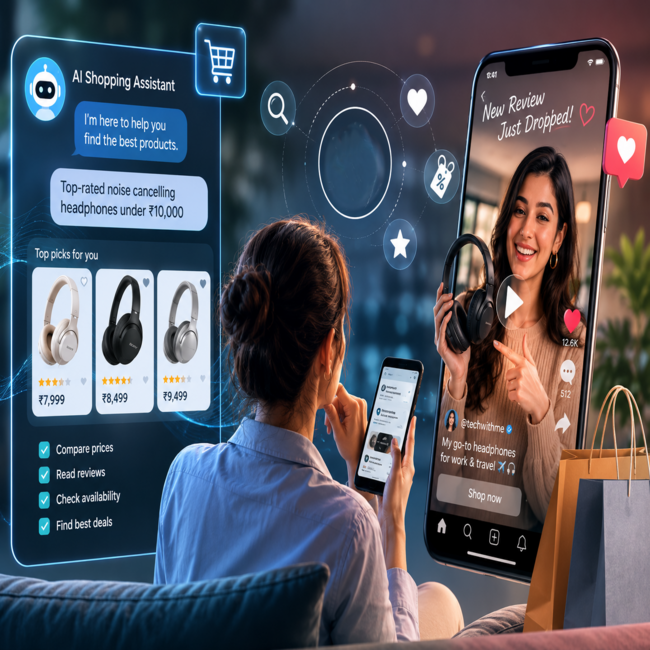

For more than a decade, influencer marketing has shaped how consumers discover products online. From beauty tutorials and fashion hauls to gadget reviews and fitness recommendations, creators have become a key part of the digital shopping journey. But a new player is entering the equation.
AI shopping assistants are moving rapidly from experimental tools to everyday buying companions. Platforms such as ChatGPT, Gemini and other AI-powered shopping interfaces are increasingly helping consumers compare products, evaluate features, find deals and narrow down purchase decisions through conversational interactions.
The shift raises an important question for marketers: if AI can recommend products instantly, analyze reviews, compare prices and answer questions in real time, what happens to the role influencers have traditionally played?
The answer, at least for now, appears less dramatic than the “AI versus creators” narrative suggests.
Recent research indicates that AI shopping assistants and influencers are influencing different parts of the consumer decision-making process. Rather than replacing one another, they are increasingly operating as separate layers within the same shopping journey.
The emergence of AI shopping is no longer limited to industry forecasts. Major technology companies are actively transforming conversational AI into a commerce interface.
OpenAI has expanded ChatGPT’s shopping capabilities, enabling users to compare products, receive personalized recommendations and browse visual product results. Google has integrated shopping features into Gemini and AI-powered search experiences, allowing consumers to evaluate products, reviews, pricing and availability without leaving the conversation.
This evolution is beginning to change how consumers research purchases.
According to Adobe’s analysis of more than one trillion visits to retail websites, traffic from AI sources to retail sites increased by 393% year-on-year during the first quarter of 2026. More significantly, AI-generated traffic converted 42% better than traditional traffic sources during March 2026, a sharp reversal from the previous year when AI-referred visitors converted at lower rates.
Adobe’s consumer research also found that 39% of consumers have already used AI while shopping online. Among those users, 85% said the technology improved their shopping experience and 66% believed the recommendations were accurate.
These figures suggest AI is moving beyond novelty and becoming a practical shopping tool.
David Cohen, Chief Executive Officer of the Interactive Advertising Bureau (IAB), summarized the transition succinctly when discussing AI’s growing role in commerce.
“AI is reinventing the traditional shopping journey.”
The IAB’s research with Talk Shoppe provides further evidence of that shift. Nearly 40% of shoppers now use AI while shopping. Among AI users, these tools have already become the second most influential shopping resource after search engines, ranking ahead of retailer websites and recommendations from friends and family.
Even more striking is the frequency of use. Forty-six percent of AI-assisted shoppers say they use AI every time or almost every time they shop, while 80% expect their reliance on AI shopping tools to increase in the future.
For consumers facing overwhelming product choices, the appeal is straightforward. Instead of opening multiple tabs, reading dozens of reviews and comparing specifications manually, shoppers can ask a conversational assistant to summarize options and recommend products based on specific needs.
The efficiency factor is proving difficult to ignore.
Yet efficiency alone does not automatically translate into trust.
The same IAB study found that only 46% of consumers fully trust AI recommendations. Nearly nine out of ten shoppers still verify AI-generated information before making a purchase.
Jack Koch, Senior Vice President of Research and Insights at IAB, captured the current consumer mindset when he noted that “AI isn’t replacing how consumers shop, it’s enhancing it.”
That distinction may explain why influencers continue to occupy a powerful position in the commerce ecosystem despite rapid advances in AI.
While AI is gaining influence in product evaluation and comparison, creators continue to dominate areas where trust, identity and aspiration play a central role.
The creator economy remains one of the fastest-growing segments of digital advertising.
According to IAB estimates, creator advertising reached $37 billion in 2025 and is projected to grow to $44 billion in 2026. Creator advertising spending is growing faster than the overall advertising market, and nearly half of creator media buyers now classify creators as a “must-buy” channel.
The industry’s commitment to creator partnerships is also reflected in future spending plans.
Research conducted by LTK and Northwestern University’s Retail Analytics Council found that 97% of surveyed marketing leaders intend to increase creator marketing investments during 2026. Notably, creators ranked above AI-powered search, paid social and paid search among channels receiving increased budget allocations.
This suggests marketers are not abandoning influencers as AI shopping gains momentum. Instead, many brands appear to be investing in both.
The reason becomes clearer when examining the specific role creators play in consumer decision-making.
AI excels at answering questions such as which smartphone has the best battery life, which laptop offers the strongest performance within a budget, or which vacuum cleaner has the highest ratings.
Influencers often answer a different set of questions.
How does a product fit into everyday life?
Does it align with a consumer’s lifestyle?
Can they imagine themselves using it?
What does ownership of that product signal socially or culturally?
These questions are harder to resolve through specifications and review summaries alone.
CreatorIQ’s 2026 Creator-Powered Funnel Report highlights the continued commercial value of creator content. The study found that 92% of paid media leaders now use creator-generated content within paid advertising campaigns. Creator assets account for an average of 44% of paid media creative inventory, while more than 80% of respondents reported at least a two-times return on investment from creator marketing initiatives.
Additionally, 77% said creator content outperforms traditional branded advertising across metrics including click-through rates, conversions and cost efficiency.
These findings suggest influencers are no longer operating solely at the awareness stage. They are increasingly embedded throughout the customer acquisition funnel.
Frank Dudley of Northwestern University’s Retail Analytics Council described this evolution as a shift toward “one unified, full-funnel strategy” involving creators.
The category context also matters.
AI’s effectiveness varies significantly depending on the nature of the purchase.
In categories driven primarily by functionality, AI recommendations appear to resonate strongly. Electronics, household products, office equipment and other utility-focused categories lend themselves naturally to AI-assisted comparison.
However, categories shaped by personal identity often tell a different story.
Research conducted by Vogue Business among readers in the United States, Europe and the United Kingdom found that while AI chatbot usage is growing, adoption for fashion and beauty shopping remains relatively limited.
Only 2% of respondents said they always use AI chatbots when shopping for fashion and beauty products, while more than half reported never using AI for those purchases.
When asked whom they trusted more for recommendations in these categories, consumers favored influencers by a wide margin. Twenty-seven percent trusted influencers, compared with only 8% who trusted AI chatbots. For style inspiration specifically, just 3% looked to AI, while 35% relied on influencers.
The findings suggest that AI’s ability to provide accurate recommendations does not necessarily translate into cultural authority.
Consumers may trust AI to compare products, but they often continue to rely on people for inspiration.
This distinction becomes even more relevant as AI moves closer to autonomous purchasing.
Accenture’s Consumer Pulse research, conducted across 16 countries with more than 25,000 respondents, found that 74% of consumers would trust a personal AI agent more than their best friend to make a purchase on their behalf.
The study also revealed that 74% would allow AI agents to handle routine tasks such as negotiating deals, renewing subscriptions and reordering products. Nearly one-third would permit AI agents to make purchasing decisions independently within predefined limits.
Such findings indicate that consumers are becoming increasingly comfortable delegating practical shopping tasks to machines.
However, that comfort comes with conditions.
Capgemini’s research found that while one in four consumers has already used generative AI shopping tools, 76% want strict controls before allowing AI agents to act autonomously. Concerns around privacy, data usage and decision-making transparency remain widespread.
Visa’s research across several markets echoes those concerns, with consumers citing data privacy, purchase accuracy and loss of control among their primary reservations regarding AI shopping assistants.
In other words, consumers appear willing to use AI, but not necessarily surrender complete authority to it.
Perhaps the clearest indication of where the market stands today comes from Walmart’s Retail Rewired research.
When consumers were asked whose recommendations they preferred, 27% chose AI suggestions while 24% selected influencer endorsements.
The narrow gap is noteworthy.
Just a few years ago, many marketers would likely have assumed influencers held a commanding lead in recommendation-driven commerce. The data now suggests AI has achieved comparable influence in certain shopping scenarios.
Yet the same study also found that consumers remain hesitant about fully automated shopping experiences. Nearly half of respondents said they would be uncomfortable allowing a digital assistant to manage an entire shopping journey without human involvement.
That hesitation reinforces an important reality.
Consumers are not necessarily looking for a replacement for human influence.
They are looking for convenience.
AI shopping assistants are proving valuable because they reduce friction, organize information and accelerate decision-making. Influencers continue to matter because they provide context, authenticity and social relevance.
The two systems are increasingly serving different psychological needs.
For marketers, this creates a more complex commerce landscape.
Success will require brands to optimize for both machine-driven discovery and human-driven influence.
Product information must be structured in ways AI assistants can interpret accurately across emerging shopping interfaces. At the same time, brands must continue investing in creator partnerships that build trust, demonstrate product usage and generate cultural relevance.
One strategy addresses discoverability.
The other addresses desirability.
The emerging evidence suggests that the future of shopping may not be defined by AI assistants replacing influencers or influencers resisting AI. Instead, the purchase journey itself is being divided into specialized layers.
AI is becoming the engine that helps consumers evaluate options, compare alternatives and reach decisions more efficiently.
Influencers remain a critical source of inspiration, validation and community-based trust.
Consumers increasingly appear willing to use both.
A shopper may first encounter a product through a creator’s recommendation, ask an AI assistant to compare it against competing options, verify reviews through search and ultimately complete the purchase through a retailer.
The journey is becoming more connected, not less.
For brands, the challenge is no longer deciding between AI shopping assistants and influencers.
It is understanding where each one has the greatest impact and ensuring they work together within the same customer experience.
The AI assistant may help consumers choose between the final options.
The influencer may still determine which products make the shortlist in the first place.
Disclaimer: All data points and statistics are attributed to published research studies and verified market research. All quotes are either sourced directly or attributed to public statements.
Related Articles


