
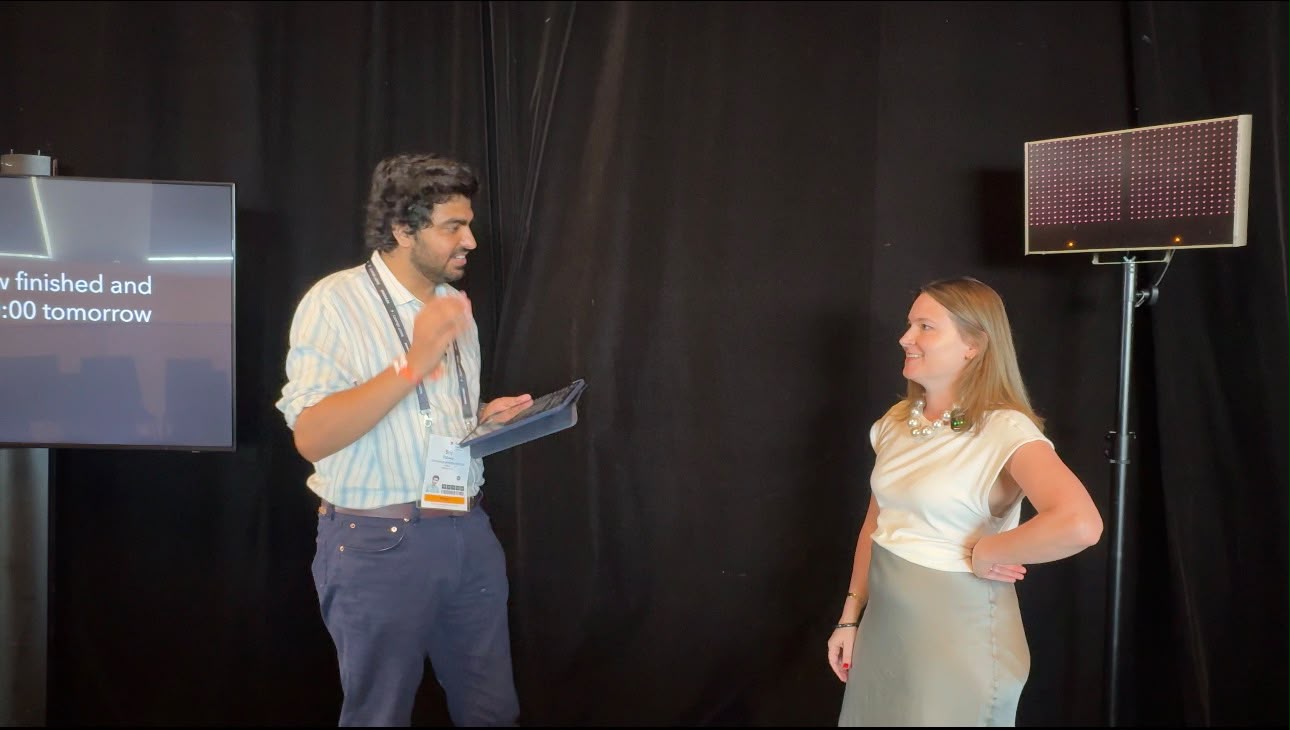

At Cannes Lions 2026, where AI dominated conversations across stages, jury rooms and brand corridors, Adelise Ashdown offered a sharper warning for marketers: efficiency alone will not build great brands.
Ashdown, Global Head of Brand and Client Experience and Regional Marketing Lead, APAC, JLL, said the real conversation around AI must move beyond speed and cost savings.
“I think we need to move beyond AI for efficiency to AI for effectiveness,” she said in an interview with Brij Pahwa on Day 4 of Cannes Lions 2026.
Ashdown, who was part of the Creative B2B jury this year, said the category has matured significantly since Cannes introduced a dedicated B2B award five years ago. According to her, this year’s entries showed a wider understanding of what B2B creativity can mean.
“It’s really pleasing to see such a breadth from different types of B2B represented,” she said. “We had large enterprise entries. We had more SME or B2B-to-C entries as well.”
She said the strongest work this year showed innovation not only in how brands reached customers, but also in how they understood the human emotion behind business decisions.
For Ashdown, the growing availability of the same AI tools and LLMs across organisations does not mean brands will automatically become indistinguishable. The difference, she argued, will come from mastery, audience insight and emotional intelligence.
“Everybody has tools, but then you need to master them,” she said. “It comes back to the basics of what makes great marketing, and that is deep audience insight.”
In B2B, she said, marketers must go beyond buyer signals and understand the client’s operating environment and emotional state at the point of decision-making.
“It’s about deep empathy for the operating environment in which your client is living through and the emotional state when they’re making that buyer decision,” she said.
Ashdown also warned that the industry is not talking enough about AI’s impact on the talent pipeline. While AI is making it faster to access client sentiment, test messages and listen to customers in real time, she said senior leaders must consciously invest in younger talent.
“One of the things that’s not talked about is the impact of the talent pipeline,” she said. “We’re seeing a lot of more junior jobs are under threat.”
Her solution is not to replace people with technology, but to invest in the humans who carry the brand.
“People buy from people,” she said. “Particularly in B2B, this is about trust and it’s about relationships.”
Ashdown pointed to Tra Mongkut Fertilizer’s Soil Stay, created by VML Bangkok, as one of the strongest examples of AI being used not just to save money, but to serve customers better. The company, she said, used its data on soil types in Thailand to create a deeper brand experience and training programme for farmers.
“It wasn’t just about selling the fertilizer to them. It was passing on the education so that they could get much better production and use from the soils that they have,” she said.
She added that 10,000 farmers left their farms to attend the company’s in-person training experience, which she called a powerful sign of brand relevance.
“That’s using AI to better serve your audience,” she said.
On whether companies with larger data sets have a natural advantage in the AI era, Ashdown agreed, but said data alone is not enough. Brands still need distinction.
“You don’t want to copycat everybody else and look like other businesses that have similar services to you,” she said. “You need to be distinctive in your category and lean into brand personality and be likable.”
She also cautioned marketers against removing too much human interaction from high-value business relationships through excessive personalisation and automation.
“I think there’s such a thing as positive friction,” she said. “I still think that people buy from people.”
According to her, AI and LLMs may accelerate the sales process, but complex B2B relationships still require empathy, trust and relationship-building over time.
On ROI, Ashdown said AI and measurement have given marketing greater seriousness at the board level, especially when teams can show marketing-originated or marketing-influenced revenue. But she warned against over-indexing on short-term metrics.
“What measures gets done,” she said. “We need to balance short-term impact with long-term impact, which is brand fame and reputation.”
She added that the very signals that make brands visible to LLMs, such as third-party sources, trust and credibility, are also the foundations of long-term brand building.
On B2B creativity, Ashdown admitted that many brands still play safe, but said the best entries at Cannes showed that emotion and audacity are possible even in technical categories.
She cited SKF’s The Faroe Islands Space Program, created by NORD Stockholm, which won the Creative B2B Grand Prix at Cannes Lions 2026.
“Instead of talking about the products and benefits, they launched a real-life space programme,” she said.
The campaign, she explained, created a space programme that never left Earth. It went under the sea, using tidal power linked to the moon to generate electricity.
“That kind of audacity and inspiring storytelling is still possible in B2B without compromising some of the other parts,” she said.
When asked whether next year’s Cannes conversation would move from creativity to emotion, Ashdown questioned whether the two could even be separated.
“Can you separate the two?” she said. “Memorable creativity talks to you as a human.”
In a rapid-fire round, Ashdown said AI has made marketers “faster, but not better yet.” On the agency of the future, she said it would be “adaptable and creative-led.”
Asked for one word to describe AI, she chose “transformational.”
But her broader message was clear: AI may make marketing faster, cheaper and more measurable. It will not automatically make it more meaningful.
The brands that win, Ashdown suggested, will not be the ones using AI only to reduce cost or increase speed. They will be the ones using it to understand people better, serve clients better and create experiences that remain deeply human.
Related Articles


