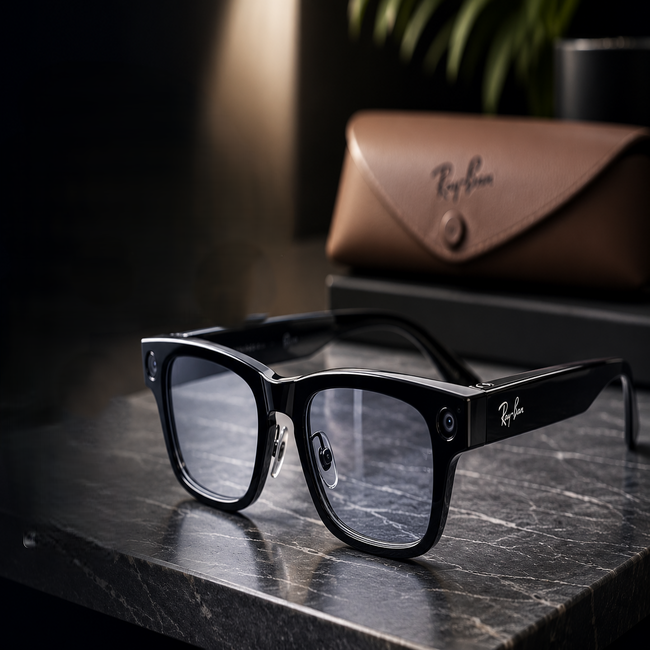
Meta has expanded its Ray-Ban Meta smart glasses lineup with Blayzer, a new prescription-focused model designed for users who rely on everyday eyewear, as competition in AI-powered wearables continues to grow.
The new Ray-Ban Meta Blayzer is part of Meta’s broader push to make smart glasses more practical for daily use rather than positioning them only as lifestyle or experimental devices. The model has been designed specifically for prescription wearers and is expected to support a wider range of lens requirements through optical retail partners.
The development comes as Meta and eyewear partner EssilorLuxottica continue building their AI glasses portfolio across Ray-Ban and Oakley-branded products. The companies have increasingly focused on combining familiar eyewear design with hands-free AI features, voice interaction, audio, camera functions and connected experiences.
Blayzer introduces a rectangular frame style and is aimed at consumers who want prescription glasses that can also function as connected AI wearables. The product is expected to be available in standard and larger sizes, with design adjustments intended to improve comfort for all-day use.
According to company details cited in reports, the prescription-optimised glasses include adjustable features such as overextension hinges, interchangeable nose pads and optician-adjustable temple tips. These additions are meant to address fit and comfort, two areas that are important for users who wear glasses throughout the day.
The glasses are expected to support core Ray-Ban Meta capabilities, including hands-free photo and video capture, calling, music playback, livestreaming and access to Meta AI. Users can interact with the glasses through voice commands and receive responses through open-ear speakers built into the frame.
Meta has also been adding AI-enabled software functions to its smart glasses ecosystem, including visual assistance, translation, reminders and contextual responses. These features are part of the company’s attempt to position AI glasses as a practical interface for everyday computing.
The prescription-focused launch is significant because it addresses a key adoption barrier for smart glasses. While many consumers need vision correction, earlier smart glasses were often designed first as sunglasses or tech accessories, with prescription support treated as an add-on. Blayzer shifts that approach by treating prescription wearers as a primary user segment.
Industry analysts say the move could help Meta reach a broader consumer base at a time when wearable AI devices are gaining renewed attention. Smart glasses are increasingly being viewed as a possible next interface after smartphones, especially as AI assistants become more conversational and context-aware.
The wearable AI market has also become more competitive, with technology companies exploring glasses, pins, watches, earbuds and other devices that can deliver continuous AI assistance. Meta’s advantage lies in its partnership with Ray-Ban, which gives the product a familiar fashion identity rather than a purely technical appearance.
The launch also comes as concerns around privacy, recording indicators and responsible AI usage remain part of the wider smart glasses debate. Devices with built-in cameras and microphones are likely to face continued scrutiny from regulators, consumers and privacy advocates.
For marketers and consumer technology companies, the product reflects a broader shift toward ambient AI experiences, where digital assistants are embedded into everyday objects and routines. If adoption grows, smart glasses could become important touchpoints for content, commerce, search, navigation and social interaction.
Meta has not positioned Blayzer as a replacement for smartphones, but the product underlines how the company is trying to build wearable AI into more routine consumer behaviour. As AI hardware evolves, prescription-ready smart glasses may become an important step toward making connected eyewear more mainstream. The company is likely to expand the category gradually as hardware improves and everyday consumer use cases become clearer across global markets.