
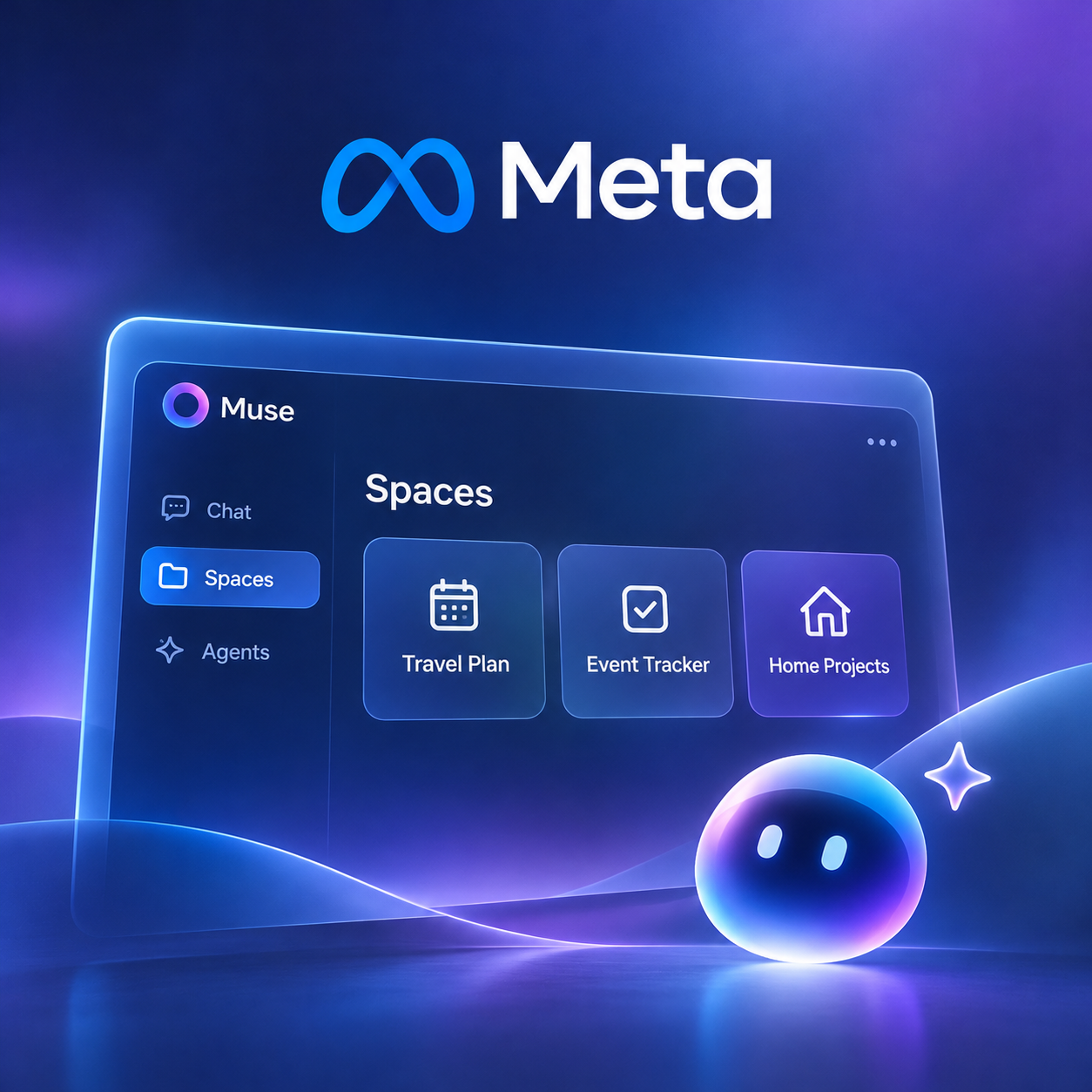

Meta has introduced Spaces, a new feature for its Muse AI agents that allows users to create dedicated workspaces for planning activities, organising information and managing ongoing projects through artificial intelligence.
Announced on November 6, the feature enables users to build customised spaces within the Muse interface by describing their requirements in a conversation with the AI agent.
Rather than managing multiple tasks within a single conversation, users can create separate spaces for individual activities and return to them whenever they need to review information or continue working on a project.
According to Meta, Spaces can be configured as trackers, planners or project boards, depending on the instructions provided by users.
For example, a user planning a holiday can create a dedicated space to organise travel-related information, while another can use the feature to maintain a gift tracker, coordinate a wedding or manage home improvement projects.
These spaces appear in the sidebar of the Muse interface, allowing users to access individual projects without starting a new conversation each time.
The feature also supports connections with third-party applications and information sources, enabling spaces to reflect changes without requiring users to manually request every update.
Meta said connected spaces can update information in the background, including concert schedules, price changes and progress towards savings goals.
The functionality is intended to extend Muse beyond responding to individual prompts by allowing its agents to support activities that require ongoing monitoring and organisation.
Meta CEO Mark Zuckerberg shared examples of how he had been using the feature, including creating a barbecue game, an event tracker and a home control dashboard.
He explained that users could describe what they wanted Muse to build, with the agent generating a corresponding space based on those instructions.
The announcement follows Meta's recent introduction of Muse agents, which combine conversational AI capabilities with animated avatars designed for consumer interactions.
During the company's October earnings call, Zuckerberg said Muse agents had reached 10 million users across the United States and Canada within two months of their introduction.
Spaces is the second addition to Muse announced within the same week.
On November 5, Meta introduced Muse Voice, a feature that allows users to communicate with their AI agents through spoken commands and video conversations.
Together, the updates expand the ways users can interact with Muse and assign tasks to its agents.
The development comes as technology companies continue introducing AI assistants designed to support recurring activities rather than responding exclusively to one-time requests.
Meta's approach combines conversational interaction with persistent project spaces and connections to external applications.
However, the company has not disclosed detailed information about the geographic availability of Spaces, the full range of supported integrations or any subscription requirements.
Further details regarding broader availability and additional functionality have yet to be announced.
Disclaimer: This article may include information derived from interviews, press releases, public statements, research, company communications and other publicly available or third-party sources. Such material may be summarised, paraphrased or contextualised for journalistic and editorial purposes. All rights in third-party content remain with their respective owners.