
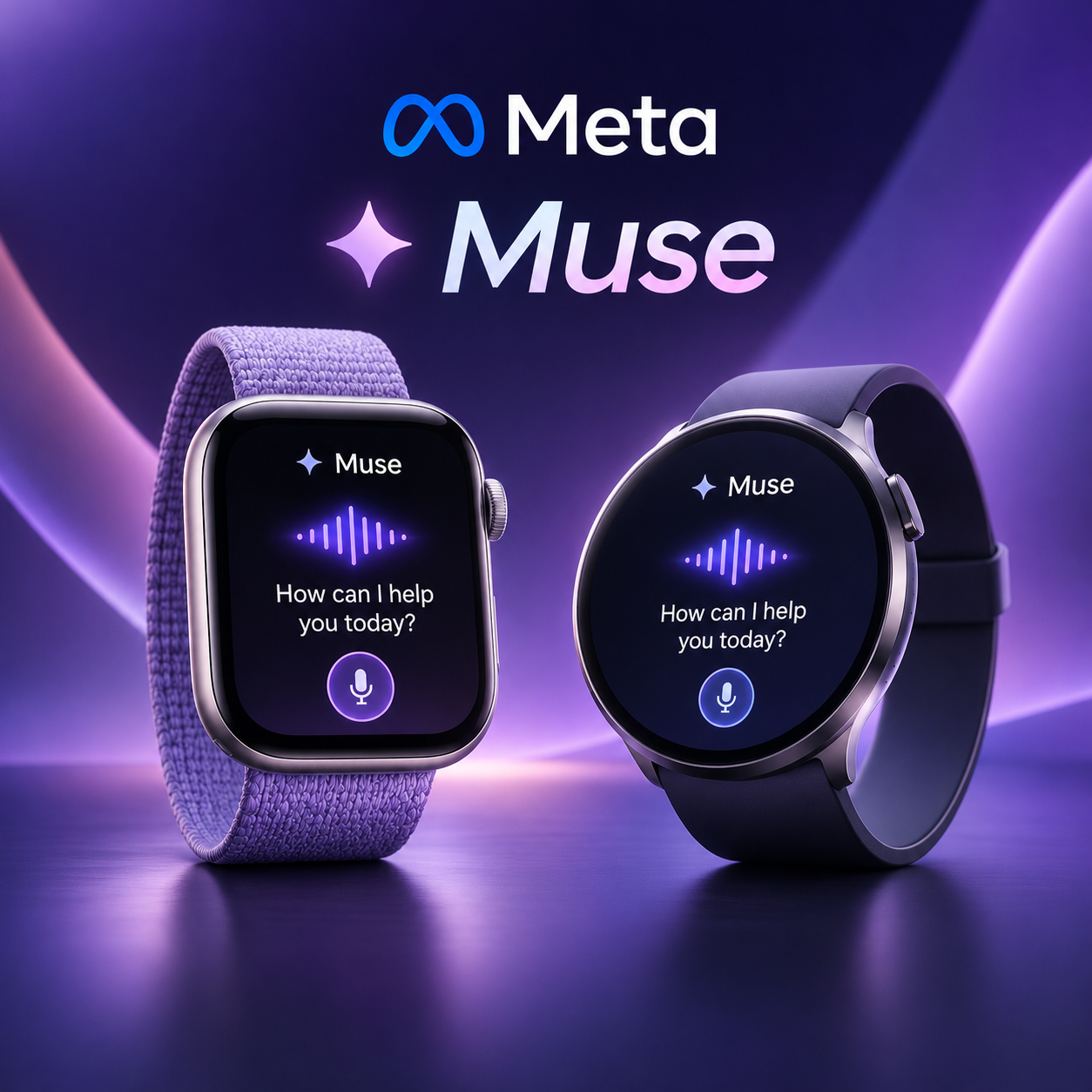

The expansion allows smartwatch users to interact with Meta's AI assistant through voice calls, messages and dictation, extending its availability beyond smartphones and tablets.
Meta has expanded its artificial intelligence agent, Muse, to Apple Watch and Google's Wear OS, allowing users to access the assistant directly from their smartwatches. Announced on November 9, 2026, the rollout introduces voice and text-based interactions on wearable devices as the company continues to expand its consumer AI offerings.
With the new integration, users can communicate with Muse through voice calls, text messages and dictation without needing to interact directly with their smartphones. The expansion is intended to make the assistant accessible across additional devices, enabling users to manage tasks through their smartwatches.
Muse is designed to function as an AI agent capable of carrying out activities on behalf of users through connected accounts and services. Its capabilities include managing emails, scheduling meetings, handling bills, making reservations, ordering groceries and completing purchases.
The assistant also supports goal-setting and task management, allowing users to organise activities through conversational interactions.
The smartwatch rollout follows Meta's introduction of a dedicated Muse application for iPad in October. The AI assistant initially launched on Apple's App Store in September 2026, marking the company's entry into a growing market for consumer-facing AI agents.
Since its launch, Meta has introduced several features aimed at expanding Muse's functionality across communication, collaboration and personal assistance.
Earlier this month, the company introduced Spaces, a feature that allows users to create dedicated conversations around specific topics or objectives. These spaces function as personalised environments where the AI agent can work towards a particular goal.
The feature appears within the Muse interface and enables users to organise conversations according to individual tasks or ongoing activities.
Meta has also introduced video conversations with Muse's AI avatar for users in the United States. The feature allows users to communicate with the assistant through real-time audio interactions accompanied by animated facial expressions and gestures.
According to Meta, the avatar adjusts its expressions and movements based on the tone and context of conversations. However, the assistant does not visually observe users during these interactions and instead relies on audio input.
Users can also customise their Muse avatars, choosing appearances resembling people, animals or other characters.
The company's expansion comes amid growing adoption of consumer AI applications. Muse surpassed 10 million downloads in the United States within its first 40 days on Apple's App Store, becoming one of 12 applications to achieve the milestone.
The latest rollout extends Muse's availability to wearable devices, providing another interface for accessing AI-powered assistance.
Meta has not disclosed separate adoption figures for the smartwatch applications or detailed performance metrics for the wearable experience.
The expansion adds to Meta's efforts to make Muse accessible across multiple devices as AI assistants increasingly support everyday digital activities.
Disclaimer: This article may include information derived from interviews, press releases, public statements, research, company communications and other publicly available or third-party sources. Such material may be summarised, paraphrased or contextualised for journalistic and editorial purposes. All rights in third-party content remain with their respective owners.