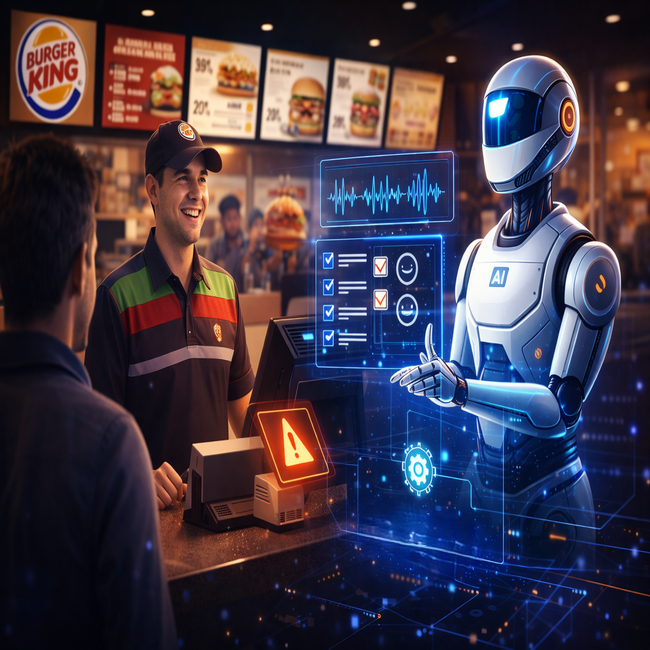

Burger King is testing an artificial intelligence powered assistant designed to monitor and evaluate customer interactions across select locations, as part of broader efforts to improve service quality and operational consistency. The pilot underscores how global quick service restaurant chains are turning to AI to enhance frontline performance and customer experience.
According to reports, the AI assistant is being deployed to analyse conversations between staff and customers, with the objective of identifying patterns, measuring service standards and offering feedback. The system is intended to help franchise operators and store managers gain insights into employee performance and customer engagement in real time.
The move reflects a growing trend within the retail and food service sectors, where companies are leveraging AI driven analytics to streamline operations and maintain brand consistency. In highly competitive markets, even incremental improvements in service speed and order accuracy can influence customer loyalty and revenue.
Burger King’s pilot reportedly focuses on voice based interactions, enabling the AI system to process and assess verbal exchanges at counters and drive through lanes. By analysing tone, language and transaction details, the assistant can flag deviations from service protocols and suggest areas for improvement.
Industry analysts note that quick service restaurants handle high volumes of transactions daily, making manual monitoring of service quality both time consuming and inconsistent. AI tools that automate performance evaluation can provide managers with structured data rather than anecdotal feedback.
The testing phase is expected to assess the technology’s accuracy, scalability and impact on employee workflows. While automation can offer efficiency gains, companies must balance technological adoption with employee privacy considerations and customer transparency.
Artificial intelligence has already found applications in the fast food industry, from predictive inventory management to personalised digital marketing. Some chains have introduced AI driven menu boards that adjust promotions based on time of day, weather or purchasing patterns. Others have implemented chatbots and automated ordering systems to reduce wait times.
Burger King’s experiment with an AI monitoring assistant extends this digital transformation into employee performance management. By capturing and analysing interaction data, the system may help standardise customer service across franchises, particularly in markets with diverse operating practices.
From a martech perspective, the development highlights how AI is reshaping customer journey analytics. Traditionally, customer satisfaction metrics have relied on surveys and post purchase feedback. Real time conversational analysis offers a more immediate and granular view of service dynamics.
However, experts caution that the deployment of AI monitoring tools requires clear governance frameworks. Employee consent, data protection and compliance with local labour regulations are critical factors. Organisations adopting such systems must ensure that data collection aligns with privacy laws and ethical standards.
For franchise driven brands like Burger King, maintaining consistent service quality across independently operated outlets presents ongoing challenges. AI based monitoring tools could provide centralised visibility while allowing local managers to act on specific insights.
The broader food service industry has faced pressures including rising labour costs, supply chain volatility and shifting consumer expectations. Technology adoption has emerged as a lever to offset operational strain and enhance efficiency. AI powered systems that analyse service interactions may contribute to improved training and faster issue resolution.
Consumer perceptions will also influence the success of such initiatives. Transparency around how interaction data is used and safeguarded may be important in maintaining trust. Companies must communicate that AI tools are intended to enhance service rather than penalise employees unfairly.
In addition to performance insights, AI driven monitoring could help identify trends in customer sentiment. For example, recurring complaints about wait times or product availability may surface through aggregated data analysis, enabling proactive adjustments.
The pilot comes at a time when generative AI and conversational intelligence technologies are advancing rapidly. Improvements in natural language processing and speech recognition have expanded the scope of real time analytics in commercial settings.
If successful, the initiative could pave the way for broader deployment across Burger King’s network. Scaling such systems would involve integration with existing point of sale infrastructure and training programmes for staff and managers.
As digital transformation accelerates across the hospitality sector, AI powered tools are increasingly moving from back end analytics to frontline operations. Burger King’s trial illustrates how brands are exploring technology to refine everyday customer interactions.
The long term impact of AI monitoring on service quality and employee engagement will depend on implementation strategies and measurable outcomes. For now, the pilot signals continued experimentation within the quick service industry as companies seek data driven approaches to enhance competitiveness.
Related Articles