For five days in New Delhi, the future of artificial intelligence did not unfold quietly in labs or boardrooms. It unfolded on a global stage.
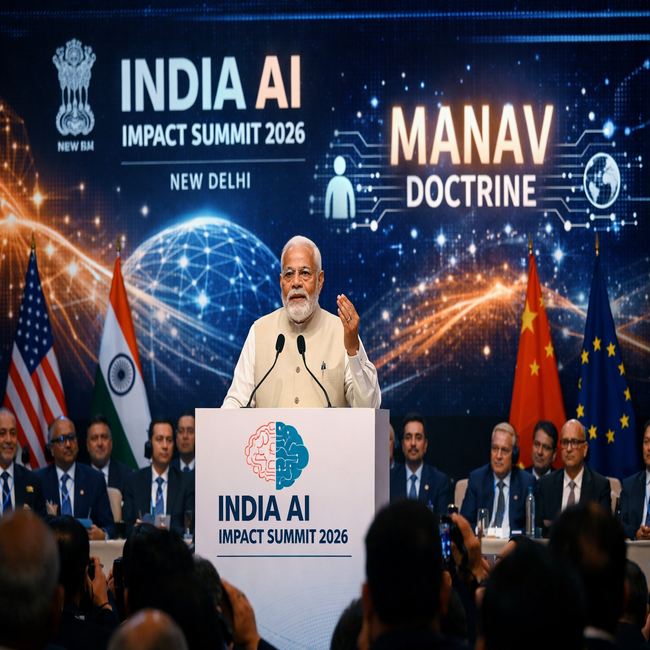
Prime ministers, presidents, billionaire tech CEOs, and founders of emerging AI startups gathered at Bharat Mandapam for the India AI Summit 2026, an event that many leaders described as a turning point not just for India, but for the global AI order itself.
What emerged was not merely a conference. It was a declaration of intent. India is no longer positioning itself as an adopter of AI. It is positioning itself as an architect of the AI era.
From sovereign AI models and trillion-rupee infrastructure ambitions to global declarations signed by dozens of countries and unprecedented commitments from companies like Google and Microsoft, the summit marked a moment where India stepped firmly into the center of the global AI conversation.
“This progress shows what’s possible when humanity dreams big,” said Google CEO Sundar Pichai, capturing the ambition that defined the summit.
India positions itself as the bridge between AI superpowers and the Global South
The summit opened with a clear theme. AI will define the next global order, and India intends to shape how it unfolds.
Prime Minister Narendra Modi set the tone by framing artificial intelligence as a tool for inclusive development, not just economic growth.
“Our goal is clear. AI should be used for shaping humanity, inclusive growth, and a sustainable future,” he said during his address.
The message resonated beyond India’s borders. Leaders from across Europe, Asia, and Latin America attended, underscoring India’s growing role as a diplomatic and technological bridge between developed and developing nations.
Former UK Prime Minister Rishi Sunak called India the ideal venue for shaping the global AI future.
“There is no better place to discuss this AI transformation than India,” he said, highlighting India’s digital infrastructure and innovation ecosystem.
The summit culminated in the adoption of the Delhi Declaration, a global framework endorsed by dozens of countries outlining principles for safe, inclusive, and trustworthy AI.
The declaration emphasized equitable access, global cooperation, and the need to prevent AI from deepening inequality between nations.
For the first time, a major global AI framework emerged not from Silicon Valley, London, or Beijing, but from New Delhi.
Big Tech commits billions as India becomes the next AI infrastructure hub
If the diplomatic messaging was powerful, the economic commitments were even more significant.
Google announced a massive expansion of its AI and cloud infrastructure in India, including plans to build one of its largest AI data center facilities in Visakhapatnam. The investment is expected to power AI systems serving hundreds of millions of users and businesses.
“No technology has me dreaming bigger than AI,” Pichai said. “It is the biggest platform shift of our lifetimes.”
Microsoft, meanwhile, announced a $50 billion commitment aimed at expanding AI access across developing economies, with India positioned as a central hub.
Brad Smith, Vice Chair and President of Microsoft, warned that the world faces a growing AI divide.
“Unless we act with urgency, a growing AI divide will perpetuate this disparity in the century ahead,” he said.
The investments signal a fundamental shift. Global AI infrastructure is no longer concentrated exclusively in Western economies. India is rapidly becoming one of its central nodes.
This shift is driven by several structural advantages.
India has one of the world’s largest pools of software engineers, one of the fastest growing startup ecosystems, and digital public infrastructure such as Aadhaar and UPI that have already demonstrated the ability to operate at massive scale.
For global AI companies, India represents both a market and a laboratory.
India launches sovereign AI models to control its technological destiny
Perhaps the most strategically significant announcement came from the Indian government itself.
India unveiled plans to build sovereign AI models trained on Indian languages, Indian datasets, and optimized for Indian use cases.
This move reflects a growing global realization. AI models trained primarily on Western data cannot adequately represent the linguistic, cultural, and economic diversity of countries like India.
Twelve consortia involving startups, academic institutions, and technology organizations have been selected to develop these indigenous models.
The initiative is part of a broader push to build national AI infrastructure and ensure technological independence.
Union Minister Ashwini Vaishnaw emphasized the importance of sovereignty in AI development.
“AI’s promise is best realized only when its benefits are shared by humanity,” he said.
The initiative will also help India reduce reliance on foreign AI platforms and ensure greater control over data, privacy, and strategic capabilities.
Indian startups demonstrate AI innovation tailored for real-world scale
Beyond the geopolitical and economic announcements, the summit showcased tangible innovation from Indian startups.
Sarvam AI unveiled voice-enabled AI systems capable of interacting in more than 20 Indian languages, reflecting India’s linguistic diversity.
These systems could transform access to AI across sectors such as education, healthcare, and financial services.
Unlike traditional AI systems designed primarily for English users, these models are designed for India’s multilingual population.
Another standout demonstration came from robotics company Ottonomy, which showcased autonomous delivery robots capable of navigating complex urban environments.
The robots are designed to operate in airports, hospitals, and commercial environments, offering a glimpse into the future of AI-powered logistics.
These innovations highlight a key difference in India’s AI trajectory.
While Silicon Valley has focused heavily on large language models and enterprise software, Indian startups are focusing on real-world deployment at scale.
AI in India is being designed not just for productivity gains, but for societal transformation.
AI moves from experiment to national infrastructure
One of the most striking themes of the summit was the shift in how leaders view AI.
AI is no longer seen as an experimental technology.
It is increasingly being treated as national infrastructure, similar to electricity, telecommunications, or transportation.
This shift was reflected in announcements related to healthcare, governance, and public services.
India launched initiatives to integrate AI into disease detection, healthcare diagnostics, and public service delivery.
Union Health Minister J.P. Nadda emphasized that AI must be deployed responsibly.
“AI does not operate in isolation. It thrives on strong digital infrastructure and high-quality data,” he said.
This infrastructure-first approach aligns with India’s broader digital transformation strategy.
India has already demonstrated its ability to deploy technology infrastructure at national scale through initiatives like Aadhaar and UPI.
AI is now becoming the next layer of that digital infrastructure.
AI becomes the defining geopolitical and economic battleground
Beyond the announcements, the summit revealed a deeper shift.
Artificial intelligence is emerging as the central geopolitical and economic battleground of the 21st century.
Countries are racing to build their own AI capabilities, attract investment, and ensure technological sovereignty.
Companies are racing to control infrastructure, talent, and platforms.
India’s emergence as a major AI player reshapes the global balance.
It introduces a new center of gravity in AI development.
It creates alternatives to US- and China-dominated ecosystems.
It opens new opportunities for innovation tailored to emerging markets.
It also introduces new competition.
For global AI companies, India is no longer just a market.
It is a strategic partner and a potential competitor.
Why the India AI Summit marks a historic turning point
Several factors make the India AI Summit a defining moment.
First, it demonstrated that leadership in AI is no longer confined to traditional technology hubs.
Second, it highlighted India’s unique ability to combine scale, talent, and infrastructure.
Third, it brought together political leaders and technology companies in a coordinated push toward AI development.
Fourth, it introduced concrete initiatives that will shape the future of AI, from sovereign models to global infrastructure investments.
Most importantly, it signaled a shift in narrative.
India is no longer talking about catching up in AI.
It is talking about leading.
“This AI impact summit has been a grand success on many fronts,” said Ashwini Vaishnaw. “The world has confidence in India’s role in the new AI age.”
The future of AI may now be written in India
The implications of the summit extend far beyond the event itself.
The infrastructure investments will accelerate AI deployment across industries.
The sovereign AI initiatives will strengthen technological independence.
The global partnerships will reshape the global AI ecosystem.
The startup innovations will bring AI to millions of new users.
For marketers, businesses, and technology leaders, the message is clear.
India is becoming one of the most important markets and innovation centers for AI in the world.
The global AI race is entering a new phase.
And India is no longer on the sidelines.
It is at the center of it.
Disclaimer: All data points and statistics are attributed to published research studies and verified market research. All quotes are either sourced directly or attributed to public statements.
Related Articles