
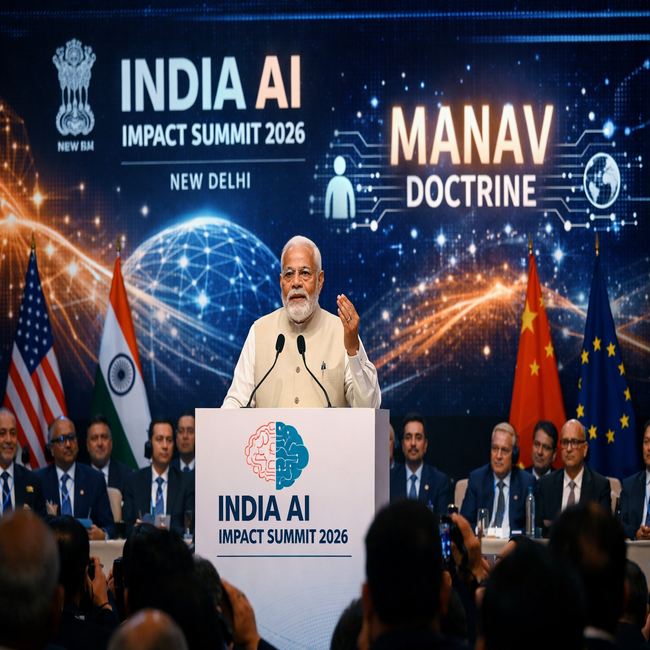

New Delhi, February 19, 2026: India’s artificial intelligence ambitions moved from policy rhetoric to global execution on Thursday as Prime Minister Narendra Modi inaugurated the India AI Impact Summit at Bharat Mandapam, signaling the country’s clearest assertion yet that it intends to become not just a participant in the AI economy, but one of its defining powers.
The first full day of the summit brought together heads of state, global technology CEOs, sovereign funds, startup founders, and policymakers in what is now being seen as a turning point in India’s AI trajectory. Beyond ceremonial speeches, the day delivered concrete signals across three fronts: India’s positioning as a global AI governance voice, massive investment momentum into domestic AI infrastructure, and the emergence of sovereign AI as a strategic national priority.
At the center of it all was Modi’s unveiling of India’s “MANAV” doctrine for artificial intelligence, a framework designed to anchor AI development in human-centric values while accelerating domestic innovation and infrastructure.
India introduces its first coherent AI governance doctrine
In his keynote, Modi introduced what he described as the MANAV framework, outlining India’s philosophical and operational approach to artificial intelligence. The doctrine positions AI not merely as a commercial technology but as a societal infrastructure that must remain accountable, inclusive, safe, and human-aligned.
The framework reflects India’s attempt to distinguish itself from both the market-led AI model of the United States and the state-controlled AI model of China. Instead, India is presenting itself as a democratic AI power capable of building scalable systems while maintaining openness, accountability, and accessibility.
The doctrine also aligns with India’s broader geopolitical positioning. Rather than importing AI governance frameworks from Western institutions, India is now actively attempting to shape global standards, particularly for emerging markets across Asia, Africa, and Latin America.
This marks a shift in India’s technology diplomacy. For decades, India’s technology narrative centered around services and talent. February 19 signaled a clear move toward leadership in foundational technology and governance.
India emerges as a global convening power in artificial intelligence
The scale and composition of participation underscored India’s growing importance in global AI conversations. Government leaders, technology executives, investors, and multilateral institutions gathered in New Delhi to discuss AI infrastructure, regulation, investment, and economic transformation.
The summit saw participation from global technology firms, sovereign investors, and AI startups, reflecting India’s importance both as a talent hub and as a growth market. Leaders discussed not only technological innovation but also AI safety, compute access, and global regulatory alignment.
This positioning matters strategically. Global AI leadership is currently concentrated among a small number of countries, primarily the United States and China. India is now actively inserting itself into that leadership group by combining talent, infrastructure expansion, and policy clarity.
The summit demonstrated that India is no longer simply reacting to global AI trends. It is attempting to shape them.
Massive infrastructure momentum signals India’s AI scaling phase has begun
One of the most consequential developments on February 19 was the wave of infrastructure commitments and expansion plans discussed during the summit.
Global technology firms and Indian conglomerates are accelerating investments in data centers, compute infrastructure, and AI deployment capabilities. These investments are critical because compute infrastructure has become the foundational constraint in artificial intelligence development.
India’s current AI compute capacity remains significantly smaller than that of the United States and China. However, the summit made clear that both government and industry are moving aggressively to close this gap.
Several major initiatives were highlighted:
-
Expansion of AI-optimized data center infrastructure
-
Development of domestic AI training and deployment environments
-
Establishment of new AI hubs to support enterprise adoption
-
Increased partnerships between global technology companies and Indian ecosystem players
These developments reflect a structural shift. India’s AI ecosystem is moving from experimentation and pilot deployments toward industrial-scale infrastructure build-out.
This transition is critical because infrastructure, not algorithms, now defines global AI competitiveness.
India’s sovereign AI push moves from concept to execution
Perhaps the most strategically important theme emerging from February 19 was India’s push toward sovereign AI capabilities.
Sovereign AI refers to a country’s ability to build, deploy, and operate artificial intelligence systems using domestic infrastructure, talent, and governance frameworks. It has become a central strategic priority globally as governments recognize AI’s implications for national security, economic competitiveness, and technological independence.
India’s sovereign AI ambitions include:
-
Building domestic compute capacity
-
Developing indigenous AI models
-
Ensuring data sovereignty
-
Reducing dependence on foreign infrastructure providers
Government initiatives under the IndiaAI Mission are designed to accelerate this transition. The mission aims to strengthen India’s domestic AI ecosystem across research, startups, infrastructure, and talent development.
India’s sovereign AI push is driven by both economic and strategic motivations. Artificial intelligence is expected to contribute significantly to global economic growth over the next decade, and countries with domestic capabilities will capture disproportionate value.
February 19 made clear that India intends to be among those countries.
India’s talent advantage becomes its strongest strategic asset
India’s AI strategy rests heavily on its talent base, which is one of the largest in the world. The country already has millions of software engineers and a rapidly expanding AI workforce.
India produces hundreds of thousands of engineering graduates each year, and global technology firms have long relied on India as a key talent hub. However, historically much of this talent contributed to global companies rather than domestic AI infrastructure.
That dynamic is now changing.
As domestic infrastructure expands and local AI startups scale, India’s talent is increasingly being deployed toward building indigenous AI capabilities rather than supporting foreign ecosystems.
This shift is critical for India’s long-term competitiveness.
Countries that combine talent, infrastructure, and capital tend to emerge as technology leaders. February 19 demonstrated that India is now building all three simultaneously.
AI transitions from enterprise experimentation to national infrastructure
Another key theme emerging from summit discussions was the transition of artificial intelligence from enterprise experimentation to national infrastructure.
AI is no longer viewed solely as a tool for improving efficiency in individual companies. It is increasingly being seen as a foundational layer across sectors, including healthcare, education, governance, agriculture, and public services.
India showcased several examples of AI deployment in public services, including education platforms and citizen service delivery systems.
These deployments illustrate how AI is becoming embedded into national systems rather than remaining confined to private sector use cases.
This transition significantly expands the economic and societal impact of AI.
India positions itself as the global AI partner for emerging markets
India’s messaging throughout February 19 emphasized accessibility and inclusion. This positioning reflects India’s broader strategy of becoming the preferred AI partner for emerging markets.
Many developing countries lack the infrastructure, talent, and capital required to build independent AI ecosystems. India is positioning itself as a collaborator capable of providing technology, infrastructure, and expertise.
This strategy mirrors India’s earlier success in digital public infrastructure, including Aadhaar and UPI, which became global reference models.
Artificial intelligence may become the next phase of that strategy.
If successful, India could play a central role in shaping AI adoption across large parts of the developing world.
Global power dynamics in AI begin to shift
The summit also reflected broader shifts in global AI power dynamics.
Until recently, artificial intelligence leadership was concentrated in Silicon Valley and a small number of Chinese technology firms. However, the rapid expansion of AI adoption globally has created opportunities for new entrants.
India is uniquely positioned due to its scale, talent, and government support.
Unlike smaller technology ecosystems, India combines a massive domestic market with strong technical talent and growing infrastructure investment.
This combination creates the conditions necessary for sustained AI leadership.
February 19 marked India’s clearest assertion yet that it intends to occupy that role.
India’s AI ambitions now move into execution phase
The significance of February 19 lies not only in announcements but in strategic clarity.
India has now articulated a coherent AI doctrine, accelerated infrastructure investment, strengthened sovereign AI ambitions, and positioned itself as a global AI governance participant.
The summit demonstrated that India’s AI ambitions are no longer aspirational. They are operational.
The next phase will be defined by execution.
India must now translate doctrine into infrastructure, investment into innovation, and talent into global leadership.
The global AI race is still in its early stages.
On February 19, 2026, India made clear that it intends to run at the front.