


Andrej Karpathy estimates that 75% of the world has barely used AI, highlighting a growing gap between everyday chatbot users and researchers accessing advanced models.

xAI co-founder Igor Babuschkin’s River AI has raised $1.1 billion to expand tools that help enterprises customise AI models using their own data.
Consint.AI has raised Rs 22 crore in Series A funding to expand its AI-powered fraud detection, claims processing and risk management technology globally.

Jellyfish has expanded its Share of Model platform with AI-powered ad optimisation to help brands improve campaign performance and visibility across AI-driven discovery.
Meta has launched Muse Code, an AI coding agent built on Muse Spark 1.2 to help developers manage large codebases and automate software engineering workflows.
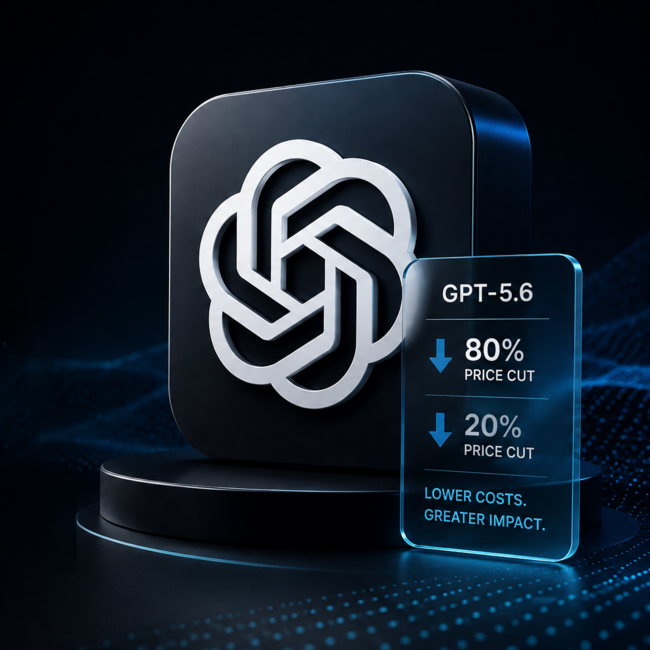
OpenAI has surpassed one billion active users while cutting GPT-5.6 pricing, making its AI models more affordable for developers and enterprises.

Apple is revamping Siri into a conversational AI chatbot, expanding Apple Intelligence to compete with ChatGPT, Gemini and other leading AI assistants.

Alibaba has launched Qwen3.8-Max, its most advanced AI model, claiming breakthrough performance as competition with leading US AI companies intensifies.

Sarvam has announced plans for a trillion-parameter AI model and launched a managed inference service to help developers and enterprises deploy AI applications at scale.

Anthropic has launched Claude Opus 5, a new enterprise AI model offering improved coding, reasoning and knowledge capabilities while reducing operational costs.

Google has launched Gemini 3.6 Flash and Gemini 3.5 Flash-Lite, introducing faster, more efficient AI models designed for developers, enterprise applications and AI agents.

Alibaba has unveiled a preview of its flagship Qwen3.8 AI model, positioning it among the world's most advanced large language models.

Mira Murati's Thinking Machines has launched Inkling, an open weight multimodal AI model designed for enterprise customisation and developer flexibility.

Anthropic has introduced rupee pricing for Claude, making its AI platform more accessible as India becomes one of the company's fastest growing markets.

Goldman Sachs has identified China's leading AI models, highlighting Alibaba Qwen, DeepSeek and GLM as competition with US AI developers intensifies.

SpaceXAI has launched Grok 4.5, its latest AI model focused on coding, enterprise productivity and lower inference costs as competition among AI developers intensifies.

Meta says its next AI model has reached GPT-5.5 level on internal benchmarks as it accelerates investments in frontier AI and enterprise capabilities.
Elon Musk has teased Grok 4.5, claiming xAI's upcoming model delivers performance comparable with the industry's leading AI systems.

An Oxford study finds that AI models with higher “temperature” settings tend to produce more errors, highlighting a trade off between creativity and accuracy.

Anthropic has launched a $100 million program to support startups and developers building applications using its Claude AI models.

OpenAI has introduced GPT-5.4 with improvements in reasoning, reliability and enterprise capabilities as generative AI adoption continues to expand.

Alibaba unveils open-source Qwen3.5-9B AI model that delivers competitive benchmark performance while running efficiently on modest hardware systems.

OpenAI reportedly hires a former Apple AI models head from Meta, highlighting intensifying competition for top generative AI talent.
SchemaNinja launches an AI-powered content marketing platform designed to help brands optimise structured data and improve visibility across large language models.

Microsoft has developed a new scanner that detects hidden backdoors and sleeper agent risks in large AI models, strengthening safeguards for AI deployment.
Meta has developed a new AI system that signals progress in advanced model efficiency, potentially reshaping competition in the generative AI landscape.

AI research firm DeepSeek has proposed a new mathematical framework to improve the stability and scalability of large language models.

Google DeepMind has invested in Indian AI startup CoRover AI, creator of BharatGPT, signalling growing global interest in India-focused language models.

Xiaomi launches MiMo-V2-Flash, an open source large language model designed for reasoning, coding and agent tasks with high speed and low cost access.

Swireasoning introduces a new reasoning framework that reduces large language model costs while enhancing efficiency, logic, and output accuracy for enterprises.

Mira Murati’s AI startup Thinking Machines has launched its first product, Tinker, enabling users to fine-tune large language models directly on personal laptops.

Mistral AI, the Paris-based startup, is challenging OpenAI with open-source large language models, driving global AI competition through accessibility and efficiency.

With AI transforming personalization strategies, marketers are taking a fresh look at third-party data—this time with a sharper focus on quality, compliance, and contextual insights.
