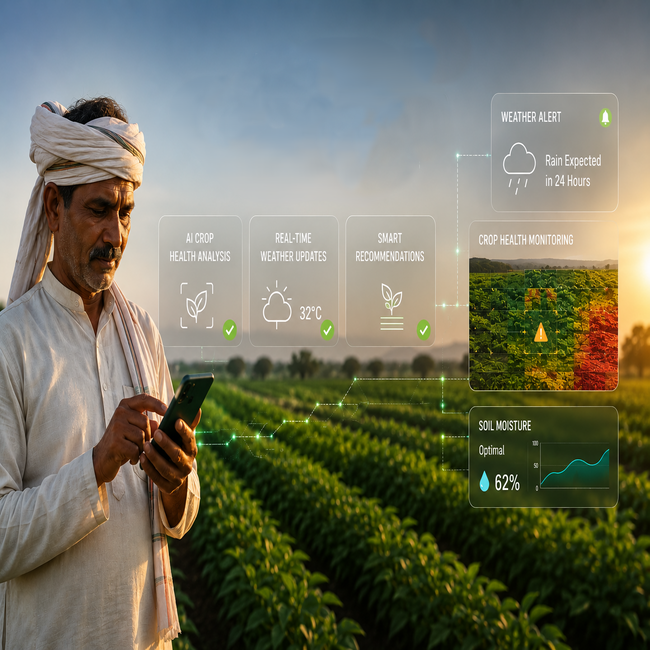
Farmers in Rajasthan are being introduced to artificial intelligence-powered tools designed to improve crop monitoring and provide real-time weather updates, as technology adoption accelerates across India’s agricultural sector.
The initiative aims to help farmers make faster and more informed decisions related to crop health, irrigation, pest management, and changing weather conditions. Officials associated with the programme said AI-based systems are being deployed to support productivity and reduce risks linked to climate variability and crop damage.
According to reports, the technology combines satellite imagery, weather forecasting systems, data analytics, and AI-powered monitoring to provide timely information directly to farmers. The tools are expected to assist users in identifying crop stress, disease outbreaks, water requirements, and adverse weather conditions before they significantly impact agricultural output.
Industry experts say AI adoption within agriculture is growing rapidly as governments, agritech companies, and research institutions increasingly focus on improving efficiency and sustainability within farming ecosystems. AI systems are being used globally for precision farming, soil analysis, irrigation planning, supply chain forecasting, and yield optimisation.
The Rajasthan initiative reportedly includes real-time weather alerts delivered through mobile-based platforms and digital communication systems. Farmers can receive updates regarding rainfall patterns, temperature fluctuations, storms, humidity levels, and other environmental conditions that may influence farming operations.
Agriculture remains highly dependent on weather conditions, particularly in states such as Rajasthan where water scarcity and extreme climatic conditions often affect crop cycles. Analysts say access to predictive weather intelligence could help farmers better plan sowing, irrigation, harvesting, and crop protection activities.
The AI tools are also expected to support early detection of crop diseases and pest infestations through image analysis and data-driven monitoring systems. Experts believe such technologies may help reduce dependence on reactive farming practices by enabling preventive action at earlier stages.
India’s agritech ecosystem has witnessed increasing investment over the past few years as digital technologies become more integrated into rural economies. Startups and technology providers are increasingly focusing on AI, IoT, drone monitoring, and satellite-based solutions for agricultural productivity.
Government agencies and agricultural institutions have also been promoting digital farming initiatives aimed at improving rural access to information and technology-driven decision-making. Analysts say AI-based agriculture systems could play an important role in improving efficiency while addressing long-term food security challenges.
The Rajasthan programme reflects broader national efforts to modernise farming through digital infrastructure and data-led agricultural practices. Technology companies and policymakers are increasingly exploring how AI can support small and medium-scale farmers facing unpredictable climate conditions and operational challenges.
Industry observers note that accessibility and digital literacy remain important factors for successful technology adoption in rural areas. Many agritech platforms are therefore focusing on simplified mobile interfaces, multilingual communication systems, and localised advisory support to improve usability among farming communities.
Experts also believe AI-powered agriculture tools could help optimise resource utilisation, particularly water and fertiliser management. Precision recommendations may reduce waste while improving crop quality and operational efficiency across farms.
At the same time, challenges including internet connectivity, affordability, infrastructure gaps, and awareness levels continue to affect large-scale adoption of digital farming technologies in several regions.
The integration of AI into agriculture comes as India increasingly positions technology as a critical component of rural development and economic growth. Analysts say data-driven farming systems could become more common across states as governments seek to improve resilience against climate-related disruptions.
The Rajasthan initiative highlights how artificial intelligence is gradually moving beyond urban industries into core sectors such as agriculture. As AI adoption expands across farming ecosystems, technology is expected to play a growing role in helping farmers manage uncertainty, improve productivity, and make more informed operational decisions in increasingly climate-sensitive agricultural environments across India in the years ahead.