
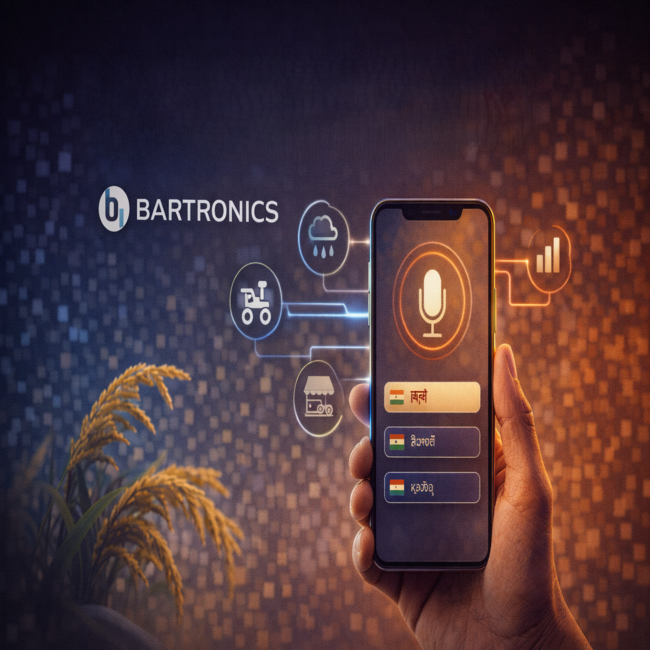

Bartronics India has announced plans to advance its rural agritech platform with the development of a voice-first multilingual mobile application aimed at improving access to digital services for farmers. The initiative reflects growing interest in using technology to bridge the gap between rural communities and the digital economy while addressing challenges related to language, accessibility and digital literacy.
The planned app is designed to support multiple local languages, enabling farmers to interact with digital tools and services through voice commands rather than text-based interfaces. This approach seeks to reduce barriers for users who may have limited literacy or familiarity with technology and to complement existing digital agriculture initiatives in India.
Bartronics India is developing the voice-first app to enhance its existing suite of agritech solutions, which focus on empowering farmers with information, market access and actionable insights. The company said the multilingual feature is intended to make the platform more inclusive and responsive to the diverse linguistic landscape of rural India.
The business environment for agritech has evolved rapidly in recent years as startups and technology firms explore ways to support farmers with tools for crop planning, weather forecasting, price discovery and supply chain integration. However, adoption of digital platforms remains uneven in rural regions, in part because of language differences and challenges with conventional user interfaces.
By incorporating voice-first capabilities, Bartronics India aims to allow users to seek agricultural advice, access market prices, receive personalised recommendations and connect with services in languages they are comfortable with. The company believes that enabling voice interactions will lead to higher levels of engagement and more effective use of digital resources.
The app’s development is aligned with broader national objectives to increase digital inclusion and leverage technology for economic empowerment. Rural populations often face structural challenges in accessing technology due to infrastructure limitations, device costs and skill gaps. Voice-based solutions can help overcome some of these constraints by offering more intuitive and context-aware interaction.
Bartronics India said the multilingual app will support a range of local languages spoken across different states. The inclusion of multiple languages is seen as a key differentiator, as many digital tools primarily operate in English or a limited number of languages that do not reflect the full linguistic diversity of rural users.
The initiative also reflects increasing use of artificial intelligence and natural language processing to enable more nuanced and reliable voice interactions. Advances in speech recognition technology have made it possible to support regional languages with a higher degree of accuracy, which is critical for applications where misinterpretation can lead to confusion or misguidance.
In addition to voice commands, the app will offer graphical interfaces and personalised dashboards tailored to specific crop cycles, seasons and local conditions. Bartronics India said the objective is to provide an integrated platform that can assist farmers at different stages of their agricultural activities.
Digital agriculture tools have been shown to improve efficiency, crop yields and income for farmers who adopt them. Market access and price transparency, in particular, have been identified as areas where technology can help small and marginal farmers negotiate better outcomes. Voice-first systems are expected to make these tools more accessible to a broader segment of the farming population.
Bartronics India’s announcement comes as policymakers, industry groups and development organisations increasingly focus on rural digitalisation. Government schemes have emphasised connectivity, digital literacy and creation of local language content for enhanced inclusion. Technology innovators are responding to these priorities with solutions that reflect local needs.
The company said it will pilot the voice-first app in select districts before scaling it more widely. Pilot testing will allow Bartronics India to gather feedback, refine language models and improve the overall user experience. This iterative approach is common in technology rollouts where user behaviour and contextual factors vary significantly.
Agritech observers noted that voice-enabled technology could contribute to faster adoption of digital services, but meaningful impact depends on complementary factors such as network availability and user support. In areas with limited mobile data connectivity, offline features and lightweight architectures can help reduce dependency on continuous internet access.
Bartronics India said it is exploring features that will allow some content to be accessed offline or with minimal data usage, recognising that intermittent connectivity remains an issue in many rural regions. Ensuring that core features work reliably under such conditions is considered essential for real-world adoption.
The planned voice-first app also aligns with broader trends in conversational interfaces across industries. Enterprises from healthcare to finance have introduced voice-based interaction models to simplify access for users with different levels of digital proficiency. In agritech, where users may be less familiar with smartphone interfaces, such modalities have particular relevance.
Bartronics India’s approach looks to combine linguistic inclusivity with contextual relevance specific to agriculture. By building features that consider seasonal patterns, local crop calendars and region-specific advisories, the platform seeks to deliver actionable insights rather than generic information.
In addition to language and voice capabilities, the company said it plans to integrate analytics tools that can generate personalised recommendations based on soil data, crop history and weather patterns. These insights can help farmers plan irrigation, fertiliser use and market timing more effectively.
The company also highlighted plans to collaborate with local extension services, agronomists and marketplace partners to enrich the value proposition. Such collaborations can support a more holistic ecosystem approach that goes beyond information provision to include facilitation of inputs and outputs.
Bartronics India’s voice-first multilingual app initiative illustrates how technology can be tailored to the socio-economic realities of rural users. By focusing on accessibility and user experience, the company aims to support digital adoption and improve outcomes for farmer communities.
The planned rollout is expected to generate insights into how voice and language technologies perform in diverse rural settings. Successful implementation may encourage other innovators to integrate similar capabilities into their platforms, contributing to a more inclusive digital transformation in agritech.
As Bartronics India moves forward with its voice-first strategy, the effectiveness of its approach will depend on user uptake, technology performance and integration with local ecosystems. The initiative reflects a broader shift towards more user centric design in digital agriculture, with the potential to broaden access to essential services for rural populations.