
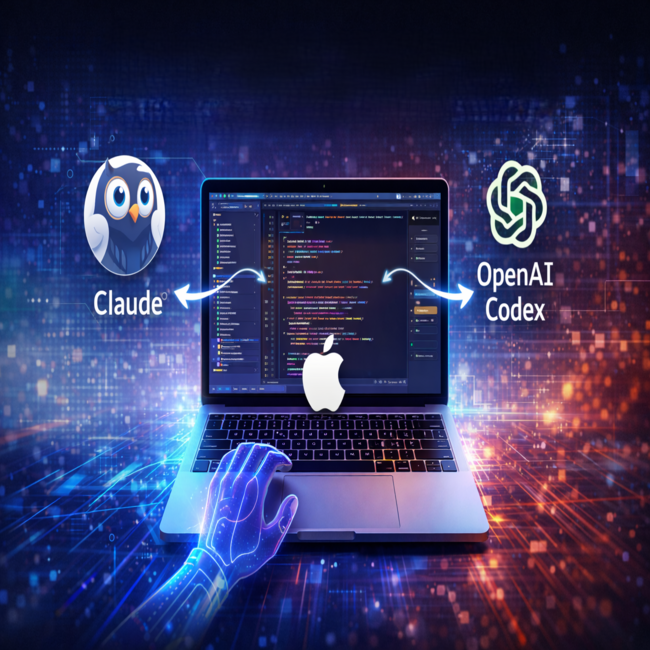

Apple has introduced agentic coding capabilities to its Xcode development environment, marking a significant step in the company’s expanding use of artificial intelligence to support software developers. The new functionality allows developers to delegate complex coding tasks to AI agents powered by Claude and OpenAI Codex, reflecting a broader shift toward more autonomous AI-assisted development workflows.
The update enables Xcode users to interact with AI agents that can plan, write, modify and test code across a project, rather than limiting assistance to simple code suggestions or autocomplete features. Agentic coding refers to AI systems that can take initiative, break tasks into steps and execute them with limited human intervention, while still operating within defined boundaries.
With the integration of Claude and OpenAI Codex, Apple is giving developers access to two widely used large language models directly within its integrated development environment. These models can be used to generate code, refactor existing functions, identify bugs and suggest fixes, streamlining workflows for both individual developers and larger teams.
Apple has positioned the new capabilities as optional tools that augment, rather than replace, human decision making. Developers can assign tasks to AI agents, review proposed changes and approve or reject modifications before they are applied. This approach is intended to maintain control and accountability while benefiting from automation.
The introduction of agentic coding in Xcode reflects growing demand for more advanced AI assistance in software development. As applications become more complex, developers are seeking tools that go beyond syntax help to support higher-level reasoning, debugging and project management tasks.
AI-assisted coding has gained traction across the industry, with several technology companies launching tools designed to improve developer productivity. Apple’s move brings these capabilities deeper into its own ecosystem, aligning Xcode with evolving expectations around intelligent development environments.
The integration supports tasks such as generating new features based on natural language prompts, updating code to meet changing requirements and running automated tests to validate changes. Developers can describe objectives in plain language and allow the AI agent to propose an implementation plan.
Apple has emphasised that the AI agents operate within the context of the developer’s project, using existing files, dependencies and conventions. This contextual awareness is critical to ensuring that generated code aligns with project architecture and coding standards.
The use of multiple AI models offers flexibility. Developers can choose between Claude and OpenAI Codex depending on the nature of the task or personal preference. This model-agnostic approach allows Apple to incorporate external innovation while retaining control over how AI is deployed within Xcode.
Security and privacy considerations remain central to Apple’s AI strategy. The company has indicated that safeguards are in place to prevent unintended data exposure and ensure that sensitive code remains protected. Developers retain visibility into how AI agents interact with their projects.
The agentic coding update also highlights Apple’s broader push into AI-driven tools across its platforms. While much attention has focused on consumer-facing AI features, the Xcode update underscores the company’s recognition that developers are a key audience for advanced AI capabilities.
Industry analysts note that agentic coding could significantly alter how software is built over time. By handling routine or repetitive tasks, AI agents can free developers to focus on design, architecture and problem solving. However, effective use requires careful oversight to avoid errors or unintended consequences.
Apple’s implementation seeks to balance efficiency with responsibility. By keeping developers in the approval loop, the company aims to reduce risks associated with autonomous code changes while still offering meaningful productivity gains.
The move may also influence how developers evaluate development platforms. Integrated AI tools can become a differentiating factor, particularly for teams working on large or fast-moving projects. Apple’s approach could help reinforce Xcode’s position among developers building for Apple platforms.
At the same time, the adoption of agentic coding raises questions about skills and workflows. Developers may need to adapt to new ways of working, shifting from writing every line of code to supervising and refining AI-generated output.
Apple has framed the update as an evolution of existing developer tools rather than a radical departure. AI agents are presented as collaborators that assist with execution, while strategic decisions remain with humans.
The integration of Claude and OpenAI Codex also reflects the growing role of partnerships in AI development. Rather than building all models in-house, Apple is leveraging external expertise while embedding AI into its own products.
For developers, the update offers a glimpse into how AI could reshape daily workflows. Tasks that once required hours of manual effort may be completed more quickly, provided that outputs are carefully reviewed and tested.
The rollout of agentic coding capabilities is expected to continue evolving based on developer feedback. As usage patterns emerge, Apple may refine how AI agents are configured and how tasks are delegated.
The update also aligns with broader trends toward automation in software engineering. As demand for software grows, tools that improve efficiency and reduce friction are increasingly important.
Apple’s introduction of agentic coding in Xcode signals a commitment to supporting developers with more advanced AI tools. By integrating Claude and OpenAI Codex, the company is embracing a future where AI plays a more active role in building software, while maintaining an emphasis on control, security and developer oversight.
As AI continues to advance, features like agentic coding may become standard expectations rather than experimental additions. Apple’s move places Xcode among the development environments exploring this next phase of AI-assisted software creation.