
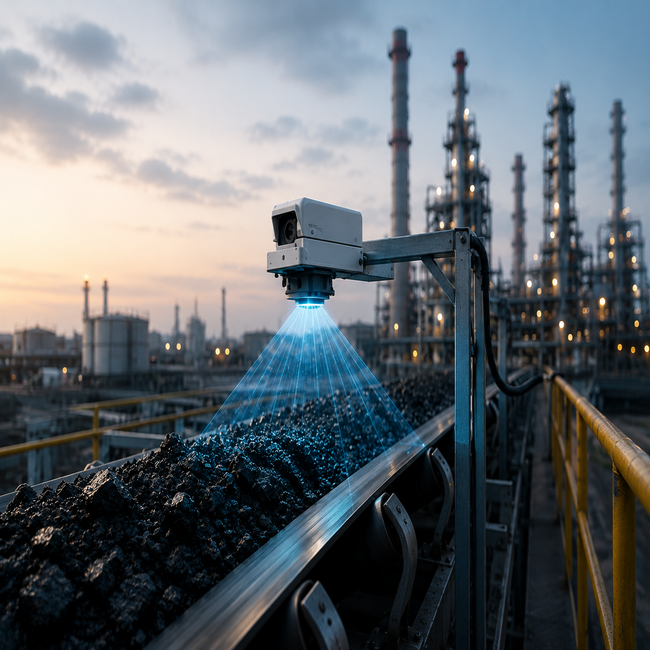

Manipal Academy of Higher Education (MAHE) and chemicals manufacturer GHCL Limited have entered into a research collaboration to develop an artificial intelligence-enabled system for real-time monitoring of fuel quality in industrial operations.
The collaboration brings together researchers from Manipal Institute of Technology (MIT), Manipal, a constituent unit of MAHE, and GHCL to work on an AI-based solution aimed at monitoring the quality of solid fuels used in industrial boilers.
The project will focus on developing a system capable of estimating key fuel quality parameters in real time. The initiative is expected to combine artificial intelligence and computer vision techniques to analyse fuel characteristics and provide data that can support industrial operations and combustion management.
Fuel quality is an important variable in industrial boiler operations as changes in parameters such as moisture and ash content can affect combustion efficiency and overall plant performance. Conventional testing methods can involve collecting samples and conducting laboratory analysis, which may result in a time gap between sampling and the availability of results.
The proposed AI-enabled approach seeks to reduce this dependence on delayed analysis by providing information closer to real time. This could allow plant operators to identify variations in fuel characteristics earlier and make operational adjustments based on the data generated by the system.
As part of the research, the teams will work on the development and validation of the technology under industrial conditions. The project is expected to examine how AI models and imaging-based techniques can be deployed to assess fuel properties without relying solely on conventional laboratory testing.
The collaboration reflects the increasing use of artificial intelligence in manufacturing, where companies are exploring applications beyond generative AI and enterprise automation. AI-based systems are increasingly being evaluated for predictive maintenance, process optimisation, quality control and data-driven decision-making across industrial environments.
For GHCL, the project is also aligned with its wider digital transformation initiatives. The company has been expanding its use of AI, advanced analytics and automation across manufacturing operations. It has also undertaken AI capability-building programmes for employees, covering areas including predictive maintenance, quality control, process automation and the integration of technologies such as the Internet of Things and digital twins.
GHCL, incorporated in 1983, operates across chemicals and other business segments and manufactures products including soda ash and sodium bicarbonate. Its chemicals business supplies industries such as glass, detergents, food processing, solar glass and lithium-ion batteries.
The partnership also highlights growing industry-academia collaboration around applied AI research, particularly in sectors where physical manufacturing processes generate data that can be used for automated monitoring and optimisation.
Unlike consumer-facing AI applications, industrial AI systems are typically designed around specific operational requirements and rely on data generated from equipment, sensors, images and production processes. In the case of fuel monitoring, the effectiveness of the proposed system will depend on its ability to generate consistent assessments under actual plant conditions.
The MAHE-GHCL project will therefore focus on developing and testing the AI-enabled monitoring approach for practical industrial use. If successfully validated, the technology could provide manufacturers with a faster method of tracking changes in fuel quality while supporting data-led decision-making in boiler and combustion operations.