
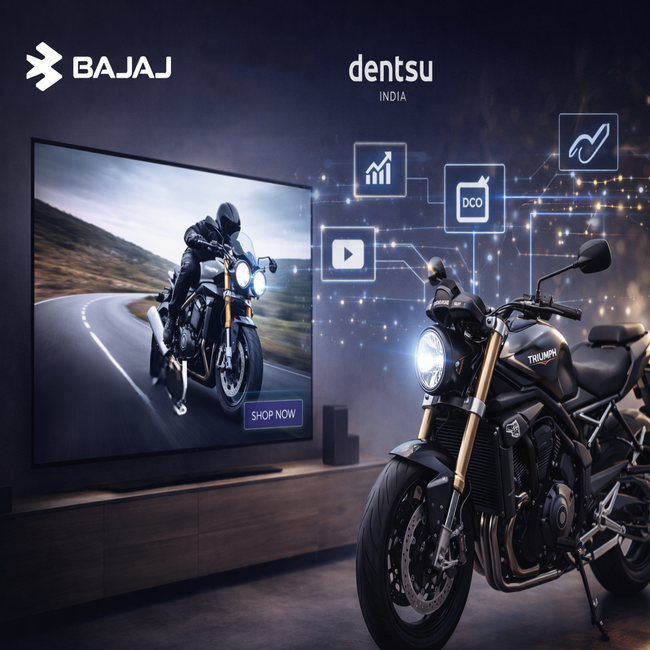

Bajaj Auto has collaborated with VDO.AI and Dentsu India to roll out a dynamic creative optimisation driven connected TV campaign for Triumph Motorcycles in India. The initiative marks a strategic push into advanced advertising formats, leveraging data led personalisation to engage premium motorcycle buyers across digital screens.
The campaign uses dynamic creative optimisation technology to tailor video messaging based on audience segments and contextual signals. Connected TV, which enables digital advertising through internet enabled television devices, has emerged as a growing channel for automotive brands seeking immersive storytelling and targeted reach.
According to the companies involved, the campaign integrates VDO.AI’s ad tech capabilities with Dentsu India’s media planning and strategy expertise. The objective is to combine creative flexibility with real time optimisation, ensuring that Triumph Motorcycles messaging resonates with specific consumer cohorts.
Dynamic creative optimisation allows marketers to modify elements such as visuals, copy and calls to action based on predefined audience parameters. In the context of connected TV, this approach supports personalised video experiences while retaining the scale and impact of television advertising.
The automotive category has increasingly turned to data driven marketing as consumer research journeys become more digital. High involvement purchases such as motorcycles require sustained engagement and tailored communication. By deploying DCO within CTV environments, Bajaj Auto aims to strengthen consideration among target audiences.
Industry observers note that connected TV advertising in India has witnessed steady growth, driven by rising smart TV adoption and expanding streaming platforms. Brands are reallocating portions of traditional television budgets toward programmatic CTV campaigns that offer enhanced measurement and targeting.
The collaboration with Dentsu India underscores the role of integrated agency networks in orchestrating complex media executions. Media agencies are now expected to combine audience insights, technology partnerships and performance analytics to deliver measurable outcomes.
VDO.AI’s platform reportedly enables real time decision making across ad placements, using data signals to determine which creative variant is served. This level of adaptability supports continuous optimisation throughout the campaign lifecycle.
From a martech perspective, the initiative highlights the convergence of programmatic advertising, data analytics and creative automation. Marketers are increasingly investing in technology stacks that allow seamless coordination between creative development and media delivery.
Triumph Motorcycles, positioned as a premium brand within the Indian market, benefits from storytelling that emphasises performance, design and heritage. Personalised video content delivered through connected TV can reinforce brand attributes while addressing distinct audience motivations.
The campaign is also indicative of broader shifts in consumer media consumption patterns. Streaming platforms and on demand content have expanded the role of digital screens within households. Advertisers are responding by deploying targeted messaging across these environments.
Experts suggest that DCO driven CTV campaigns can improve engagement metrics by aligning creative narratives with viewer preferences. Automotive brands in particular can use regional data and behavioural insights to customise messaging for urban and aspirational segments.
Measurement remains a key focus in connected TV advertising. Digital tracking capabilities allow advertisers to evaluate impressions, completion rates and engagement metrics more precisely than traditional television formats.
Bajaj Auto’s move reflects confidence in advanced ad tech partnerships to drive performance. Integrating creative optimisation within premium CTV inventory may enhance brand visibility among affluent and tech savvy consumers.
As the Indian advertising market evolves, collaborations between brands, technology providers and media agencies are becoming more strategic. Data led execution is no longer confined to social and search channels but is extending into video and television ecosystems.
The campaign demonstrates how automotive marketers are experimenting with new formats to differentiate in a competitive landscape. With rising digital penetration, brands must balance mass reach with targeted relevance.
Industry analysts anticipate further growth in connected TV investments as advertisers seek measurable impact across high value audiences. The ability to adapt creative assets dynamically offers flexibility that traditional broadcast advertising cannot match.
For Bajaj Auto and Triumph Motorcycles, the DCO powered CTV initiative represents an effort to blend brand storytelling with performance marketing principles. By combining programmatic technology with creative variation, the campaign aims to optimise reach and engagement.
The collaboration with VDO.AI and Dentsu India illustrates the expanding role of data driven video advertising within India’s martech ecosystem. As brands continue to integrate technology into media strategies, connected TV may play an increasingly prominent role in automotive marketing.
