
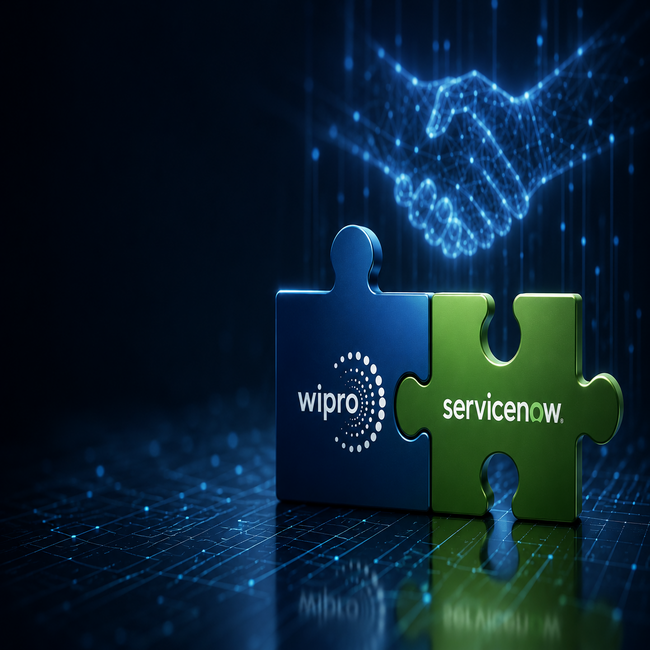

Wipro has expanded its partnership with enterprise workflow platform ServiceNow to accelerate the adoption of agentic artificial intelligence (AI) across business operations, marking another step in the Indian IT services major's broader AI strategy.
The announcement comes at a time when global technology companies are increasingly investing in AI-driven automation and workflow transformation as enterprises seek greater operational efficiency and productivity. Following the development, Wipro's shares rose more than 4% in market trading, reflecting positive investor sentiment around the company's growing focus on AI-led services and solutions.
Under the expanded collaboration, Wipro and ServiceNow will work together to deploy agentic AI-powered workflows across key enterprise functions, including information technology, human resources, procurement and cybersecurity. The initiative is aimed at helping organizations automate complex processes, improve decision-making capabilities and streamline operations.
Agentic AI refers to systems that can perform tasks with a higher degree of autonomy compared to traditional automation tools. These systems are designed to understand objectives, coordinate actions and execute workflows with limited human intervention, making them an increasingly important area of focus for enterprises looking to modernize business operations.
The partnership builds on the long-standing relationship between Wipro and ServiceNow, which has focused on digital transformation, workflow automation and enterprise service management. Wipro has been one of ServiceNow's strategic implementation and consulting partners, helping organizations integrate and manage digital workflow solutions across industries.
Industry observers note that partnerships between IT service providers and enterprise software companies are becoming increasingly important as businesses move from AI experimentation to real-world deployment. Organizations are now looking for scalable solutions that can deliver measurable business outcomes rather than isolated AI pilots.
For Wipro, the expanded engagement strengthens its position in a competitive technology services market where companies are racing to capture enterprise AI spending. The company has made AI a key pillar of its growth strategy in recent years, including investments in AI capabilities, workforce training and partnerships with major technology platforms. Wipro had previously announced a $1 billion investment aimed at advancing its AI capabilities and accelerating AI adoption across its services portfolio.
The collaboration also aligns with ServiceNow's broader efforts to embed AI across its platform. The company has been actively introducing AI-powered products and capabilities designed to help enterprises automate workflows, improve employee experiences and enhance operational efficiency. Industry estimates suggest AI-driven enterprise software and workflow automation solutions will remain among the fastest-growing segments within enterprise technology over the coming years.
The latest announcement arrives amid growing demand from enterprises seeking to integrate AI into core business processes while maintaining governance, security and operational control. Areas such as IT operations, customer service, HR management and procurement are increasingly being viewed as high-impact opportunities for AI deployment.
As enterprises continue to evaluate AI's business value, technology partnerships such as the one between Wipro and ServiceNow are expected to play a significant role in enabling large-scale adoption. While financial details of the expanded collaboration were not disclosed, the move signals both companies' intent to strengthen their presence in the rapidly evolving enterprise AI market.
The development underscores how AI is becoming a central component of digital transformation strategies, with technology providers increasingly focusing on practical, workflow-driven applications that can deliver operational efficiencies and business outcomes at scale.