
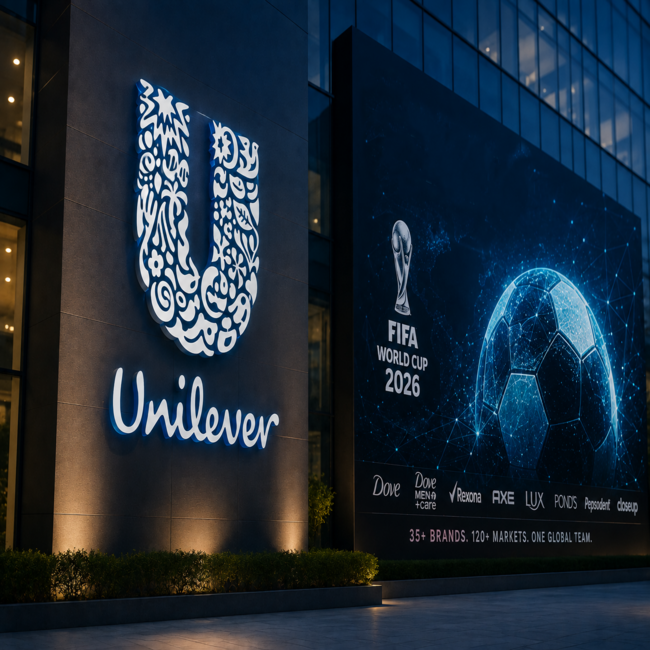

Unilever has used artificial intelligence across its supply chain and content operations to support its FIFA World Cup 2026 activation, as the consumer goods company tests how technology can coordinate marketing, production and distribution at a global scale.
The company activated more than 35 Personal Care brands across over 120 markets during the tournament, including Dove, Dove Men+Care, Rexona and Degree, Axe and Lynx, LUX, Pepsodent and Closeup. The programme formed part of Unilever's five-year partnership with FIFA, signed in 2023.
Behind the consumer-facing campaign, Unilever deployed data and AI-driven forecasting to determine production cut-offs for 180 limited-edition products. The system was used to help ensure products were manufactured and distributed to relevant markets in time to support local World Cup campaigns.
The approach highlights the role of supply-chain technology in large marketing activations, where advertising can generate demand across multiple markets within short timeframes. For brands, coordinating that demand requires decisions around inventory, production schedules and distribution alongside creative and media planning.
AI was also used on the content side. Unilever said its Personal Care AI Content Studio and Social Studios created more than 18,000 assets for 120 multi-brand and multi-market campaigns connected to the activation.
The company also deployed more than 50,000 creators during the World Cup, using social media and creator-led content to extend campaigns around matches and other cultural moments. Unilever said the creators collectively reached an audience of more than 600 million people.
A 24-hour social media operation called The Locker Room supported the programme, bringing together creators, community specialists and football strategists to produce reactive content for platforms including TikTok and YouTube.
Physical activations were also part of the strategy. Unilever operated House of Fresh creator hubs in locations including New York, Miami and Mexico City, connecting in-person events with social content and retail activity.
The World Cup programme sits within Unilever's wider effort to increase the use of AI across its operations. The company has been deploying AI in areas including marketing, product development, manufacturing and consumer insights. It has also used AI-powered digital twins within factories to optimise manufacturing processes.
The commercial impact of the World Cup campaign, however, has not yet been fully quantified. Following the tournament, Unilever Chief Executive Fernando Fernandez said the company did not yet have sufficient results to validate the overall effect of the activation, although it expected the campaign to support brand equity and longer-term competitiveness.
The activation therefore provides a large-scale test of how AI can connect parts of marketing that have traditionally operated separately. For Unilever, the technology was used not only to generate content, but also to forecast demand and coordinate the products, markets and infrastructure supporting one of its largest global marketing programmes.
Disclaimer: This article may include information derived from interviews, press releases, public statements, research, company communications and other publicly available or third-party sources. Such material may be summarised, paraphrased or contextualised for journalistic and editorial purposes. All rights in third-party content remain with their respective owners.