
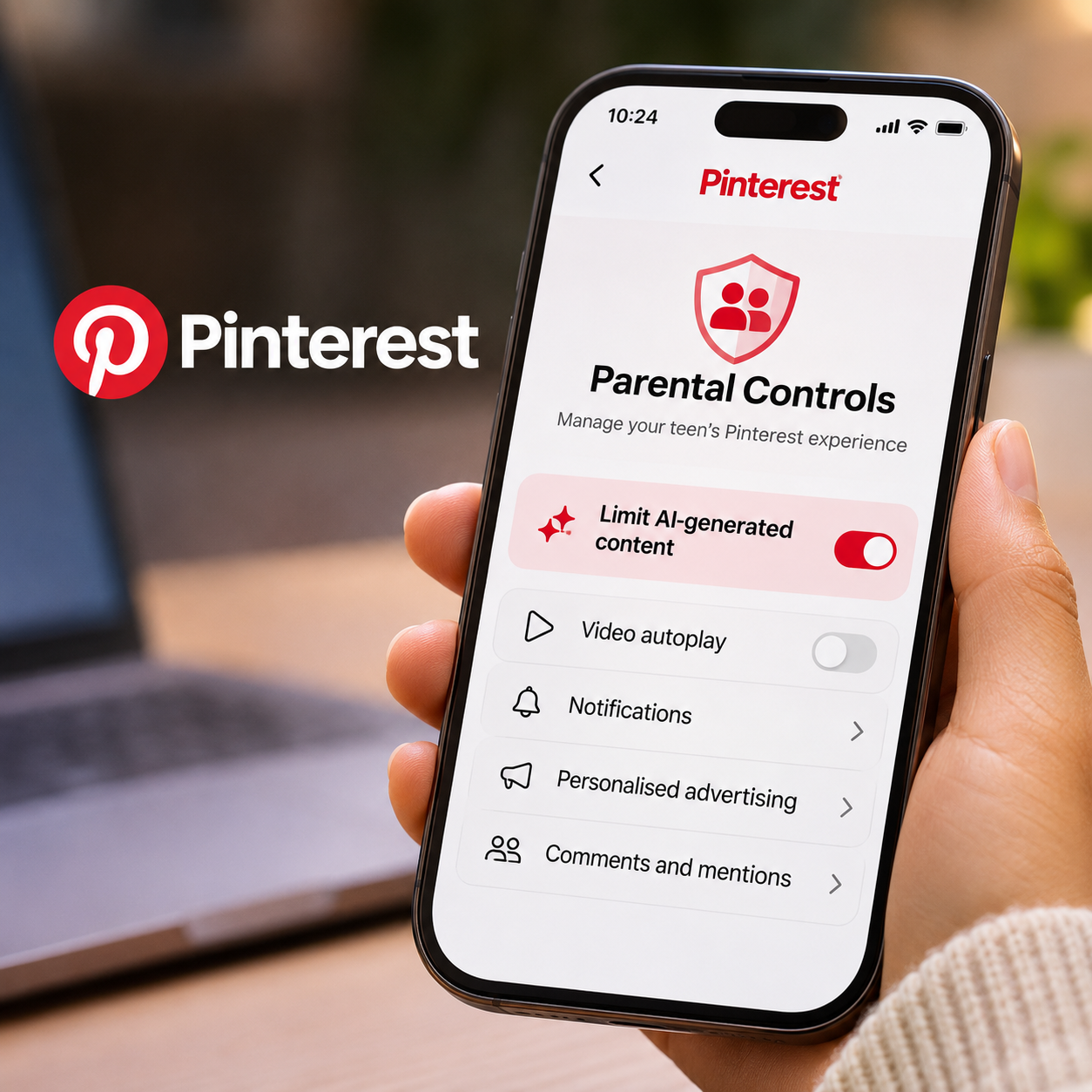

Pinterest has expanded its parental controls to allow parents and caregivers to regulate the amount of artificial intelligence-generated content appearing in teenagers’ recommendations. The development comes as social media platforms face increasing scrutiny over the proliferation of AI-generated material and its impact on younger audiences.
Announced on November 23, the update introduces a redesigned Parental Controls page that consolidates several safety, privacy and content preferences within a single interface. Alongside the AI content restrictions, parents can manage video autoplay, notifications, advertising personalisation and social interactions.
The new feature distinguishes Pinterest’s approach from that of several other social media platforms, which have primarily focused on restricting teenagers’ interactions with AI chatbots and virtual characters. Pinterest’s latest controls extend parental oversight to the content recommended to young users.
The updated interface allows parents to manage notifications across email, browsers and mobile applications, as well as disable automatic video playback. It also provides direct access to device-level screen time and location settings on Android and iOS.
Existing safeguards, including private account settings, restrictions on personalised advertising and controls governing comments and mentions, have also been incorporated into the redesigned page.
These settings are protected through a parental passcode. Once enabled, teenagers require parental permission to make their account settings less restrictive.
Bill Ready, CEO of Pinterest, said the company’s approach was focused on creating age-appropriate experiences while allowing families to determine the level of protection suitable for younger users.
The development builds on Pinterest’s earlier efforts to address the growing volume of AI-generated imagery on its platform. In April 2025, the company introduced labels to identify images potentially created or altered using generative AI, drawing on image metadata and automated classification systems.
In October 2025, Pinterest introduced additional recommendation preferences, enabling users to reduce their exposure to AI-generated images across categories such as fashion, beauty, art and home décor. The company subsequently extended these controls to food and drink content.
Other technology companies have also introduced measures addressing teenagers’ exposure to artificial intelligence. Snapchat allows parents to restrict responses from its My AI chatbot, while WhatsApp introduced parental settings in September 2026 that enable families to select more restrictive Meta AI experiences.
In April 2026, children’s advocacy organisation Fairplay, supported by more than 200 organisations and experts, called on YouTube to remove AI-generated material from YouTube Kids and prevent such videos from being recommended to minors.
For Pinterest, which operates at the intersection of visual discovery, digital advertising and social commerce, the latest update introduces another layer of user control over algorithmic content distribution.
The company has not disclosed the precise extent to which the new settings will reduce AI-generated recommendations or whether they will affect the distribution of AI-generated advertising content. The development comes as digital platforms continue to balance generative AI integration with content transparency, user preferences and online safety requirements.
Disclaimer: This article may include information derived from interviews, press releases, public statements, research, company communications and other publicly available or third-party sources. Such material may be summarised, paraphrased or contextualised for journalistic and editorial purposes. All rights in third-party content remain with their respective owners.