
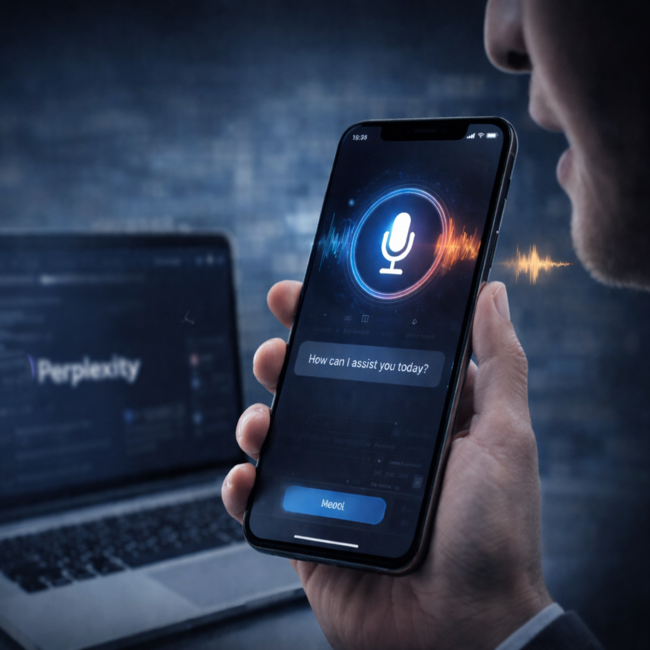

Artificial intelligence search company Perplexity has introduced a new voice mode for its Perplexity Computer platform, expanding the ways users can interact with its AI powered system. The feature allows users to communicate with the platform using spoken commands, enabling hands free interaction with the AI assistant while performing digital tasks.
The launch reflects a broader shift in the AI industry toward more natural forms of human computer interaction. Voice driven interfaces are increasingly being integrated into AI systems as companies seek to make digital tools more intuitive and accessible for everyday use.
Perplexity Computer is designed to help users perform a range of tasks through conversational AI. The system combines large language models with web search capabilities to generate responses, assist with research, and support productivity related activities.
With the introduction of voice mode, users can now speak directly to the system instead of typing queries. The AI assistant interprets spoken input and responds with conversational answers while also performing certain actions on the user’s computer.
According to the company, the feature is intended to simplify the way users interact with AI systems by allowing them to communicate through natural speech. Voice interaction can enable users to multitask, continue working without relying on a keyboard, and access information more quickly.
Hands free AI interaction has become an area of increasing interest within the technology sector. Digital assistants powered by voice recognition have existed for several years, but advances in generative AI are enabling more sophisticated conversations and more complex task execution.
In this context, Perplexity’s voice mode aims to combine conversational search with the ability to control digital workflows through spoken commands.
Users interacting with Perplexity Computer can ask questions, request information, and instruct the system to carry out certain functions while the platform processes commands through speech recognition technology.
The company says the feature is designed to maintain the platform’s emphasis on real time information retrieval. Perplexity’s AI systems are known for generating responses that include references to web sources, helping users verify the information presented by the assistant.
Voice based interaction allows these capabilities to be accessed without manual typing, which could be useful in situations where users are working across multiple applications or performing other tasks simultaneously.
Industry analysts note that voice interfaces are becoming an important component of AI powered productivity tools. As artificial intelligence systems become more capable, developers are exploring ways to integrate them more seamlessly into everyday computing environments.
The addition of voice mode reflects this trend toward multimodal interaction, where users can communicate with AI systems through multiple input methods including text, voice, and visual data.
Technology companies are increasingly focusing on multimodal AI experiences that allow users to switch between different forms of communication depending on context and convenience.
For Perplexity, the voice feature represents another step in the company’s efforts to compete with larger technology platforms offering AI driven search and assistant tools.
The company has positioned its platform as an alternative to traditional search engines by combining conversational AI with web based information retrieval.
Perplexity’s interface allows users to explore topics through dialogue with the AI system rather than browsing through a list of links. This approach is designed to provide direct answers while still offering transparency about the sources used to generate responses.
The addition of voice capabilities may also help expand the accessibility of AI tools. Voice interaction can make digital systems easier to use for individuals who may prefer spoken communication over typing or who require assistive technologies.
At the same time, voice based AI tools raise questions about privacy, data security, and the handling of spoken information. Companies developing these systems must ensure that voice data is processed securely and that users understand how their interactions are stored or analysed.
As voice interfaces become more widely used, technology companies are expected to continue refining speech recognition accuracy and conversational capabilities.
Perplexity’s latest update highlights how AI driven platforms are evolving beyond traditional text based interfaces.
In recent months, several technology companies have introduced features designed to integrate AI assistants more deeply into personal computing environments. These developments reflect a growing focus on creating systems that can assist users throughout their digital workflows.
The introduction of voice mode aligns with the broader direction of the AI industry, where conversational interfaces are becoming central to how people access information and interact with technology.
For users, voice enabled systems may offer a more fluid and natural way to interact with digital tools, particularly in situations where typing may be inconvenient or inefficient.
As AI assistants continue to develop, the ability to interact with computers through speech is likely to become a standard component of many digital platforms.
The rollout of voice mode for Perplexity Computer suggests that the company is seeking to position itself within this evolving landscape by offering more flexible and accessible ways for users to engage with its AI technology.
With growing interest in conversational computing, voice enabled AI systems may play an increasingly important role in shaping how people search for information, manage tasks, and interact with digital services in the future.