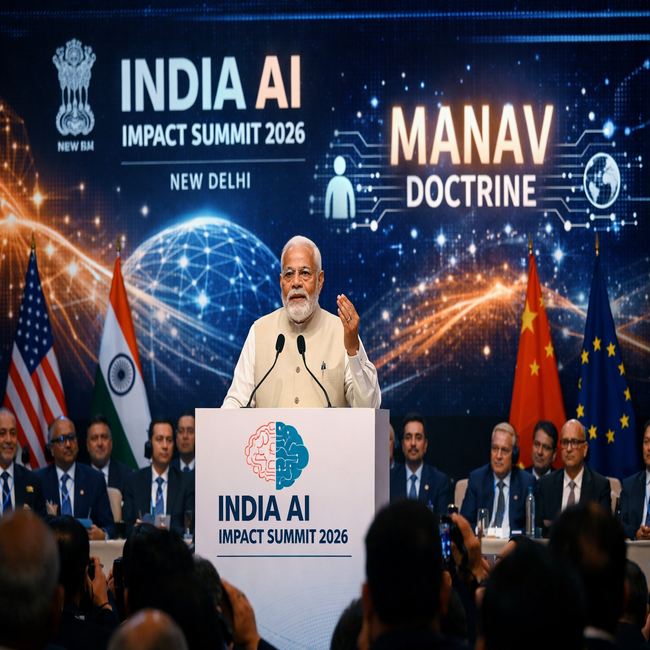
India’s national artificial intelligence initiative is expected to train thousands of students across different academic levels as the government moves to strengthen the country’s AI talent pipeline. According to Principal Scientific Adviser Ajay Sood, the IndiaAI Mission aims to train 500 PhD scholars, 5,000 postgraduate students, and 8,000 undergraduate students in artificial intelligence related disciplines.
The initiative reflects a broader effort to expand the country’s capabilities in emerging technologies and ensure that India has a strong workforce prepared to develop and deploy artificial intelligence systems. As AI continues to transform industries ranging from healthcare and finance to manufacturing and digital services, governments around the world are placing greater emphasis on building skilled talent pools.
The IndiaAI Mission was launched to support research, innovation, and infrastructure development in artificial intelligence. Training programmes form an important component of the mission, which seeks to encourage collaboration between academic institutions, research organisations, and industry.
By focusing on education and research, policymakers aim to create a sustainable pipeline of professionals who can contribute to the development of AI technologies in the coming years.
Artificial intelligence has become a strategic priority for many economies because of its potential to influence productivity, economic growth, and technological leadership.
Countries investing in AI talent development are seeking to ensure that their workforces can design algorithms, manage data systems, and develop applications that rely on machine learning and advanced analytics.
India has already established a strong presence in the global technology services sector, and the expansion of AI related training programmes may help strengthen the country’s role in advanced digital innovation.
According to Sood, the IndiaAI Mission’s training targets are intended to create a multi level talent ecosystem.
PhD scholars trained under the initiative are expected to contribute to advanced research and the development of new AI methodologies. Postgraduate students will focus on applied research and technical implementation, while undergraduate students will gain foundational skills that can support entry level roles in the AI ecosystem.
This layered approach aims to ensure that the country has expertise across the entire spectrum of artificial intelligence development.
Universities and research institutions are expected to play a central role in delivering the training programmes associated with the mission.
Academic institutions may introduce specialised courses, research fellowships, and collaborative projects designed to equip students with practical knowledge in machine learning, data science, and related fields.
Partnerships with industry are also likely to be encouraged so that students can gain exposure to real world applications of artificial intelligence.
Industry participation is considered important because companies working with AI technologies can provide insights into emerging trends and practical challenges faced in deploying AI systems.
Collaboration between academia and industry may also help ensure that training programmes remain aligned with evolving workforce requirements.
Many technology companies have expressed interest in working with universities to support research initiatives and talent development programmes.
The growth of artificial intelligence applications across sectors has created strong demand for professionals with expertise in machine learning, data analysis, and AI system design.
Organisations are increasingly seeking employees who can develop predictive models, manage large datasets, and build intelligent software systems.
As demand for these skills increases, education programmes focused on AI are expanding in many countries.
India’s approach through the IndiaAI Mission reflects a broader trend of governments investing in education and research to strengthen their positions in the global technology landscape.
By supporting training at multiple academic levels, the initiative aims to address both immediate workforce needs and long term research capabilities.
Students participating in the programme may also contribute to research projects that explore new applications of artificial intelligence. AI research often involves interdisciplinary collaboration across fields such as computer science, mathematics, engineering, and social sciences.
Encouraging such collaboration may help researchers address complex challenges related to data analysis, algorithm design, and ethical considerations surrounding AI deployment. In addition to education and research, the IndiaAI Mission includes initiatives designed to strengthen infrastructure for artificial intelligence development.
Access to computing resources, data platforms, and collaborative research networks can support innovation by enabling researchers to test new models and develop advanced applications.
Such infrastructure is often essential for training machine learning systems that require large datasets and significant computational power. India’s technology sector has been expanding rapidly, supported by growth in digital services, startup ecosystems, and technology driven entrepreneurship.
Artificial intelligence has become an important component of this expansion as businesses seek to use data driven insights to improve decision making and efficiency.
The development of a strong talent pipeline may help companies adopt AI technologies more effectively and encourage the creation of new products and services.
Government initiatives such as the IndiaAI Mission are also intended to strengthen India’s global competitiveness in emerging technologies.
Countries that successfully develop AI expertise may gain advantages in areas such as digital infrastructure, innovation ecosystems, and high technology exports.
By investing in education and research programmes, policymakers aim to ensure that India remains an active participant in shaping the future of artificial intelligence.
The planned training of thousands of students under the mission illustrates how national strategies are increasingly focusing on human capital as a key driver of technological progress.
As artificial intelligence continues to evolve and influence industries worldwide, the availability of skilled researchers, engineers, and data specialists will remain an important factor in determining how effectively countries can adopt and develop new technologies.
Related Articles