
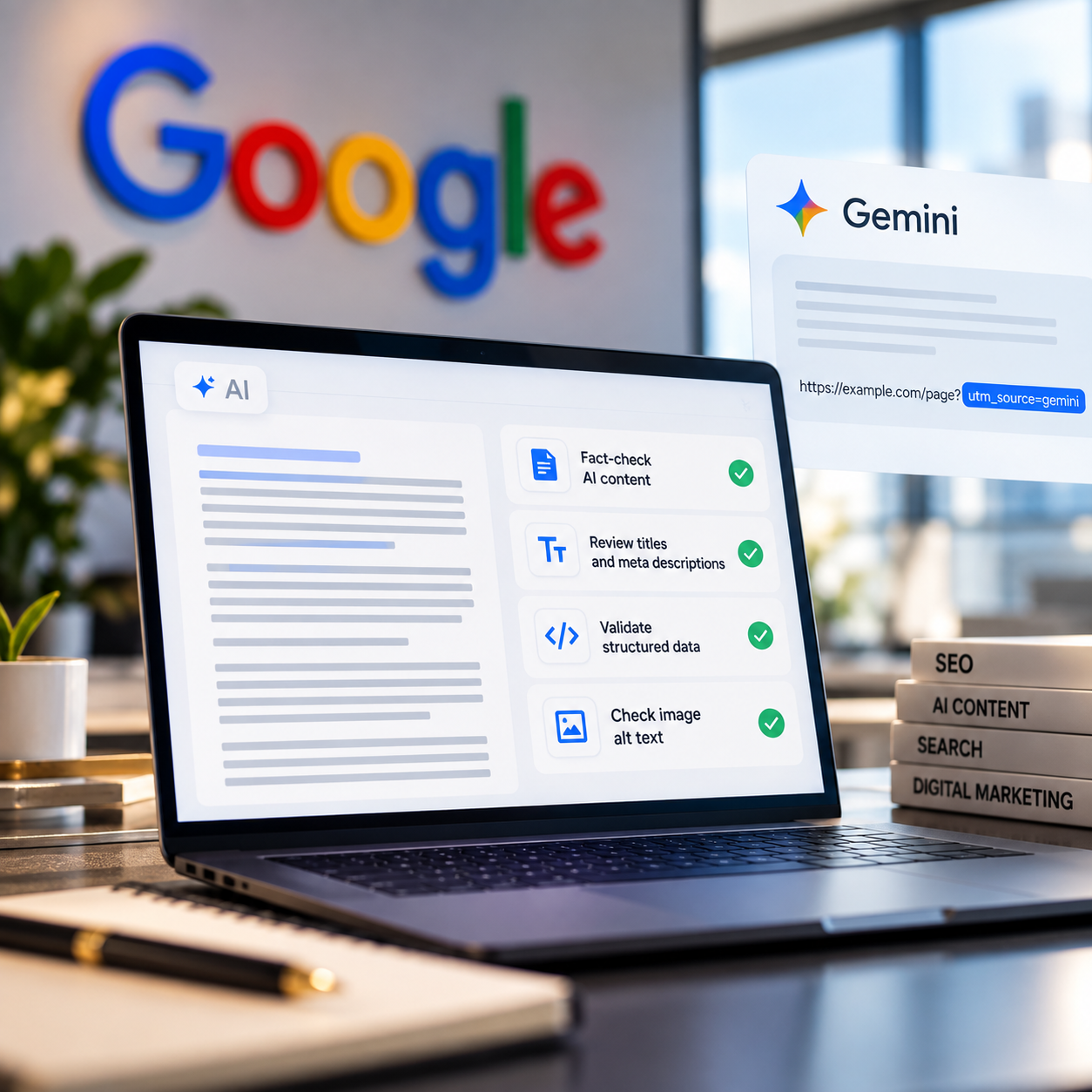

Google has updated its guidance on generative AI content, explicitly asking website owners to manually fact-check AI-generated material before publishing, including metadata that can appear across Search.
The company updated its documentation on October 1, adding new language to its guidance around accuracy, quality and relevance. Google said generative AI models work by predicting likely sequences based on the data they have been trained on and are not designed to retrieve facts in the same way as a database or search engine.
As a result, Google said it is critical for publishers to manually fact-check and review AI-generated content for accuracy and trustworthiness before it goes live.
The requirement extends beyond the main body of an article. Google’s updated guidance also applies to AI-generated titles, meta descriptions, structured data and image alt text. These elements can influence how content is interpreted or presented across Search, making verification relevant to both editorial and SEO workflows.
The update does not prohibit publishers from using generative AI to create content. Google has previously maintained that the use of automation or AI is not inherently against its guidelines. The focus remains on whether content is useful, accurate and created primarily to help users rather than manipulate search rankings.
Google’s documentation changelog said the latest revisions were made to align the guidance with information presented at developer events.
Separately, Google’s Gemini has been observed adding UTM parameters to some outbound links, potentially giving marketers and publishers another way to identify traffic originating from the AI assistant.
The development was spotted by a Reddit user and acknowledged by Google Search Advocate John Mueller, who said he could also see the parameters. However, Google has not documented when or under what circumstances Gemini applies UTM tags to outbound links.
For publishers, UTM parameters could provide an additional way to distinguish Gemini-generated visits in analytics without depending entirely on referrer information. Comparing UTM-tagged sessions with existing referral data could also help websites understand how AI-driven traffic is being attributed.
The two developments arrive as generative AI becomes more closely integrated with search, content creation and discovery. Google’s latest guidance places greater responsibility on publishers to verify AI-assisted material across both editorial copy and metadata, while emerging attribution signals from Gemini could give marketers more visibility into how users move from AI interfaces to websites.
Disclaimer: This article may include information derived from interviews, press releases, public statements, research, company communications and other publicly available or third-party sources. Such material may be summarised, paraphrased or contextualised for journalistic and editorial purposes. All rights in third-party content remain with their respective owners.