
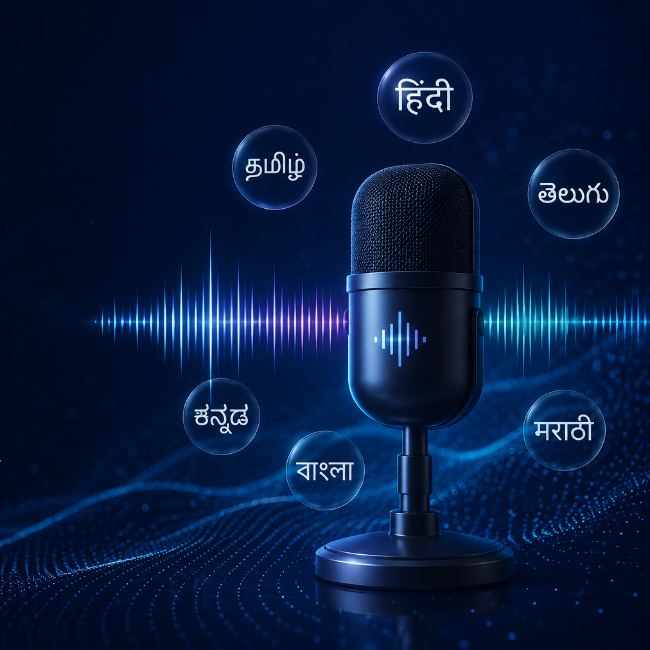

Bengaluru-based voice AI company Gnani.ai has launched Prisma v2.5, a new speech-to-text model built for Indian languages, as competition intensifies in the country's enterprise AI market.
The company said the model has been trained on 14 million hours of proprietary Indic speech data and supports 12 languages. Prisma v2.5 is designed to handle several speech conditions that are common in India, including regional accents, dialect variations, background noise, compressed telephony audio and code-switching between English and Indian languages.
Gnani.ai has claimed that Prisma v2.5 outperformed several global and Indian speech recognition models across independent benchmarks for real-world and noisy audio. According to the company, the model ranked first in eight out of nine Indian languages tested, positioning it as a locally built alternative for enterprises that need higher accuracy in Indian-language voice interactions.
The launch is aimed primarily at enterprise customers and will be available through application programming interfaces. Gnani.ai expects the model to support use cases across contact centres, banking, financial services, insurance, healthcare, retail, government services and other sectors where voice remains a major customer engagement channel.
The company said Prisma v2.5 has been developed to improve transcription quality in high-volume business environments where conversations often include mixed languages, poor call quality and local speech patterns. These conditions have historically made speech recognition difficult for models trained mainly on cleaner English or global datasets.
Ganesh Gopalan, Co-founder and CEO of Gnani.ai, said Indian speech environments cannot be treated as edge cases because accents, noise and code-switching are part of everyday communication. He said Prisma v2.5 was built with training data that reflects real-world Indian conversations, making it better suited for domestic enterprise deployments.
The development comes at a time when Indian businesses are rapidly adopting voice AI for customer support, call analytics, agent assist, compliance monitoring and automated service delivery. In sectors such as banking and insurance, accurate speech-to-text systems are becoming important for quality checks, customer intent detection and regulatory documentation.
For marketers and customer experience teams, improved speech recognition can also strengthen consumer insights by turning call centre conversations into structured data. Brands increasingly use voice analytics to identify customer pain points, service gaps, sentiment patterns and product feedback across large volumes of calls.
India's multilingual market has created a distinct challenge for AI companies. Unlike markets where customer communication is largely concentrated in one or two dominant languages, Indian enterprises often need systems that can process Hindi, Tamil, Telugu, Kannada, Bengali, Marathi and other languages, along with English. This has pushed local AI companies to build India-specific models rather than relying only on global speech technologies.
Gnani.ai's launch also comes after the company raised $10 million from Aavishkaar Capital earlier this year to expand its voice AI models globally and strengthen research and development. The company has been building a broader voice AI stack that includes speech-to-text, text-to-speech, speech-to-speech, voice agents, speech analytics and voice biometrics.
The release of Prisma v2.5 places Gnani.ai in direct competition with other companies working on Indic AI models, including Sarvam AI and global voice technology providers such as ElevenLabs and OpenAI. However, the company is seeking to differentiate itself through enterprise-focused deployment and a training corpus built specifically around Indian speech conditions.
As businesses increase investment in AI-led automation, voice is emerging as a critical layer in customer engagement. With Prisma v2.5, Gnani.ai is betting that India-specific speech intelligence will become central to how enterprises serve multilingual consumers at scale.
The company said its focus will remain on practical enterprise adoption, where speech accuracy can directly affect service speed, customer trust and the cost of operating large support teams.