
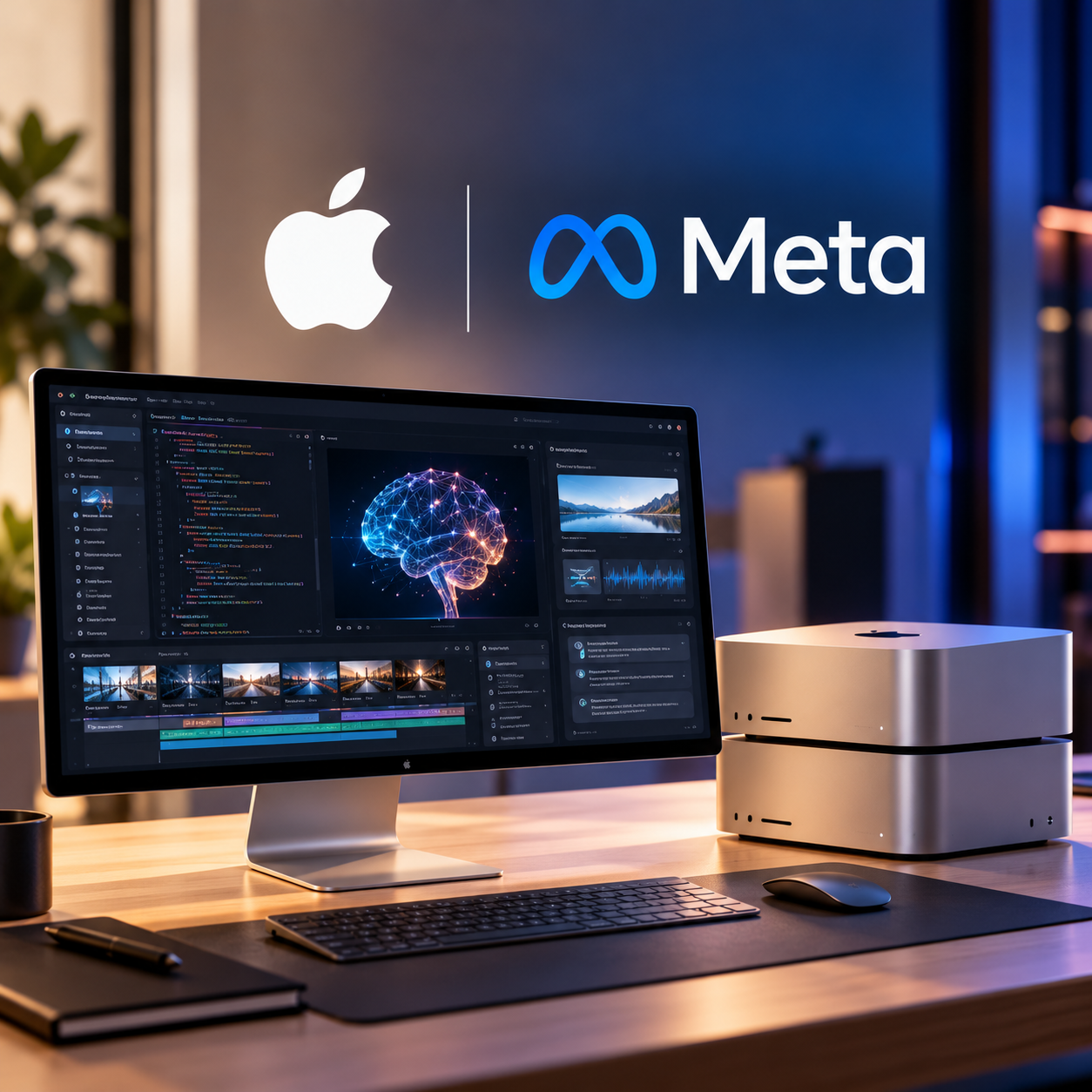

The collaboration will allow developers to run Meta's 816-billion-parameter Muse Spark Open model locally on Apple's high-end Mac Studio systems.
Apple and Meta have announced a collaboration to enable developers to run Meta's newly released Muse Spark Open artificial intelligence model on Apple's high-end Mac computers, marking a rare partnership between two technology companies that have previously disagreed over privacy and digital advertising practices.
Announced on October 15, 2026, the collaboration focuses on optimising Meta's open-weight AI model for Apple's Mac Studio systems, allowing developers to perform advanced AI tasks locally rather than relying entirely on cloud infrastructure.
Muse Spark Open is an 816-billion-parameter model built using a mixture-of-experts architecture. Meta describes it as its most capable open-weight model, designed to support complex reasoning, software development and agentic AI applications.
Under the arrangement, developers can connect between two and four Mac Studio computers to run the model for tasks including coding, video analysis and AI agent workflows.
The collaboration uses Apple's MLX framework, which is designed to support machine learning workloads on Apple Silicon. Optimising the model for the company's hardware could provide developers with another option for running large AI systems outside conventional cloud environments.
Unlike proprietary models that are accessible primarily through hosted services, open-weight models allow developers to download their parameters and operate them on compatible hardware. However, access to model weights does not necessarily mean unrestricted use, and Meta's release includes licensing conditions governing commercial applications.
The companies have positioned local processing as an alternative for developers and organisations seeking greater control over their computing environments.
Running AI models on locally managed infrastructure can reduce the need to transfer certain information to external cloud services, although data protection and security remain dependent on how the systems are configured and operated.
The announcement represents an unusual development in the relationship between Apple and Meta, which have previously clashed over Apple's privacy policies and their implications for digital advertising.
Apple's App Tracking Transparency framework, introduced in 2021, restricted how applications could track users across other companies' apps and websites without permission. The changes affected advertising businesses that relied on cross-platform tracking.
Despite those differences, both companies have continued investing in artificial intelligence technologies and developer ecosystems.
For Meta, the collaboration expands the hardware options available to developers adopting its AI models. For Apple, it demonstrates the ability of its Mac hardware and software framework to support large-scale AI workloads.
The development also comes amid competition among technology companies to provide AI models and computing infrastructure for enterprise and developer applications.
The companies have not disclosed financial terms associated with the collaboration or indicated whether it will extend into other AI products.
The current arrangement is focused on developer access and local model deployment rather than integrating Meta's AI technology into Apple's consumer-facing applications.
Disclaimer: This article may include information derived from interviews, press releases, public statements, research, company communications and other publicly available or third-party sources. Such material may be summarised, paraphrased or contextualised for journalistic and editorial purposes. All rights in third-party content remain with their respective owners.