
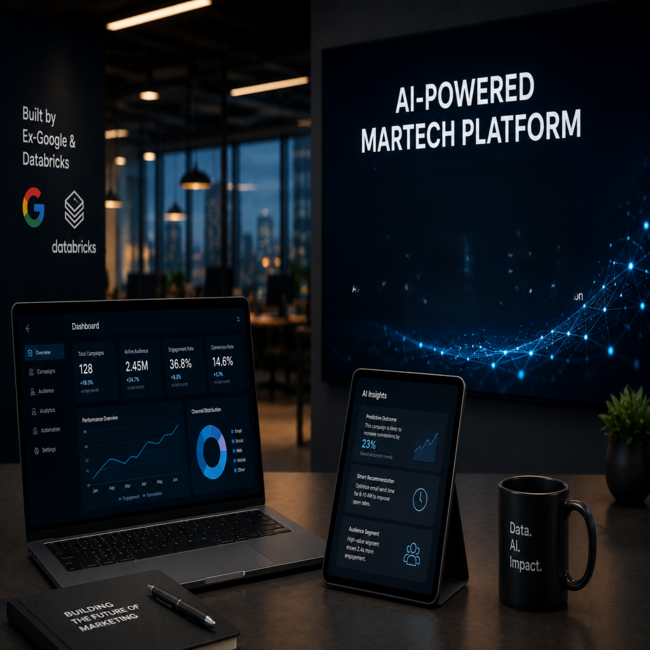

Former engineers from Google and Databricks have launched a new AI-powered marketing technology platform as competition intensifies across the rapidly expanding martech and enterprise automation sectors.
According to reports, the startup aims to simplify how businesses manage customer engagement, marketing automation and data-driven campaign operations through AI-enabled systems. The platform reflects growing demand for enterprise tools capable of integrating artificial intelligence into core marketing workflows.
Industry observers say martech companies are increasingly repositioning themselves around generative AI, automation and predictive analytics as brands seek more efficient ways to manage customer communication and digital engagement.
The broader marketing technology sector has witnessed rapid expansion over the past two years as businesses accelerate adoption of AI-powered tools across advertising, content generation, analytics and campaign management. Enterprise software providers are investing heavily in intelligent automation infrastructure.
Reports suggest the founders previously worked on large-scale data and machine learning systems at Google and Databricks, bringing technical expertise in cloud infrastructure, AI operations and data processing into the new venture. Businesses are increasingly valuing platforms capable of combining customer data with AI-driven execution systems.
Industry analysts believe enterprise marketing operations are becoming more dependent on automation and real-time decision-making as brands manage increasingly fragmented digital ecosystems. AI systems are being positioned as tools capable of improving efficiency and campaign responsiveness.
The latest launch also highlights how experienced engineers from large technology companies continue moving into startup ecosystems to build specialised AI-focused enterprise platforms. Venture activity around AI-native software companies remains strong across global technology markets.
Reports indicate the martech platform is designed to support automation-led customer engagement while helping businesses process and interpret marketing data more efficiently. Companies are increasingly seeking unified systems capable of handling analytics, customer communication and operational workflows together.
Industry executives say marketing teams are under growing pressure to deliver personalised customer experiences across multiple channels while managing rising operational complexity. AI-powered platforms are increasingly viewed as essential for scaling engagement strategies.
Analysts believe AI-driven martech systems could reshape how brands approach customer acquisition, retention and digital communication by reducing manual operational tasks and improving data interpretation capabilities.
At the same time, experts continue raising concerns around data governance, transparency and overdependence on automated systems within marketing ecosystems. Questions around AI accountability and ethical data usage remain central to ongoing industry discussions.
Reports suggest enterprise clients are increasingly prioritising software platforms that can integrate directly with existing customer relationship management systems, analytics infrastructure and cloud-based operations. Interoperability has become a key competitive factor within the martech industry.
Industry observers note that AI-driven customer engagement tools are evolving beyond simple automation toward systems capable of contextual analysis, predictive insights and autonomous operational support. Businesses are focusing more heavily on intelligent workflow management.
The martech industry globally has witnessed increasing consolidation and investment activity as companies compete to strengthen AI capabilities and enterprise software ecosystems. Automation-led marketing remains one of the fastest-growing segments within business technology markets.
Industry executives say enterprises are shifting spending priorities toward platforms capable of improving operational efficiency and delivering measurable performance insights through AI-assisted analytics and engagement systems.
Reports indicate AI-native startups are attracting investor interest by positioning themselves as alternatives to fragmented enterprise software environments. Businesses are increasingly seeking integrated systems rather than multiple disconnected tools.
Analysts believe the next phase of martech growth will be driven by platforms capable of combining customer data infrastructure, AI automation and predictive engagement capabilities within scalable enterprise environments.
The launch of the new platform by former Google and Databricks engineers underscores how artificial intelligence continues reshaping enterprise marketing technology strategies. Industry experts say businesses capable of integrating automation, analytics and customer engagement into unified AI-driven systems are likely to remain competitive as digital marketing operations become increasingly data-intensive and technology-led worldwide.